
Reader Briefing
Reader Briefing
Start here if you need a practical read on dating a widower red flags: 10 signs: who should use verification, what signals to check, and what to do before moving from online interest to an in-person plan.
Who this is for
- Readers preparing for a first in-person date.
- Anyone checking identity, profile consistency, and trust signals.
- People trying to avoid romance scams, fake profiles, or pressure tactics.
- Online daters improving conversations, profiles, or match screening.
You’ll learn
- How to evaluate identity signals without treating any single check as certainty.
- Which trust signals matter and how to weigh them together.
- How to spot inconsistencies, pressure, or behavior patterns that deserve caution.
- How to move from online conversation to a safer first meeting.
- Where GuyID tools fit into a quick pre-date screening workflow.
- How to compare options using practical safety and trust criteria.
Bottom line
Verification reduces uncertainty; it does not guarantee future behavior. Use a layered approach: confirm identity signals, compare profile consistency, ask for a short video call, keep early plans public, and slow down when someone pressures you to skip normal safety steps.
Key takeaways
- Identity verification improves confidence, not certainty.
- Patterns matter more than isolated incidents.
- Verify before meeting privately or sharing sensitive details.
- A short video call can reveal many inconsistencies.
- Pressure to skip reasonable safety steps is useful information.
Free Tools
Catfish Probability Detector
Check whether a dating profile has suspicious identity or photo signals.
Dating Bio Red Flag Detector
Review a bio for scam, pressure, or trust-warning language.
Dating Safety Checklist
Use free GuyID tools before moving from chat to a real date.
Next step
Create your GuyID trust profile
Share consent-based trust signals before a date without turning the conversation into an interrogation.
Dating a widower can be one of the most deeply rewarding relationship experiences — but it comes with unique emotional complexities that require heightened awareness, genuine patience, and clear-eyed evaluation of whether the person is genuinely ready for a new relationship or using you as a grief management tool. Not every challenge with a widowed partner is a red flag — grief is messy, nonlinear, and doesn’t follow a schedule. But some dating a widower red flags indicate genuine problems that won’t resolve with time or patience: unprocessed grief that makes healthy attachment impossible, comparison dynamics that erode your self-worth, or chronic emotional unavailability disguised as “just needing a little more time.” This comprehensive guide distinguishes the 10 actual red flags that indicate genuine problems from the normal, expected, and healthy challenges of dating someone who has experienced profound loss.
NavigateTable of Contents23 sections
Normal Grief vs. Dating a Widower Red Flags
Before identifying red flags, it’s essential to understand what’s NORMAL when dating a widower — because pathologizing grief responses as red flags is both unfair to the widower and counterproductive to building connection:
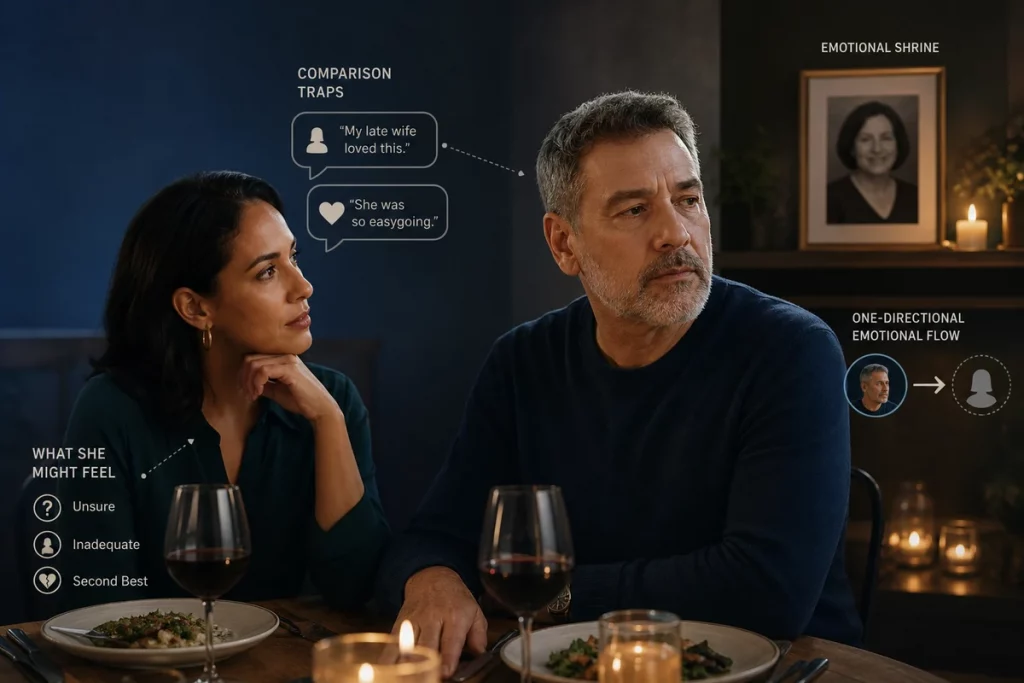
Normal: Occasionally mentioning the late spouse in relevant contexts. Getting emotional around anniversaries, holidays, or specific triggers. Having photos of the late spouse in the home (not shrines — photos). Missing aspects of the previous relationship without comparing you unfavorably. Needing occasional space to process grief that surfaces unexpectedly. Moving at a different emotional pace than you might with a never-widowed partner.
Not normal (red flags): Constant comparison between you and the late spouse. Maintaining the home as a memorial that excludes any new presence. Using you as an emotional support substitute without reciprocating investment. Refusing to introduce you to friends and family after months of dating. Becoming hostile or shutting down when you express your own needs within the relationship. These patterns indicate unresolved grief that’s preventing genuine partnership — not grief that’s being processed alongside healthy new connection.
The distinction matters because dating a widower red flags are about patterns, not moments. A single tearful evening isn’t a red flag. A consistent pattern of emotional unavailability dressed up as “I’m still processing” is — because it indicates that meaningful processing isn’t actually happening and you’re filling a role (grief companion, loneliness solution, emotional stand-in) rather than building a genuine partnership. The American Psychological Association describes healthy post-loss dating as a dynamic where grief and new love coexist — not one where unprocessed grief permanently dominates at the expense of the new partner’s emotional needs.
Research from the National Library of Medicine on widowed individuals who enter new relationships shows that the strongest predictor of relationship success isn’t the time elapsed since the loss — it’s whether the widowed partner has engaged in structured grief processing before or alongside dating. Partners who’ve done therapeutic work can hold grief and new love simultaneously. Partners who haven’t done the work often use the new relationship as an unconscious grief management strategy — which places an unsustainable burden on the new partner who may not recognize the dynamic until they’re emotionally invested.
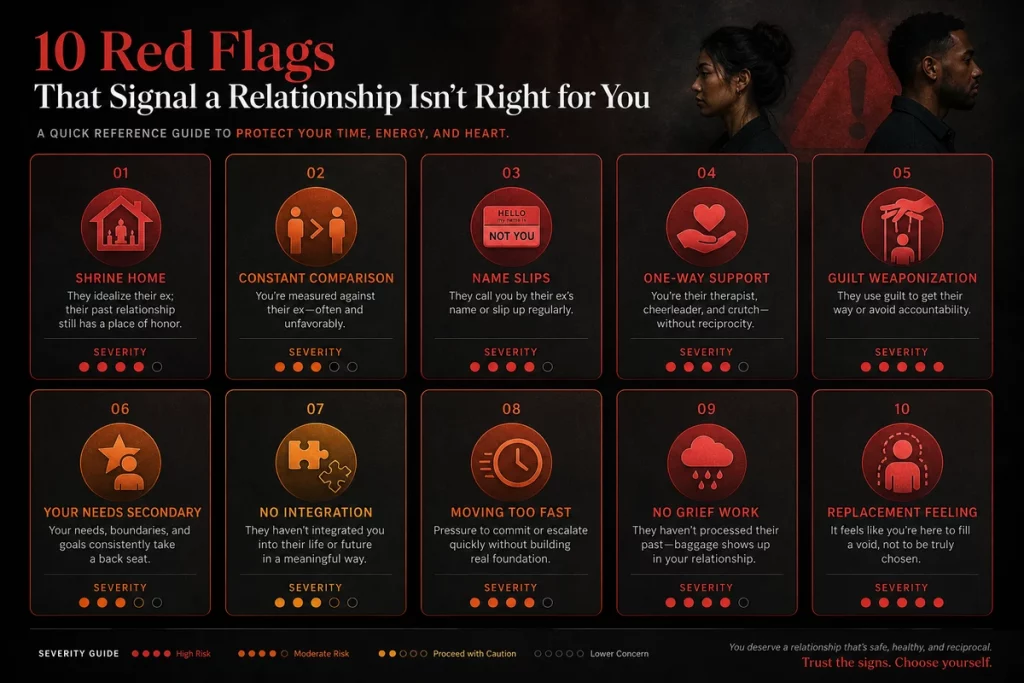
10 Dating a Widower Red Flags
1. The Home Is a Shrine
Photos are normal. A dedicated photo in the living room is normal. What’s NOT normal: the late spouse’s belongings untouched in every room, their clothes still in the closet, their toiletries still in the bathroom, their place setting still at the table. This is among the most visible dating a widower red flags because it’s observable from the first visit.
2.
“She used to make this differently.” “She would never have said that.” “She was always so [quality you apparently lack].” Occasional positive memories of the late spouse are natural and healthy. Consistent comparisons that position you as inferior are not grief — they’re a control dynamic where the idealized, deceased partner is positioned as setting an impossible and permanently unattainable standard that a living person can never meet. If the late spouse is consistently invoked to make you feel inadequate, this is a dating a widower red flag that won’t resolve with patience.
3. He Uses You as Emotional Support Without Reciprocating
You listen to his grief. You hold space for his pain. You accommodate his emotional schedule. But when YOU have a bad day, need support, or want to discuss YOUR feelings about the relationship — he’s unavailable, dismissive, or redirects to his own experience. This one-directional emotional dynamic indicates you’re serving a grief-management function rather than participating in a reciprocal partnership. A partner ready for a relationship — widowed or not — can hold space for your needs alongside their own.
4. Months of Dating, No Integration
After 3-6 months of consistent dating, you haven’t met his friends, family, or children. He hasn’t introduced you into his social world or publicly acknowledged the relationship. This secrecy may indicate: he’s not ready for the social implications of dating (his late spouse’s friends and family knowing), he’s keeping you compartmentalized as a private comfort rather than a genuine partner, or he’s uncertain about the relationship and maintaining deniability. Integration doesn’t need to happen immediately — but its complete absence after months is a dating a widower red flag.
5. Guilt Weaponization
“I feel guilty being happy with you.” “She’s watching from somewhere and I feel terrible.” “I don’t deserve this.” Guilt about moving on is a normal, expected phase of widowed dating. But when guilt is expressed repeatedly in ways that make YOU responsible for managing it (“You have to be patient with my guilt”), or when it’s used to justify limiting the relationship’s progression (“I can’t commit because of my guilt”), the guilt has become a weapon — keeping you invested while preventing the relationship from developing. Normal guilt is processed internally or in therapy. Weaponized guilt is performed for an audience and serves a relationship-limiting function.
6. He Calls You by the Late Spouse’s Name
Once, in a moment of genuine confusion or emotional flooding? Understandable and forgivable. Repeatedly? This is a dating a widower red flag that indicates he hasn’t cognitively separated you from the previous partner — you occupy the same relational slot rather than your own unique one. If the name slips happen primarily during intimate or emotionally vulnerable moments, the implication is that those moments are associated with the late spouse rather than with you specifically.
7. The Relationship Moves Extremely Fast
“I love you” within weeks. Wanting to move in together immediately. Discussing marriage before genuine compatibility assessment. While love bombing can occur in any context, rapid intensity deserves careful attention when dating a widower because it may reflect an attempt to fill the void left by a late spouse rather than a connection grounded in mutual knowledge. Treat love-bombing behavior as a reason to slow the pace, set boundaries, and observe whether the relationship remains respectful.
8. He Hasn’t Done Any Grief Work
No therapy. No grief support group. No grief-oriented reading. No intentional processing of the loss. Just… dating. If a widower has done nothing to process his grief professionally and is instead seeking a new relationship as the processing mechanism, you’re being positioned as the therapist rather than the partner. Research from the National Library of Medicine on widowed individuals who date without grief processing shows significantly higher rates of relationship failure, emotional volatility, and partner dissatisfaction compared to those who engaged in therapeutic grief work before re-entering dating.
9.
Every disagreement is deflected with “I’m going through a lot.” Every request for progression is met with “You need to be more patient.” Every boundary you set is reframed as “You don’t understand what I’ve been through.” Grief is real and deserves compassion — but it doesn’t override your right to have needs, express them, and have them taken seriously. A widower who consistently uses grief to silence your legitimate relationship needs is using his loss as a shield against accountability — one of the most harmful dating a widower red flags because it makes you feel selfish for having any needs at all.
10. You Feel Like a Replacement, Not a Person
The most intuitive and least quantifiable red flag: you feel like you’re filling a role rather than being known as an individual. He’s attracted to your similarity to the late spouse rather than your unique qualities. He references the late spouse’s preferences as though they should be yours. The relationship feels like a continuation of the previous one rather than something genuinely new. If you feel interchangeable — like anyone who fit the basic parameters would serve the same function — trust that feeling — it’s your nervous system telling you something important. Partners ready for genuine new love are attracted to what makes you different, not to what makes you similar to what they lost.
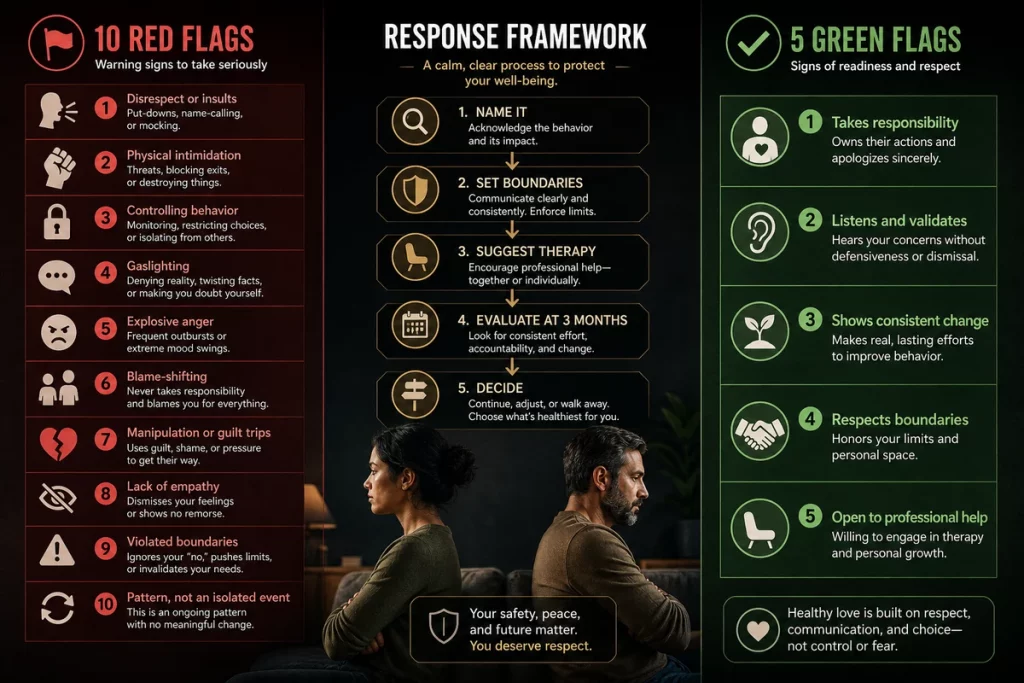
5 Green Flags: Signs He’s Genuinely Ready
Not all widowers present dating a widower red flags — many are genuinely ready for new connection. Here’s what readiness looks like:
He talks about the late spouse naturally, without comparison. He mentions her in relevant contexts with warmth — “My late wife loved this restaurant” — without the comparison that makes you feel inadequate. The late spouse exists as part of his history, not as a standard you’re measured against.
He’s done grief work. He’s seen a therapist, attended a support group, read grief-oriented books, or engaged with the loss through some structured process. Grief counseling professionals and the Grieving.com community resources consistently identify structured processing as the most reliable indicator of readiness for healthy new relationships after loss. He can name what he’s learned about himself through the grief and articulate how it’s shaped what he wants in a new relationship. This self-awareness indicates processing rather than avoidance.
He makes space for YOUR needs. He asks about your day, supports your challenges, respects your boundaries, and treats the relationship as reciprocal rather than one-directional. When you express needs, he engages with them rather than deflecting to his grief. He’s capable of being a partner, not just a patient.
He integrates you into his life. He introduces you to friends, family, and eventually children (at an appropriate pace). He publicly acknowledges the relationship. He makes you part of his present rather than keeping you compartmentalized from the rest of his world.
He’s attracted to what makes you YOU. He appreciates your unique qualities, interests, and personality — not your resemblance to the late spouse. He’s building something new rather than recreating something lost. You feel like a person he chose, not a role he needed filled.
What to Do If Dating a Widower Red Flags Appear
Name what you’re observing. “I’ve noticed that our conversations often focus on your grief and I feel like my needs aren’t getting equal space. Can we talk about that?” Naming the specific pattern opens honest dialogue without accusation or blame — and the widower’s response tells you clearly whether he is genuinely willing to address the dynamic or will deflect with grief-based reasoning.
Set clear boundaries. “I want to support your grief process AND have a relationship where my needs matter equally.” “I need to be introduced to the people in your life within the next month.” “I’m not comfortable with constant comparisons to your late spouse.” Clear, compassionately communicated boundaries reliably separate the widowed partners who are genuinely working through grief (they’ll respect your boundaries) from those who are using grief to avoid accountability (they’ll resist or weaponize guilt).
Suggest therapy if he hasn’t pursued it. “I think you could benefit from talking to someone who specializes in grief — not because there’s something wrong with you, but because the processing would help both you individually and us as a couple.” If he categorically refuses or dismisses the suggestion, the refusal itself is data about his willingness to do the work that genuine partnership with a widower requires.
Evaluate with a timeline. Give yourself a specific, calendar-marked evaluation point — 3 months of consistent dating is a reasonable and fair assessment window. At that point, assess: have the red flags improved, remained stable, or worsened? Has he taken any of the actions discussed? Does the relationship feel more reciprocal than it did? If red flags persist unchanged despite clear communication, the pattern is unlikely to change through additional patience. Your genuine compassion for his loss doesn’t obligate you to sacrifice your own emotional wellbeing, your relationship needs, or your self-worth indefinitely while waiting for readiness that may never arrive.
Verify from the beginning. Whether dating a widower you met through widow dating websites or through mainstream apps, apply the same verification practices: reverse image search photos, video call before meeting, and GuyID verification for identity confirmation. Some individuals fabricate widowed status to exploit the sympathy and reduced defenses it generates — particularly on platforms where claiming loss builds instant emotional connection. Use GuyID’s free screening tools and share your Date Mode link to establish mutual transparency from the start.
How GuyID Helps
GuyID should appear when it is useful, not as a banner ad. A GuyID Trust Profile gives someone a portable way to share trust signals before a date, while identity verification and social vouching help turn vague profile claims into clearer next steps.
Useful next steps:
- Create a GuyID Trust Profile when you want a cleaner way to share verified trust signals.
- Use GuyID free tools and related guides when you need a checklist before meeting someone.
- Treat identity verification as confidence-building, not a guarantee.
- Use social vouching when you want context from people who already know the person.
- Sign up only when the extra trust layer helps the decision you are already trying to make.
Frequently Asked Questions
What are the biggest dating a widower red flags?
The most significant red flags: constant unfavorable comparison to the late spouse, using you as one-directional emotional support without reciprocation, maintaining the home as a shrine with no space for new presence. Refusing integration into his social life after months of dating, and weaponizing guilt to avoid accountability for your relationship needs. These patterns indicate the widower is using the new relationship as a grief management tool rather than building genuine partnership.
How long should I wait for a widower to be ready?
There’s no universal answer — but 3 months of consistent dating provides enough data to evaluate whether the relationship is genuinely progressing or stuck in a pattern where grief permanently outweighs partnership. If dating a widower red flags persist unchanged after 3 months of clear communication and boundary-setting, additional patience is unlikely to produce different outcomes. You deserve a partner who can show up for you — and a widower who can’t yet do that may need more individual grief work before he’s genuinely ready.
Is it normal for a widower to talk about his late wife?
Yes — and a healthy widower SHOULD be able to talk about his late spouse naturally. The late spouse is part of his history, and denying that history would be inauthentic. The red flag isn’t talking about her — it’s HOW he talks about her. Warm, contextual mentions are healthy. Constant comparisons that make you feel inadequate are not. If you can listen to his memories without feeling diminished, the dynamic is healthy. If every mention makes you feel like you’re competing with a ghost, something needs to change.
Should a widower go to therapy before dating?
Ideally, yes — or at minimum, engage in some structured grief processing. A widower who has done therapeutic work enters dating with self-awareness, emotional vocabulary, and the ability to distinguish between grief responses and relationship responses. Without this work, the new partner often becomes the de facto therapist — a dynamic that’s unsustainable and unfair to both people. If you’re dating a widower who hasn’t done grief work, suggesting therapy isn’t insensitive — it’s an investment in the relationship’s viability.
Can a widower truly love someone new?
Absolutely. Love for a deceased spouse and love for a new partner are not competing resources — the heart’s capacity for love expands rather than divides. Research confirms that widowed individuals in healthy new relationships report genuine love, deep connection, and fulfilling partnership alongside continued love for the deceased spouse. The key is whether the widower has processed enough grief to be emotionally available for new love — not whether new love is theoretically possible. It is — and when it works, it’s one of the most profound demonstrations of the human capacity for resilience and connection.
How do I verify that someone claiming to be widowed is telling the truth?
Some individuals fabricate widowed status to exploit sympathy and lower your defenses — particularly on widow dating websites where claiming loss builds instant emotional connection. Verify through: social media cross-referencing (obituary records, memorial posts), reverse image search on profile photos, GuyID identity verification, and video calls that include organic conversation about their experience (fabricated stories often lack the specific, spontaneous, emotionally textured details that genuine grief produces). GuyID’s free screening tools provide the foundation for any match verification.
Where can I find support for dating a widower?
Online communities like Reddit’s r/datingawidower and r/relationships provide peer perspectives. Abel Keogh’s books (“Dating a Widower,” “The Ultimate Dating Guide for Widowers”) offer the most comprehensive framework. A therapist experienced in grief and relationships provides personalized guidance for navigating the complexities. Our dating red flags guide covers universal warning signs. The committed relationship vs dating guide helps clarify where your connection actually stands in terms of progression and definition.