

Reader Briefing
Reader Briefing
Start here if you need a practical read on trauma bonding test: am i trauma bonded?: who should use verification, what signals to check, and what to do before moving from online interest to an in-person plan.
Who this is for
- Readers preparing for a first in-person date.
- Anyone checking identity, profile consistency, and trust signals.
- People trying to avoid romance scams, fake profiles, or pressure tactics.
- Online daters improving conversations, profiles, or match screening.
You’ll learn
- How to evaluate identity signals without treating any single check as certainty.
- Which trust signals matter and how to weigh them together.
- How to spot inconsistencies, pressure, or behavior patterns that deserve caution.
- How to move from online conversation to a safer first meeting.
- Where GuyID tools fit into a quick pre-date screening workflow.
- How to compare options using practical safety and trust criteria.
Bottom line
Verification reduces uncertainty; it does not guarantee future behavior. Use a layered approach: confirm identity signals, compare profile consistency, ask for a short video call, keep early plans public, and slow down when someone pressures you to skip normal safety steps.
Key takeaways
- Identity verification improves confidence, not certainty.
- Patterns matter more than isolated incidents.
- Verify before meeting privately or sharing sensitive details.
- A short video call can reveal many inconsistencies.
- Pressure to skip reasonable safety steps is useful information.
Free Tools
Catfish Probability Detector
Check whether a dating profile has suspicious identity or photo signals.
Dating Bio Red Flag Detector
Review a bio for scam, pressure, or trust-warning language.
Dating Safety Checklist
Use free GuyID tools before moving from chat to a real date.
Next step
Create your GuyID trust profile
Share consent-based trust signals before a date without turning the conversation into an interrogation.
You know the relationship is harmful. Your friends have told you. Your therapist has told you. Some part of you agrees — and yet you can’t leave. If you’re reading this, you may need a trauma bonding test to understand what’s keeping you locked in a dynamic your rational mind has already rejected. Trauma bonding isn’t weakness, poor judgment, or “choosing to stay” — it’s a neurochemical attachment pattern created by cycles of abuse and intermittent reinforcement that hijacks your brain’s reward system in ways that willpower alone cannot override. This guide provides a comprehensive trauma bonding test with scored assessment, explains the neuroscience behind why you feel stuck, and provides the framework for breaking free.
NavigateTable of Contents19 sections
What Is Trauma Bonding?
Trauma bonding is a powerful emotional attachment that forms between an abused person and their abuser through cycles of intermittent reinforcement — alternating abuse with kindness, punishment with affection, cruelty with tenderness. The American Psychological Association defines trauma bonding as an attachment created by repeated cycles of abuse followed by intermittent positive reinforcement, producing a powerful emotional bond that the victim genuinely experiences as love, loyalty, or dependency despite recognizing the relationship’s harmful nature.
The mechanism is identical to what makes gambling addictive: unpredictable rewards produce the strongest behavioral attachment. In a trauma bond, the “reward” is the return of affection after a period of abuse — the relief phase feels disproportionately powerful because it follows pain. Over time, the abuser becomes simultaneously the source of greatest distress AND greatest comfort, creating a neurochemical loop that feels impossible to escape. Understanding what a trauma bonding test measures — the specific indicators of this neurochemical attachment pattern — is the first step toward recognizing and addressing the bond.
Trauma bonding is not a personal failing — it is not evidence of weakness, poor judgment, or “choosing to stay.” It’s a documented neurological response that occurs across demographics, education levels, income brackets, and relationship experience levels — affecting doctors and construction workers, CEOs and college students with equal neurochemical efficiency. Research from the National Library of Medicine demonstrates that trauma bonding activates the same neural pathways as substance addiction — which is why “just leaving” is as ineffective as advice as “just stop drinking” would be for someone with clinical alcohol dependency. The bond operates below the level of conscious choice and rational decision-making, deep in the brain’s primitive reward and attachment circuitry where willpower has limited jurisdiction.
Trauma Bonding Test: 15-Question Assessment
Answer each question honestly based on your current or most recent relationship. Score: 0 = Never, 1 = Sometimes, 2 = Often, 3 = Almost Always.
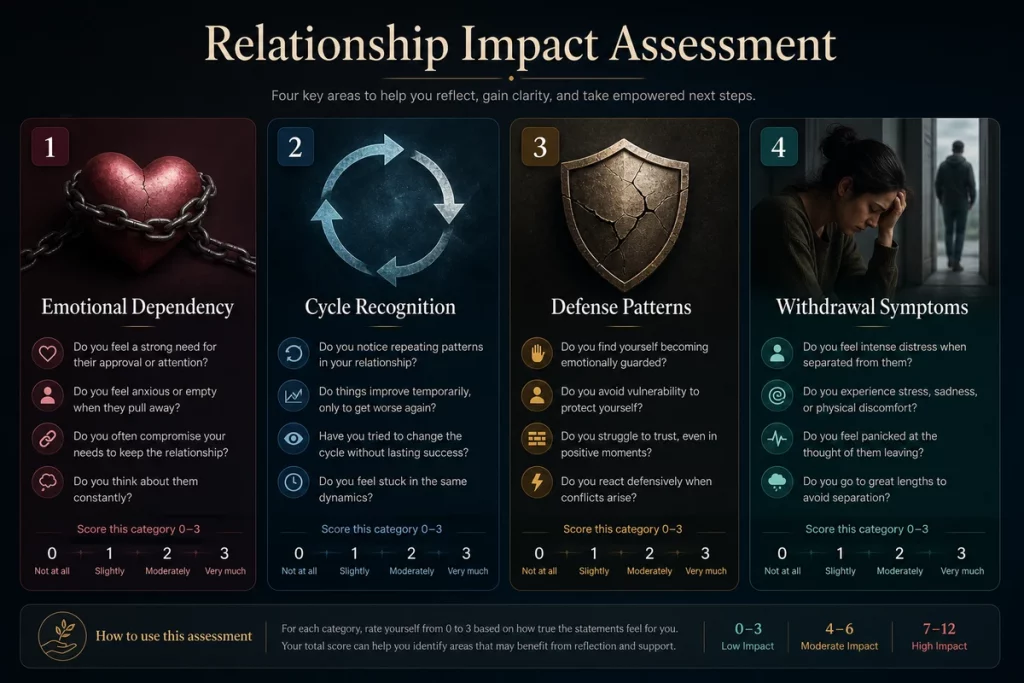
Category 1: Emotional Dependency (Questions 1-4)
1. Do you feel unable to leave the relationship even though you recognize it’s harmful? (0-3)
2. Do you feel like your partner is the only person who truly understands you, despite the pain they cause? (0-3)
3. Does your emotional state depend almost entirely on how your partner is treating you that day? (0-3)
4. Do you feel physically ill, panicked, or unable to function when you contemplate ending the relationship? (0-3)
Category 2: Cycle Recognition (Questions 5-8)
5. Does your relationship follow a pattern of tension → explosive incident → apology/reconciliation → calm period → tension again? (0-3)
6. Are the “good periods” after conflict the most intense, loving, and connected times in your relationship? (0-3)
7. Do you find yourself waiting for and anticipating the next “good period” to justify staying? (0-3)
8. Has the cycle repeated multiple times, with each reconciliation feeling like a genuine fresh start despite the pattern? (0-3)
Category 3: Defense Patterns (Questions 9-12)
9. Do you defend your partner to friends and family who express concern about the relationship? (0-3)
10. Do you minimize the harmful behavior — telling yourself “it’s not that bad” or “they didn’t mean it”? (0-3)
11. Do you blame yourself for the harmful episodes — believing you provoked them or should have known better? (0-3)
12. Do you focus on your partner’s positive qualities to justify staying, while downplaying or dismissing the negative? (0-3)
Category 4: Withdrawal Symptoms (Questions 13-15)
13. When you’ve attempted to leave or create distance, did you experience intense anxiety, depression, or physical symptoms that pulled you back? (0-3)
14. Do you feel a rush of relief, love, or euphoria when your partner is kind after a difficult period — a relief that feels stronger than normal happiness? (0-3)
15. Have you returned to the relationship after leaving, despite knowing the pattern would repeat? (0-3)
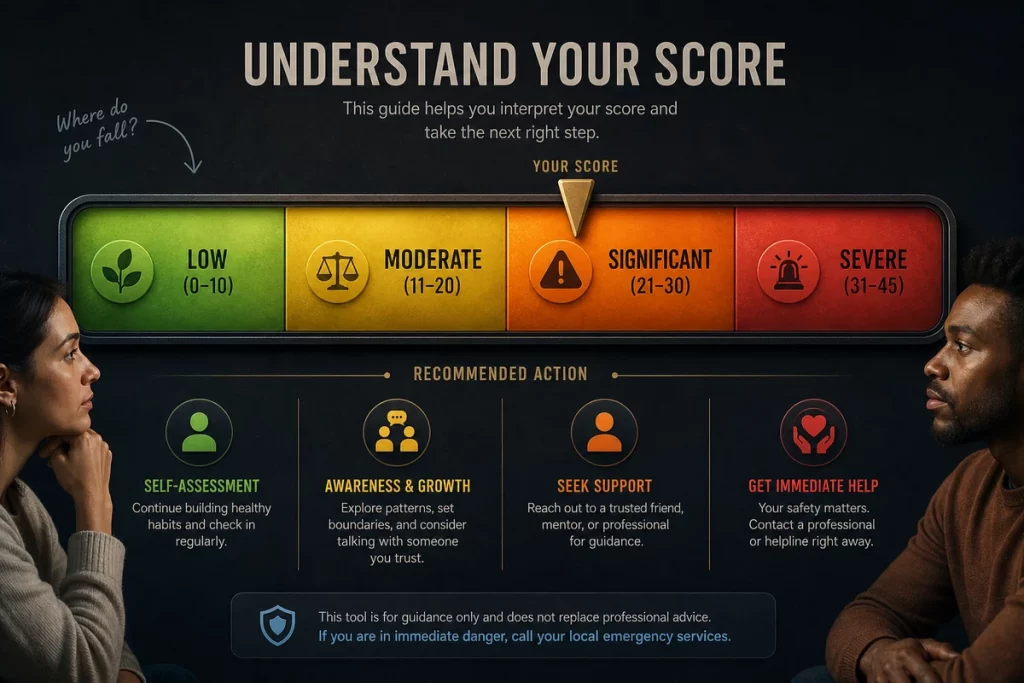
Scoring Your Trauma Bonding Test
Add your scores across all 15 questions (maximum: 45 points):
| Score Range | Interpretation | Recommended Action |
|---|---|---|
| 0-10 | Low trauma bonding indicators. Your attachment appears healthy or the relationship challenges don’t show the intermittent reinforcement pattern characteristic of trauma bonding. | If relationship concerns exist, explore other frameworks (toxic relationship quiz, emotional abuse checklist) |
| 11-20 | Moderate indicators. Some trauma bonding patterns are present — particularly if your highest scores cluster in one category. The bond may be forming but hasn’t reached full dependency. | Individual therapy recommended. Address patterns before they deepen. Set clear boundaries and observe your partner’s response. |
| 21-30 | Significant trauma bonding. Multiple categories show elevated scores, indicating an established bond operating through the intermittent reinforcement cycle. Leaving feels extremely difficult not because the relationship is good but because the bond is strong. | Individual therapy with a trauma-informed clinician is strongly recommended. Safety planning may be needed. Contact the National Domestic Violence Hotline (1-800-799-7233) for support. |
| 31-45 | Severe trauma bonding. The bond is deeply established across all categories — emotional dependency, cycle entrenchment, defense patterns, and withdrawal symptoms are all active. This score indicates a relationship where leaving requires professional support and structured safety planning. | Immediate professional help. Contact the National Domestic Violence Hotline. Individual therapy with abuse/trauma specialization. Do not attempt to “work on the relationship” from within the active trauma bond — individual safety and bond dissolution must come first. |
Category-specific analysis: Look at which categories scored highest on your trauma bonding test results to understand the specific dimensions of your bond. High Category 1 (Emotional Dependency) suggests the bond has created deep psychological dependence where your emotional functioning has become contingent on the relationship’s current state. High Category 2 (Cycle Recognition) indicates the abuse cycle is well-established, repeating predictably, and you can recognize the pattern even while feeling unable to exit it. High Category 3 (Defense Patterns) suggests cognitive distortion is actively protecting the bond from rational challenge — your brain is working to justify staying through minimization, self-blame, and selective attention to positive moments. High Category 4 (Withdrawal Symptoms) indicates the bond has reached addiction-level neurochemical involvement where separation produces genuine physiological distress responses. A trauma bonding test score that’s elevated across all four categories simultaneously indicates the most deeply entrenched bonding pattern — and the greatest urgency for professional intervention before the pattern deepens further.
The Neuroscience of Trauma Bonds
Understanding why trauma bonding happens removes the self-blame that prevents people from seeking help:
Dopamine dysregulation. The abuse-reconciliation cycle creates extreme dopamine fluctuations — crashing during abuse, spiking during reconciliation. Over time, the brain adapts to these fluctuations by downregulating baseline dopamine (creating depression and anhedonia when the cycle is interrupted) and upregulating sensitivity to the reconciliation spike (making the “good periods” feel increasingly euphoric by comparison). This is neurologically identical to drug tolerance and withdrawal — and it explains why a trauma bonding test often reveals that the “best moments” in the relationship produce feelings more intense than anything experienced in healthy connections.
Cortisol and oxytocin interference. Chronic stress from abuse elevates cortisol (stress hormone) while the intermittent affection triggers oxytocin (bonding hormone). The brain begins associating these two neurochemicals — stress becomes linked to bonding in ways that make the abusive relationship feel irreplaceable. When you’re away from the abuser, you experience both withdrawal (missing the oxytocin hits) and hypervigilance (elevated cortisol without the periodic relief that reconciliation provides). This neurochemical dual withdrawal phenomenon is why leaving feels physically worse than staying, even when staying is objectively more harmful.
Learned helplessness formation. Repeated cycles where your actions don’t prevent the abuse (it happens regardless of your behavior) produce learned helplessness — the psychological state where you stop attempting to change your situation because experience has taught you that your actions don’t matter. This isn’t passivity; it’s a documented neurological adaptation to uncontrollable adversity. A high trauma bonding test score in Categories 3 and 4 often reflects learned helplessness operating as “this is just how relationships are” or “I can’t do better.”
Identity fusion with the bond. Over time, the trauma bond becomes central to your identity — you define yourself in relation to the relationship, and the prospect of leaving feels like self-annihilation rather than self-liberation. “Who am I without them?” isn’t a dramatic question; it reflects the genuine erosion of independent identity that occurs when the relationship has consumed your emotional resources, social connections, and self-concept over months or years of the relationship consuming everything else. Your hobbies, friendships, goals, and sense of self have contracted around the relationship until the relationship IS your identity. Leaving doesn’t feel like ending a relationship — it feels like ending yourself. This identity fusion is one of the most powerful mechanisms keeping people in trauma-bonded relationships, because the alternative to the bond isn’t “freedom” — it’s “emptiness that has no shape yet.” The rebuilding of independent identity is therefore not a luxury of recovery; it’s the structural foundation without which leaving is psychologically untenable.
Cognitive dissonance maintenance. Your brain actively works to maintain consistency between your behavior (staying) and your beliefs (the relationship is harmful) by distorting one to match the other. Since leaving feels impossible due to the neurochemical bond, the brain adjusts the belief instead: “It’s not that bad.” “Every couple fights.” “They didn’t mean it.” “I provoked them.” These cognitive distortions aren’t stupidity — they’re your brain’s attempt to reduce the agonizing dissonance between “I’m staying” and “I shouldn’t stay.” A trauma bonding test that scores high in Category 3 (Defense Patterns) is measuring exactly this cognitive dissonance resolution in action. The defenses don’t reflect your true assessment of the relationship; they reflect your brain’s attempt to make the unbearable bearable.
Breaking the Trauma Bond
A high trauma bonding test score doesn’t mean you’re trapped permanently — it means leaving requires a structured approach rather than willpower alone:
Professional support is not optional. Trauma bonds operate at the neurochemical level — and addressing neurochemical patterns requires professional intervention. A therapist trained in trauma, narcissistic abuse, or EMDR provides the tools that self-help cannot: regulated processing of traumatic memories, nervous system stabilization, and the corrective relational experience of a safe therapeutic attachment. If you scored 21+ on this trauma bonding test, individual therapy with a trauma-informed clinician should be your immediate next step.
No-contact is the treatment protocol. Just as addiction recovery requires removing access to the substance, trauma bond recovery requires removing access to the abuser — including their social media, mutual friends who relay information, and any communication channels. Every contact — even seeing their social media post — reactivates the bond’s neurochemistry and resets the recovery timeline. No-contact isn’t punishment; it’s the environmental condition that allows your neurochemistry to recalibrate to baseline.
The withdrawal period is real and temporary. The first 2-4 weeks after establishing no-contact are the hardest — intense cravings to contact the abuser, idealization of the relationship’s good moments, physical symptoms (anxiety, insomnia, appetite changes), and the powerful urge to “just check in.” These are genuine withdrawal symptoms from a neurochemical dependency, not evidence that you made the wrong decision. They peak around week 2-3 and gradually diminish thereafter. A therapist provides support during this critical period.
Rebuild independent identity and social connection. The trauma bond contracted your world — it’s time to expand it again. Reconnect with friends and family the relationship isolated you from. Pursue interests the relationship suppressed. Establish routines that belong to you alone. Each independent experience provides your brain with data that you exist — and thrive — without the person the bond told you that you couldn’t survive without. This identity rebuilding isn’t a nice-to-have luxury of recovery; it’s the structural intervention that makes the recovery permanent. Without an independent identity to return to, the pull of the bond has nowhere to compete against — and the likelihood of returning increases dramatically.
Understand that grief is part of recovery. Even when you intellectually know the relationship was harmful, leaving involves genuine grief — for the person the abuser sometimes was (during reconciliation), for the future you imagined, for the time invested, and for the version of yourself that believed the relationship could work. Allowing this grief rather than suppressing it is essential. Suppressed grief becomes the unprocessed emotional residue that makes you vulnerable to hoovering attempts (the abuser’s return) and to repeating the pattern in the next relationship. Process the grief in therapy, in journaling, and with trusted friends — then use it as motivation to build the next connection on a foundation of verified, consistent behavior rather than manufactured intensity.
When ready to date again. Post-trauma-bond dating requires deliberate awareness that your “normal meter” is miscalibrated. What feels exciting might actually be the familiar activation of a love bombing pattern. What feels boring might actually be safety. Use GuyID’s free screening tools to verify matches before emotional investment. Watch for red flags and love bombing indicators. Set boundaries early and observe responses. Share your Date Mode link via GuyID to establish mutual transparency from the start. The goal isn’t to avoid vulnerability — it’s to direct vulnerability toward people whose consistent behavior has earned it rather than toward people whose intermittent kindness has manufactured it.
How GuyID Helps
GuyID should appear when it is useful, not as a banner ad. A GuyID Trust Profile gives someone a portable way to share trust signals before a date, while identity verification and social vouching help turn vague profile claims into clearer next steps.
Useful next steps:
- Create a GuyID Trust Profile when you want a cleaner way to share verified trust signals.
- Use GuyID free tools and related guides when you need a checklist before meeting someone.
- Treat identity verification as confidence-building, not a guarantee.
- Use social vouching when you want context from people who already know the person.
- Sign up only when the extra trust layer helps the decision you are already trying to make.
Frequently Asked Questions
What does a trauma bonding test measure?
A trauma-bonding questionnaire organizes self-reported experiences such as emotional dependency, recurring harm-and-reconciliation patterns, minimization, self-blame, and distress during separation. It is a reflection aid, not a validated diagnosis or substitute for assessment by a qualified professional.
Is trauma bonding the same as love?
No — though it feels similar and is often mistaken for love. Love produces consistent security, mutual respect, and emotional wellbeing. Trauma bonding produces intensity, anxiety, relief cycles, and emotional dependency. The confusion occurs because the reconciliation phase of a trauma bonding cycle produces neurochemical responses (oxytocin, dopamine) that feel like love — and because the intensity of the bond often exceeds what healthy relationships produce. But intensity is not love. Love doesn’t require pain to feel meaningful.
How long does it take to break a trauma bond?
With strict no-contact and therapeutic support: the acute withdrawal period typically lasts 2-4 weeks, with significant improvement over 3-6 months and substantial recovery within 12-18 months. Without no-contact (if you maintain communication or social media monitoring), the bond may persist indefinitely because each contact reactivates the neurochemical attachment. The timeline varies based on the bond’s duration, severity, and the quality of professional support.
Can trauma bonding happen in non-romantic relationships?
Yes. Trauma bonding occurs in any relationship with intermittent reinforcement of abuse and kindness — including parent-child relationships, friendships (friendship manipulation), workplace dynamics (abusive bosses), and cult-like groups. The neurological mechanism is relationship-type-agnostic: any dynamic where someone alternates between harming you and providing relief from the harm they caused can produce a trauma bond. This trauma bonding test focuses on romantic relationships but the categories apply to any bond type.
Why can’t I just leave if I know it’s a trauma bond?
Because the bond operates at the neurochemical level, not the cognitive level. Knowing the relationship is harmful is a cognitive awareness. The trauma bond is a neurochemical dependency — your brain’s reward and attachment circuitry has been rewired to treat the abuser as essential. Knowledge alone can’t override neurochemistry, which is why professional intervention (therapy, structured no-contact) is necessary rather than just “deciding to leave.” The inability to leave despite knowing you should is itself a diagnostic marker on this trauma bonding test — not evidence of weakness.
Is a trauma bonding test a clinical diagnosis?
No — this assessment is an educational self-screening tool, not a clinical diagnosis. It identifies patterns consistent with trauma bonding to help you determine whether professional evaluation is warranted. A licensed therapist or psychologist can provide formal, comprehensive clinical assessment and develop a personalized treatment plan based on your specific situation, history, and needs. Use the results of this trauma bonding test as an important starting point for conversation with a professional, not as a substitute for professional evaluation.
Where can I get help right now?
The National Domestic Violence Hotline (1-800-799-7233) provides immediate support for people in abusive relationships, including those experiencing trauma bonding. Our trauma bonding signs guide provides additional identification framework. The trauma bonding cycle guide explains the stages in detail. The emotional abuse checklist and toxic relationship quiz provide complementary assessments. A therapist experienced in trauma and abuse provides the personalized support that self-assessment tools cannot replace.