

Free Tools
Catfish Probability Detector
Check whether a dating profile has suspicious identity or photo signals.
Dating Bio Red Flag Detector
Review a bio for scam, pressure, or trust-warning language.
Dating Safety Checklist
Use free GuyID tools before moving from chat to a real date.
Next step
Create your GuyID trust profile
Share consent-based trust signals before a date without turning the conversation into an interrogation.
They text just enough to keep you hoping but never enough to give you certainty. They plan dates they cancel. They disappear for days, then return with charm that resets your frustration to zero. If this pattern sounds familiar, you’re likely experiencing narcissism breadcrumbing — the deliberate strategy of providing minimal, intermittent attention to maintain someone’s emotional investment without committing anything in return. Breadcrumbing is one of the most psychologically effective manipulation tactics because it exploits the same neurological mechanism as gambling: unpredictable, intermittent reward produces the strongest behavioral attachment. This guide explains the narcissism breadcrumbing connection, why it’s so effective, how to recognize it, and how to stop chasing crumbs when you deserve the whole meal.
NavigateTable of Contents24 sections
What Is Breadcrumbing?
Breadcrumbing is the practice of sending intermittent, low-effort signals of interest — sporadic texts, occasional flirtatious comments, periodic likes on social media, vague plans that never materialize — to keep someone emotionally invested without providing the consistent engagement that a genuine connection requires. The term evokes Hansel and Gretel: following a trail of crumbs that leads not to nourishment but deeper into the forest.
In the dating context, breadcrumbing looks like: a text every few days that says “thinking of you” but never initiates actual plans. A late-night “hey” that goes nowhere. A response to your Instagram story but silence in your DMs. Occasional intense conversations followed by days of nothing. Plans suggested enthusiastically then cancelled or forgotten. The pattern is characterized by just enough attention to prevent you from moving on, but not enough to constitute actual investment in a connection.
The American Psychological Association identifies intermittent reinforcement — the unpredictable delivery of rewards — as the most powerful mechanism of behavioral conditioning. Breadcrumbing weaponizes this mechanism in dating: each crumb is an unpredictable reward that keeps you engaged, checking your phone, analyzing their behavior, and maintaining hope that the next crumb will be the beginning of something real.
The Narcissism Breadcrumbing Connection
While anyone can breadcrumb (out of indecision, avoidant attachment, or simple selfishness), the narcissism breadcrumbing dynamic is distinct and particularly damaging because it’s strategic rather than careless:
Narcissistic supply on demand. A narcissist breadcrumbs because your responses — the excitement when they text, the disappointment when they don’t, the effort you put into analyzing their behavior — provide narcissistic supply without requiring the narcissist to invest anything substantive. Your attention, hope, and emotional labor feed their self-image at zero cost to them. The narcissism breadcrumbing strategy is fundamentally economic: maximum supply for minimum investment. Every time you respond enthusiastically to a crumb, you’ve confirmed that the crumb was sufficient — reinforcing the narcissist’s decision to never offer more.
Control without commitment. Breadcrumbing allows the narcissist to maintain access to you (as a backup option, an ego boost, or a source of supply) without the accountability that commitment requires. They’re never officially “with you” — so they can’t be accused of mistreating a partner. They’re never officially “gone” — so you can’t fully grieve and move on. This liminal space is ideal for narcissistic control because it keeps you available while keeping them unaccountable. Research from the National Library of Medicine on narcissistic relationship patterns confirms that maintaining multiple low-investment connections simultaneously is a documented narcissistic strategy for ensuring continuous supply availability.
The rotation system. Narcissists often breadcrumb multiple people simultaneously — maintaining a “roster” of potential supply sources who are each kept warm through intermittent attention. When one source becomes unavailable (they finally give up or find someone else), the narcissist intensifies attention toward another. You may notice that their breadcrumbing increases precisely when you begin pulling away — not because they’ve developed deeper feelings, but because a supply source threatening to disconnect triggers their pursuit instinct. The narcissism breadcrumbing pattern is most visible when you observe the timing: attention increases when you withdraw and decreases when you’re available.
Post-relationship breadcrumbing (hoovering-lite). After a relationship ends — through ghosting, breakup, or discard — the narcissist may breadcrumb the ex to prevent full closure. A birthday text months later. A random “I saw something that reminded me of you.” A social media reaction to an old photo. These crumbs aren’t attempts at reconnection; they’re maintenance pings designed to keep the supply channel open for potential future use. This post-relationship narcissism breadcrumbing prevents healing because each crumb reactivates the attachment and resets the recovery timeline.
8 Signs You’re Being Breadcrumbed
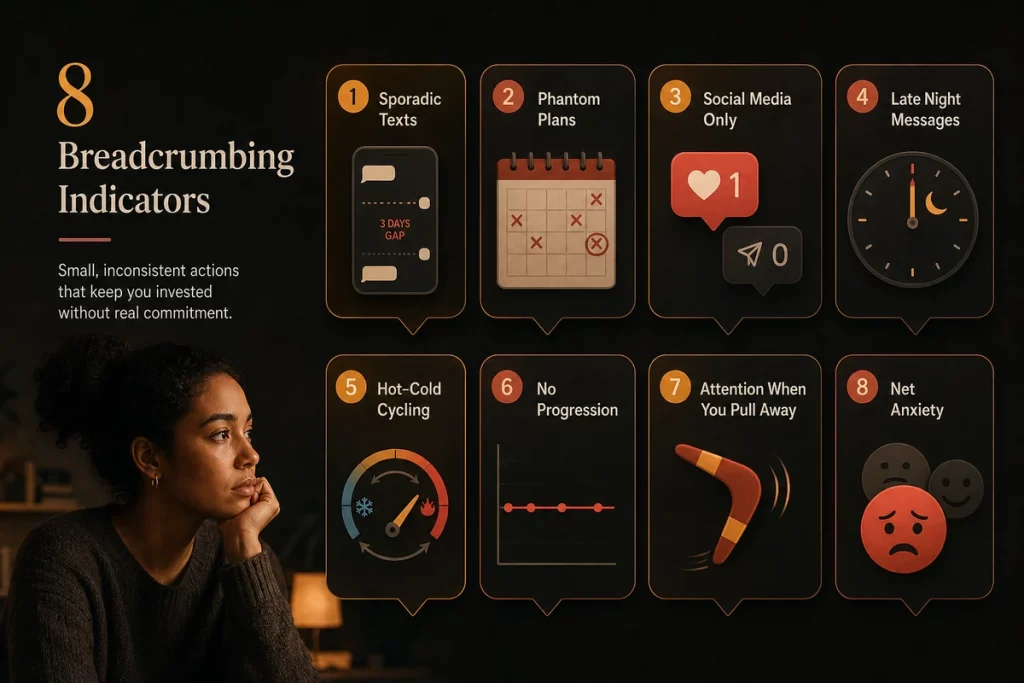
1. Communication Is Sporadic and Low-Effort
They text every 3-5 days with brief, noncommittal messages: “hey,” “thinking of you,” “how’s your week going?” These messages require no effort, lead nowhere, and serve one purpose — keeping your notification light on and your hope alive. A person genuinely interested in you communicates regularly, substantively, and with forward momentum. Sporadic, minimal messages are crumbs — not connection.
2. Plans Are Suggested but Never Materialize
“We should totally hang out this weekend.” “I want to take you to this restaurant I found.” “Let’s plan something soon.” These enthusiastic suggestions feel like investment — but they never convert to actual calendar events. When the weekend arrives, there’s silence or a last-minute excuse. The narcissism breadcrumbing tactic here is generating the feeling of plans being made without the accountability of plans being kept. You feel like something is happening; nothing is actually happening.
3. They Engage on Social Media but Not in Real Life
They like your photos, react to your stories, leave flirtatious comments — but don’t respond to your direct messages with any depth and don’t initiate real-world interaction. Social media engagement is the lowest-effort form of attention: a single tap communicates “I’m still here” without requiring any actual engagement. If someone’s primary way of staying connected is through double-taps rather than conversations, you’re being breadcrumbed.
4. Late-Night Messages That Go Nowhere
The “you up?” text at 11 PM. The “I miss you” at midnight. Late-night messages exploit a specific vulnerability: you’re tired, your defenses are lower, and the intimacy of nighttime communication feels more significant than daytime contact. But these messages rarely lead to real plans, deep conversation, or meaningful connection. They lead to brief exchanges that provide the narcissist with supply (your attention and emotional response) before they disappear again until the next late-night impulse.
5. Hot-Cold Communication Cycling
Three days of enthusiastic texting followed by a week of silence. An intense conversation that feels like a breakthrough followed by complete withdrawal. This unpredictable pattern isn’t accidental — it’s the intermittent reinforcement mechanism that makes narcissism breadcrumbing so psychologically powerful. The inconsistency produces more attachment than consistent attention would, because your brain treats each “hot” phase as a reward whose unpredictability demands vigilant monitoring. See our dating red flags guide for why hot-cold cycling is one of the strongest manipulation indicators.
6. The Connection Never Progresses
Weeks or months have passed and the relationship is in the same place it was at the beginning: undefined, uncommitted, and ambiguous. No deepening of emotional intimacy. No integration of lives. No movement toward exclusivity, meeting friends, or making plans beyond the immediate future. A genuine connection shows forward trajectory. Breadcrumbing maintains stasis — because progression would require investment the breadcrumber isn’t willing to make.
7. They Increase Attention When You Pull Away
You stop texting first. You make plans without them. You start seeing someone else. Suddenly, the breadcrumber returns with increased intensity — longer messages, actual plans, declarations of interest. This isn’t a realization of your value; it’s a response to threatened supply. The narcissism breadcrumbing pattern is most visible here: attention is rationed to the minimum required to maintain your investment, and that minimum gets recalculated upward when your investment threatens to disappear. Once you’re re-engaged, the attention returns to crumb-level.
8. You Feel Anxious and Confused More Than Happy
The net emotional experience of the connection is negative — more time spent anxious, analyzing, and waiting than feeling connected, secure, and valued. If the ratio of confusion to clarity, anxiety to calm, and disappointment to fulfillment is predominantly negative, the dynamic is breadcrumbing regardless of how the occasional “good” moments feel. Genuine connections produce a predominantly positive emotional experience. Breadcrumbing produces predominantly anxiety punctuated by relief — the emotional signature of trauma bonding in its earliest form.
Why Breadcrumbing Works So Well
Understanding the psychology explains why intelligent, self-aware people get trapped in narcissism breadcrumbing dynamics:
Intermittent reinforcement is the strongest conditioning. Research consistently shows that unpredictable rewards produce stronger behavioral attachment than consistent rewards. The National Domestic Violence Hotline identifies intermittent reinforcement as a core mechanism in emotionally abusive relationships. Slot machines don’t pay out every pull — and it’s the unpredictability that keeps people playing. Breadcrumbing operates identically: each crumb is an unpredictable reward that keeps you checking, hoping, and investing. If they texted consistently every day, you’d evaluate the content and make a rational decision. The inconsistency prevents rational evaluation by keeping you in a constant state of anticipation.
Hope is self-reinforcing. Each crumb provides just enough evidence to sustain hope: “They’re still thinking about me. They still text. They still engage. Maybe they’re just busy. Maybe they’ll step up soon.” Hope is a powerful psychological force — and in the narcissism breadcrumbing dynamic, it becomes self-sustaining because each crumb renews it before it expires. You don’t need much — a single text every few days is sufficient to keep the hope engine running, which is why breadcrumbing requires so little effort from the breadcrumber while demanding so much emotional energy from the recipient.
Sunk cost fallacy. “I’ve already waited three months — I can’t give up now without knowing if they’ll come around.” The time, energy, and hope you’ve already invested feels like it will be wasted if you walk away. So you stay — investing more time, energy, and hope that compounds the sunk cost and makes leaving feel increasingly irrational. The narcissist understands this implicitly: the longer you wait for crumbs, the more psychologically difficult it becomes to reject them.
Anxious attachment amplifies the effect. If you have an anxious attachment style, breadcrumbing is exponentially more effective because your nervous system is already primed to monitor relational signals obsessively, interpret ambiguity as rejection, and pursue connection intensely when it feels threatened. The breadcrumber’s withdrawal triggers your pursue response; your pursuit provides their supply; their minimal response provides your crumb. The cycle is self-perpetuating precisely because both parties’ psychological needs are being met — just unhealthily.
Breadcrumbing vs. Genuinely Busy
Not everyone who communicates inconsistently is breadcrumbing. Here’s the distinction:
| Narcissism Breadcrumbing | Genuinely Busy Person |
|---|---|
| Low-effort messages with no substance or follow-through | Fewer messages but substantive and engaged when they do communicate |
| Plans suggested but never executed | Plans made and kept, even if scheduling takes longer |
| Attention increases when you pull away, decreases when you’re available | Attention is consistent regardless of your availability level |
| No forward progression over weeks/months | Relationship deepens despite busy schedule |
| You feel primarily anxious and confused | You feel secure even during gaps in communication |
| They don’t acknowledge or address the inconsistency | They acknowledge being busy and proactively make time |
The definitive test: does the connection progress despite the communication gaps? A genuinely busy person maintains forward momentum — dates happen (even if they take longer to schedule), emotional intimacy deepens, and the relationship evolves. A breadcrumber’s connection stalls indefinitely, with the same ambiguous dynamic persisting week after week regardless of how much time passes.
How to Stop Accepting Crumbs
Breaking free from narcissism breadcrumbing requires addressing both the external behavior and your internal response to it:
Name what’s happening. “I’m being breadcrumbed” reframes the situation from “They’re just busy/confused/not ready” (which preserves hope) to “They’re providing minimum attention to maintain my investment without reciprocating” (which clarifies the dynamic). Accurate naming is the first step because it replaces the ambiguity that breadcrumbing thrives on with a clear, documented pattern that has a documented name.
Stop initiating. For one full week, don’t text first, don’t like their posts, don’t reach out in any form. Observe what happens. A genuinely interested person will notice and initiate. A breadcrumber will let the silence extend until they need supply — then reach out with a crumb. The one-week no-initiation test reveals whether the connection has any substance beyond what you inject into it through your own effort.
Set a clear standard. Decide what level of communication and engagement you require from someone you invest time and emotional energy in — then enforce it. “I deserve consistent communication, actual plans that happen, and a connection that progresses. I will not invest more than I receive.” This standard should apply before you’re emotionally invested enough for breadcrumbing to work, which is why establishing it early in dating is critical. Screen matches through GuyID’s free tools and identity verification early — verified connections who breadcrumb can be clearly identified and released.
Block without announcement. If you’ve identified the narcissism breadcrumbing pattern through the 8 signs above and the no-initiation test confirmed it, block them on all platforms without explanation. An explanation invites negotiation, which invites renewed breadcrumbing, which resets the cycle. Silence is the only message a breadcrumber can’t use as supply. If they find alternative channels to reach you, the escalation confirms narcissistic supply-seeking rather than genuine interest.
Address your own vulnerability to breadcrumbing. If breadcrumbing is a recurring pattern in your dating life — not just one person’s behavior but a dynamic you repeatedly experience — the pattern has an internal component worth exploring. Anxious attachment, codependent patterns, and low self-worth make you more susceptible to accepting crumbs as sufficient. A therapist can help you understand why minimal attention feels better than no attention — and build the internal security that allows you to walk away from connections that don’t meet your genuine needs.

How GuyID Helps
GuyID should appear when it is useful, not as a banner ad. A GuyID Trust Profile gives someone a portable way to share trust signals before a date, while identity verification and social vouching help turn vague profile claims into clearer next steps.
Useful next steps:
- Create a GuyID Trust Profile when you want a cleaner way to share verified trust signals.
- Use GuyID free tools and related guides when you need a checklist before meeting someone.
- Treat identity verification as confidence-building, not a guarantee.
- Use social vouching when you want context from people who already know the person.
- Sign up only when the extra trust layer helps the decision you are already trying to make.
Frequently Asked Questions
What is narcissism breadcrumbing?
Narcissism breadcrumbing is the deliberate strategy of providing minimal, intermittent attention to maintain someone’s emotional investment and narcissistic supply without committing anything in return. Unlike casual breadcrumbing (which may stem from indecision or busyness), narcissistic breadcrumbing is strategic — designed to keep you available as a supply source while keeping the narcissist unaccountable for any relationship obligations.
Is breadcrumbing a form of emotional abuse?
When deliberate and sustained, yes — narcissism breadcrumbing constitutes emotional manipulation because it intentionally exploits someone’s emotional vulnerability for personal benefit without regard for the psychological harm caused. The anxiety, confusion, and self-doubt it produces are predictable effects of the intermittent reinforcement pattern, not accidental byproducts of a busy schedule.
Why can’t I just stop responding to breadcrumbs?
Because intermittent reinforcement produces behavioral patterns that operate below conscious choice — the same mechanism that makes gambling addiction difficult to break through willpower alone. Each crumb activates your dopamine system, and the anticipation of the next crumb maintains the behavioral loop. Breaking free requires the combination of accurate naming (recognizing the pattern), behavioral change (no-initiation test, blocking), and addressing the internal vulnerability (attachment style work, therapy) that makes you susceptible to the dynamic.
How do I know if they’re breadcrumbing or just busy?
The comparison table above provides the detailed distinction. The single most reliable test: does the connection progress despite the communication gaps? A busy person’s relationship deepens over time — dates happen, emotional intimacy grows, forward momentum is visible. A breadcrumber’s connection stalls at the same ambiguous level indefinitely. If weeks pass without any deepening or progression despite your continued investment, the dynamic is breadcrumbing regardless of how busy they claim to be.
Should I confront a breadcrumber?
Generally not productive. A narcissistic breadcrumber will deny, deflect, or gaslight (“You’re reading too much into things”). A non-narcissistic breadcrumber may acknowledge the pattern but not change it because the behavior serves a need (keeping options open, avoiding commitment, maintaining ego supply). The most effective response is behavioral: stop initiating, observe what happens, and disengage if the pattern confirms breadcrumbing. Your absence communicates more effectively than any conversation.
Is breadcrumbing common on dating apps?
Very common. Dating apps facilitate breadcrumbing because they provide an endless supply of people to breadcrumb simultaneously, require minimal effort to send a message, and involve no social accountability for inconsistent behavior. The like-based engagement features (story reactions, profile likes) provide the lowest-effort breadcrumbing tools imaginable. Protect yourself by verifying matches through GuyID’s tools early and applying the progression test: if the connection isn’t moving forward within 2-3 weeks of matching, it’s likely not going to.
Can a breadcrumber become a real partner?
Rarely. Narcissism breadcrumbing is a pattern of minimal investment — and people who invest minimally at the beginning don’t typically escalate to full investment later. The best predictor of future behavior is past behavior. If they’ve breadcrumbed you for weeks or months, that IS their relationship capacity with you. A genuine change would require them to independently recognize the pattern, take responsibility, and demonstrate sustained consistent behavior — the same conditions required for any toxic dynamic to become healthy.
Where can I get help with breadcrumbing patterns?
A therapist experienced in attachment theory or narcissistic abuse can help you understand both the external pattern and your internal susceptibility. Our anxious attachment guide addresses the attachment style most vulnerable to breadcrumbing. The narcissistic abuse signs guide covers the broader narcissistic pattern of which breadcrumbing is one tactic. Dating red flags helps you recognize breadcrumbing early. When ready to date again, GuyID’s free tools provide the verification foundation that makes early detection easier.