Reader Briefing
Reader Briefing
Start here if you need a practical read on anxious attachment & dating: a guide: who should use verification, what signals to check, and what to do before moving from online interest to an in-person plan.
Who this is for
- People meeting someone from a dating app or social platform.
- Readers preparing for a first in-person date.
- Anyone checking identity, profile consistency, and trust signals.
- People trying to avoid romance scams, fake profiles, or pressure tactics.
You’ll learn
- How to evaluate identity signals without treating any single check as certainty.
- Which trust signals matter and how to weigh them together.
- How to spot inconsistencies, pressure, or behavior patterns that deserve caution.
- How to move from online conversation to a safer first meeting.
- Where GuyID tools fit into a quick pre-date screening workflow.
- How to compare options using practical safety and trust criteria.
Bottom line
Verification reduces uncertainty; it does not guarantee future behavior. Use a layered approach: confirm identity signals, compare profile consistency, ask for a short video call, keep early plans public, and slow down when someone pressures you to skip normal safety steps.
Key takeaways
- Identity verification improves confidence, not certainty.
- Patterns matter more than isolated incidents.
- Verify before meeting privately or sharing sensitive details.
- A short video call can reveal many inconsistencies.
- Pressure to skip reasonable safety steps is useful information.
Free Tools
Catfish Probability Detector
Check whether a dating profile has suspicious identity or photo signals.
Dating Bio Red Flag Detector
Review a bio for scam, pressure, or trust-warning language.
Dating Safety Checklist
Use free GuyID tools before moving from chat to a real date.
Next step
Create your GuyID trust profile
Share consent-based trust signals before a date without turning the conversation into an interrogation.
Dating with anxious attachment is like trying to enjoy a meal while convinced the restaurant is about to catch fire — the experience is overshadowed by threat detection that won’t turn off. Every unreturned text becomes evidence of rejection. Every vague response triggers a catastrophic interpretation. Every moment of silence activates a nervous system that reads uncertainty as danger. If you experience anxious attachment style dating challenges, you’re not broken — you’re operating from a nervous system wired in childhood to treat relational uncertainty as a survival-level threat. This guide provides specific strategies for navigating each dating stage with anxious attachment — from the first swipe through early dating, exclusivity, and building lasting connection.
NavigateTable of Contents16 sections
Why Dating Is Harder with Anxious Attachment
Dating is inherently uncertain — and uncertainty is the exact stimulus that anxious attachment symptoms are designed to respond to. For securely attached people, early dating uncertainty is exciting and manageable. For anxiously attached people, that same uncertainty activates a threat-detection system that interprets every ambiguous signal as potential abandonment.
Research from the National Library of Medicine confirms that anxiously attached individuals experience significantly higher cortisol levels during periods of relational uncertainty compared to securely attached individuals. This isn’t a preference — it’s a measurable physiological response that makes dating genuinely more stressful at a biological level.
The cruel paradox of anxious attachment style dating: the behaviors your nervous system generates to secure connection (excessive texting, reassurance-seeking, premature commitment pressure, monitoring online status) often push potential partners away — creating the very rejection your system was trying to prevent. This is what researchers call the “self-fulfilling prophecy of anxious attachment” — the fear of abandonment produces behaviors that increase the probability of abandonment. Understanding this paradox is the first step toward interrupting it, and the strategies in this guide are designed to help you date effectively without suppressing who you are or pretending the anxiety doesn’t exist. The goal isn’t to eliminate your attachment style — it’s to stop letting it drive your behavior on autopilot.
Anxious Attachment Style Dating: The App Stage
Dating apps create maximum anxious attachment activation because they combine relational uncertainty with total lack of accountability:
The match anxiety. Waiting for matches, checking the app compulsively, interpreting a lack of matches as confirmation of unlovability. Your anxious system processes dating app silence as rejection even though it’s simply the normal rhythm of an algorithm-driven platform. Strategy: set specific app-checking times (twice daily maximum) rather than checking continuously. The information doesn’t change meaningfully between checks, but the anxiety of constant monitoring compounds with each refresh.
The message spiral. You match with someone, send a message, and they don’t reply within an hour. Your nervous system escalates: “They’re not interested. They matched by accident. I said something wrong.” In reality, they’re at work, with friends, or doing any of the thousand things people do besides check dating apps. Strategy: after sending a message, close the app and don’t check for at least 4 hours. Most matches reply within 24 hours — watching the clock produces nothing except compounding anxiety.
The ghosting wound. Being ghosted hits anxiously attached people disproportionately hard because it confirms the core anxious belief: “People will leave without warning, and I can’t prevent it.” Strategy: reframe ghosting as information about the other person’s communication skills and emotional maturity rather than evidence of your unworthiness. Someone who can’t send a basic “I don’t think we’re a match” message is not someone whose rejection should determine your self-worth.
Use verification to reduce factual anxiety. Some anxiety has a factual basis that verification tools can address: are their photos real? (reverse image search), is their name consistent? (phone lookup), are they who they claim? (GuyID verification). Resolving factual uncertainty through free screening tools reduces the cognitive load your anxious system carries. Channel the urge to monitor into the urge to verify — one feeds anxiety, the other resolves it.
Navigating Early Dating (Weeks 1-8)
The first weeks of a new connection are peak anxiety for anxious attachment style dating — before patterns are established and before commitment provides security:
Weeks 1-2: Maximum uncertainty. You’ve matched, had good conversations, maybe had a first date. Everything is ambiguous. Your nervous system screams for clarity. Strategy: tolerate the uncertainty rather than resolving it prematurely. Pushing for a “define the relationship” conversation after two dates is driven by your anxiety, not the relationship’s readiness. Practice self-soothing techniques from your attachment reading during these moments — breathwork, journaling, calling a friend.
Weeks 3-4: Pattern establishment. Communication patterns form — texting frequency, response times, date cadence. Your anxious system studies these patterns and reacts disproportionately to any deviation. Strategy: consciously resist the urge to track patterns. Variability is normal. A different texting time doesn’t mean changed feelings. Humans are variable because they have complex lives, not because they’re withdrawing from you specifically.
Weeks 5-8: Investment anxiety. You’re developing real feelings and the stakes feel higher. The suppress-or-express dilemma peaks: express feelings too soon and risk overwhelming them; suppress and risk inauthenticity or resentment. Strategy: express moderate, proportionate interest without declaring the full intensity. “I really enjoy spending time with you and want to keep seeing where this goes” communicates investment without the pressure of “I think you might be the one” at week six.
The video call advantage. A video call before meeting in person serves dual purposes: safety verification (confirming they match their photos and aren’t a catfish) and anxiety reduction (putting a live face to the name reduces abstract uncertainty). Video calls address both safety and anxious attachment concerns simultaneously — making them the highest-value single step in early anxious attachment style dating.
The first date itself. Anxiously attached people often report that in-person dates actually reduce their anxiety compared to the texting phase — because face-to-face interaction provides the real-time data (tone, body language, energy, eye contact) that your monitoring system craves but can’t extract from text messages. Use the first date to assess genuine compatibility: Do they ask about you, or just talk about themselves? Do they respect your time and boundaries? Do they seem interested in who you actually are, or in the performance of connection? After the date, resist the urge to immediately analyze every moment for signs of disinterest. A useful post-date journal prompt: “Three specific things I enjoyed about this person” — which directs your attention toward factual positive data rather than anxious interpretation of ambiguous signals.
Navigating the texting-after-first-date window. The period between a first date and the next contact is among the most anxiety-producing moments in early anxious attachment style dating. Your nervous system demands immediate confirmation: “Did they have a good time? Will they text first? Should I text first? What if they don’t reach out?” Strategy: if you had a genuinely good time, it’s perfectly appropriate to send one message within 24 hours expressing that — “I had a great time tonight, thanks for suggesting that restaurant.” Then let it breathe. One post-date message is confident and clear. Three follow-up messages in six hours is your anxiety talking.
Moving Toward Exclusivity
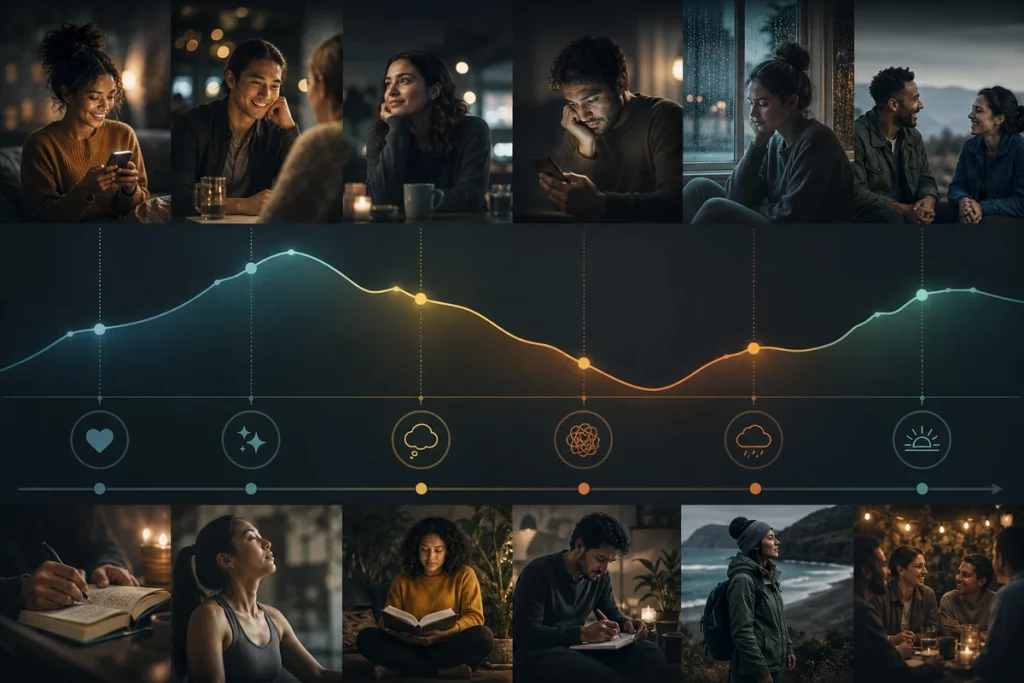
The transition from casual dating to exclusivity is where anxious attachment style dating challenges are most visible — and where the right approach makes the biggest difference:
Don’t rush exclusivity to manage anxiety. The urge to “lock it down” comes from your attachment system’s need to resolve uncertainty, not from genuine relationship readiness. Exclusivity should follow genuine compatibility assessment — shared values, compatible communication styles, mutual respect, and enough experience together to evaluate the dynamic under various conditions (stress, disagreement, celebration, routine). If you’re pushing for exclusivity primarily because uncertainty is intolerable, the exclusivity addresses your anxiety but not the relationship’s actual foundation.
Have the conversation from ground, not panic. When you’re ready to discuss exclusivity, approach from a calm, grounded state — not during an anxiety spike. “I’ve really enjoyed getting to know you, and I’d love to talk about where we both see this going” invites mutual exploration. “I need to know if you’re seeing other people because I can’t handle the uncertainty” pressures from a place of need. The first approach reflects readiness; the second reflects anxiety management. Wait until you can genuinely deliver the first version before having the conversation.
Their response is data, not destiny. If they’re not ready for exclusivity at the same time you are, the anxious interpretation is: “They don’t want me enough.” The reality may be: they process at a different pace, they have a different attachment style, or they genuinely need more time to evaluate compatibility. A reasonable request for more time is not rejection — though your nervous system will try to convince you it is. The key question: are they moving toward commitment gradually and transparently, or are they avoiding the conversation entirely while keeping their options open? The first is a timing difference; the second is a red flag.
Choosing the Right Partner
The single most impactful decision for anxious attachment style dating is choosing the right partner — because the wrong partner activates the anxious system constantly while the right partner gradually heals it:
The anxious-avoidant trap. Anxiously attached people are most intensely attracted to avoidant partners — because the avoidant’s emotional distance creates maximum activation in the anxious monitoring system, which feels like passion. The avoidant’s inconsistency mirrors the inconsistent caregiving that created anxious attachment, making the dynamic feel “familiar” even though it’s harmful. Breaking this pattern is the most important shift in anxious attachment style dating. See our love bombing examples for how this trap often begins.
What secure attraction feels like. A secure partner’s consistent responsiveness may initially feel “boring” because it doesn’t trigger the hypervigilant monitoring system. The absence of anxiety feels like absence of connection — when it’s actually the presence of safety. Learning to recognize calm, consistent interest as genuine attraction (rather than dismissing it because it doesn’t produce the familiar anxiety-high) is one of the most valuable skills in anxious attachment recovery. It’s not boring; it’s what love without fear actually feels like.
Green flags for anxious daters. A partner who: responds within reasonable timeframes consistently, expresses interest directly rather than through ambiguity, respects your boundaries, welcomes GuyID verification and transparency, maintains their own life while making time for you, and responds to your vulnerability with empathy rather than withdrawal. Watch for dating red flags from a grounded perspective rather than an anxious one — and use GuyID’s free tools to address factual questions that fuel anxious speculation.
Research from the American Psychological Association on attachment and partner selection confirms what clinical experience shows: anxiously attached people who deliberately choose secure partners report significant reductions in attachment anxiety within 1-2 years — even without formal therapy. The secure partner’s consistent responsiveness gradually rewires the anxious person’s relational expectations, providing the “corrective attachment experience” that healing requires. Choosing the right partner isn’t just a preference — it’s a therapeutic intervention.
| What It Feels Like | With an Avoidant Partner | With a Secure Partner |
|---|---|---|
| Early chemistry | Electric, consuming, all you think about | Warm, pleasant, leaves room for the rest of your life |
| Between dates | Anxious speculation, phone-checking, catastrophizing | Looking forward to seeing them without distress between contacts |
| After expressing needs | They withdraw, get defensive, or make you feel needy | They listen, acknowledge, and respond constructively |
| During conflict | They shut down or become cruel; you pursue desperately | They engage directly; resolution feels achievable |
| Your self-worth | Dependent on their mood and responsiveness that day | Stable — supported by the relationship but not sourced from it |
| Overall trajectory | Anxiety increases over time as avoidance escalates | Anxiety decreases over time as trust builds through consistency |
10 Strategies for Anxious Attachment Style Dating
Practical rules that protect you without suppressing your authentic self:
1. Set app-checking limits. Twice daily maximum. Continuous checking amplifies anxiety without changing the information available.
2. Implement a “double-text delay.” When the urge to follow up hits because they haven’t replied, wait 24 hours. Most urgency dissipates overnight, and if you still want to send it tomorrow, go ahead from a calmer place.
3. Verify instead of monitor. Replace checking their WhatsApp online status with productive verification: reverse image search, GuyID screening, social media cross-referencing. These answer real questions rather than feeding anxious speculation.
4. Maintain your independent life. Keep seeing friends. Keep your hobbies. Keep your routine. A life that exists independently of the relationship prevents over-investment in early dating outcomes and provides the emotional stability your anxious system needs.
5. Tell one trusted friend about the connection. External perspective punctures the anxiety bubble. When your nervous system insists “They’re definitely losing interest,” a friend who says “Or they’re just busy” provides the reality check your internal system can’t generate alone.
6. Pace physical intimacy. Physical intimacy releases oxytocin — the bonding hormone — which intensifies anxious attachment activation. Moving slowly physically allows emotional intimacy to develop at a matching pace, reducing the gap between physical bonding and genuine relational security.
7. Ask directly rather than testing. If you need to know where things stand, ask directly: “I’m enjoying this — are you still feeling positive about where we’re going?” This is more productive than withdrawal, jealousy provocation, or other indirect “tests” that generate reassurance through manipulation rather than honest communication.
8. Journal your anxiety separately. When anxiety hits, write it down before acting on it. “I feel anxious because they haven’t texted today” externalizes the feeling and separates it from the urge to act. Often, writing the anxiety removes the compulsion to text, call, or check their profiles.
9. Share your Date Mode link. Normalize mutual verification by sharing your GuyID profile and inviting reciprocation. Transparency early in dating builds the factual foundation that reduces speculative anxiety about unknowns.
10. Remember: anxiety is not intuition. Anxious attachment produces distress signals that feel like gut instincts — but they’re triggered by uncertainty rather than danger. Actual red flags (refusal to video call, story inconsistencies, money requests) are factual. Anxious alerts (“They used a period instead of an exclamation mark”) are your attachment system, not your intuition. Learning to distinguish them is the most important skill in anxious attachment style dating.

How GuyID Helps
GuyID should appear when it is useful, not as a banner ad. A GuyID Trust Profile gives someone a portable way to share trust signals before a date, while identity verification and social vouching help turn vague profile claims into clearer next steps.
Useful next steps:
- Create a GuyID Trust Profile when you want a cleaner way to share verified trust signals.
- Use GuyID free tools and related guides when you need a checklist before meeting someone.
- Treat identity verification as confidence-building, not a guarantee.
- Use social vouching when you want context from people who already know the person.
- Sign up only when the extra trust layer helps the decision you are already trying to make.
Frequently Asked Questions
Can anxiously attached people have successful dating lives?
Absolutely. Anxious attachment doesn’t prevent successful relationships — it makes the path more intentional. With self-awareness, therapeutic support, deliberate partner choice (secure over avoidant), and the practical strategies in this guide, anxiously attached people build deeply fulfilling, secure partnerships. The awareness itself is an advantage — you understand relational dynamics at a depth many securely attached people never explore.
Should I tell my date I have anxious attachment?
Not on the first date — but yes, eventually. Share behavioral implications naturally as the relationship develops: “I tend to overthink when I don’t hear from you — it’s something I’m working on” is vulnerability that builds connection. This communicates self-awareness without framing your attachment style as a warning label. The American Psychological Association supports vulnerability disclosure as a relationship-strengthening behavior when timed appropriately.
Why do I lose interest when someone is consistently available?
Because your attachment system equates activation with attraction. An available partner doesn’t trigger hypervigilant monitoring — so the absence of anxiety feels like absence of interest. This is the anxious-avoidant trap: consistent availability feels “boring” because your nervous system is calibrated for uncertainty. The calm you feel with an available partner isn’t boredom — it’s safety. Stay through the initial “boring” phase and notice whether genuine appreciation develops.
What’s the biggest mistake in anxious attachment style dating?
Confusing anxious activation with genuine chemistry. Pursuing “intense” relationships when the intensity is actually anxiety, then dismissing “boring” relationships when the calm is actually security. The partner who makes your nervous system go quiet isn’t wrong for you; they’re the right choice your anxiety hasn’t learned to recognize yet. Choosing emotional safety over emotional intensity is the single most transformative shift.
Is anxious attachment style dating harder on dating apps?
Yes. Apps maximize uncertainty (matches disappear, conversations stop) and lack accountability (no social context or mutual friends). However, apps also enable verification tools that reduce factual uncertainty — which traditional dating didn’t offer. The key is managing app usage (limited checking, no obsessive monitoring) while leveraging verification tools like GuyID’s free screening that address legitimate questions rather than feeding anxious speculation.
How do I stop obsessively checking their social media?
Replace the behavior: (1) Name it — “This is my anxious attachment, not a genuine need.” (2) Redirect — do something physical that interrupts the phone-reaching pattern. (3) Set barriers — mute their stories, use screen time limits. (4) Channel verification needs through GuyID tools rather than anxious social media surveillance. Each time you resist the urge, you’re rewiring the neural pathway that drives it.
Where can I learn more about anxious attachment dating?
Our anxious attachment symptoms guide provides the complete symptom framework. The recommended books list reviews 8 essential titles. A therapist experienced in attachment theory provides personalized guidance. Reddit communities r/anxiousattachment and r/attachment_theory offer peer support. GuyID’s free tools provide factual certainty that reduces the anxious speculation inherent to early-stage dating.