
Long-Distance Dating Safety Guide: Verification When You Can’t Meet (2026)
Long-distance dating is romance scam paradise. Every safety mechanism that protects in-person dating — meeting face to face, introducing to friends, observing behavior in real life — is delayed by weeks or months in long-distance relationships. Meanwhile, every manipulation technique scammers use — love-bombing over text, deepening emotional dependency through constant messaging, manufacturing urgency for financial requests — thrives in the distance-only environment where digital communication is the only channel and in-person reality checks don’t exist. 630,000+ scam operators (SpyCloud, Feb 2026) operate long-distance by default — because they’re not in the same country as their targets. Understanding long-distance dating safety is understanding how to maintain verification and trust when the most powerful safety check — physical presence — is unavailable.
This guide provides the complete safety framework for long-distance dating: the specific risks distance creates, the scam types that exploit distance as a core feature, the verification methods that work when you can’t meet in person, and the rules that protect you during the weeks or months before physical proximity becomes possible.
Why Long-Distance Dating Is the Highest-Risk Configuration
Long-distance dating safety requires elevated protocols because distance amplifies every existing dating risk while removing the most effective mitigation: physical presence.
The Verification Delay
In local dating, you can meet within days of matching. Meeting confirms reality: the person exists, looks like their photos, behaves consistently with their messages, and interacts naturally in a physical environment. This confirmation happens early — often before significant emotional investment. In long-distance dating, meeting may be weeks or months away. During that delay, emotional investment deepens without any physical confirmation. By the time you finally meet — if you ever do — you’ve invested substantial emotional capital in a person whose physical reality is unconfirmed.
The Communication Channel Limitation
Long-distance relationships exist primarily in digital channels: text, WhatsApp, phone calls, and video calls. Every one of these channels can be manipulated: text by anyone, voice by AI voice synthesis, video by deepfake technology. In-person interaction is the one channel that can’t be faked — and it’s the one channel long-distance relationships lack. The relationship develops entirely within channels where fabrication is possible.
The Emotional Intensity Amplifier
Long-distance relationships often develop heightened emotional intensity compared to local dating. The constant texting, the anticipation of eventual meeting, the late-night calls, the shared longing — all create emotional bonds that are genuine in experience even when the other person’s identity is fabricated. Scammers exploit this: the distance that prevents meeting also creates the emotional intensity that makes manipulation more effective. The victim invests MORE emotionally precisely because they can’t express connection physically — channeling everything into the digital relationship.
The Perfect Scam Environment
Distance provides scammers with their ideal operating conditions: digital-only communication (manipulable), delayed physical verification (extraction window extended), plausible explanations for unavailability (distance itself), and heightened emotional investment (intensity amplified by separation). Romance scam operations are long-distance by default because distance IS the scam’s enabling condition — not an inconvenience but a feature.
Scams That Are Built Around Distance
Certain scam types require distance to function — they don’t work if the target can easily meet in person.
The Military/Overseas Deployment Scam
“I’m a military officer deployed overseas.” “I’m an engineer working on an oil rig in the Gulf.” “I’m a doctor with Médecins Sans Frontières in Africa.” These career claims create permanent, credible distance: the target can’t visit (deployed location), the scammer can’t travel (military restrictions, work obligations), and the unavailability is normalized within the relationship (service duty). The military persona projects financial stability and heroic character while providing an unassailable explanation for why meeting is impossible for months. The financial request arrives framed within the military narrative: “customs fees for a care package,” “emergency leave costs,” or “investment opportunity I discovered here.” See the complete romance scam detection guide.
The “Almost Ready to Relocate” Perpetual Delay
“I’m moving to your city in three months.” “I just need to wrap up this project and then I’m coming.” “My transfer got delayed — probably next month.” The perpetual relocation promise maintains hope while indefinitely postponing the in-person meeting that would expose the scam. Each delay has a plausible explanation. Each explanation buys more time for emotional dependency to deepen and financial extraction to escalate. Some victims wait years for a meeting that was never going to happen.
The Pig Butchering Long-Distance Format
Pig butchering operations are inherently long-distance — the criminal syndicates operating them are based in Southeast Asia, targeting victims globally. The fake dating profile claims to be in the target’s country or a plausible international location. The relationship develops over weeks to months via WhatsApp and phone. The “investment opportunity” is introduced after emotional dependency is established. The distance prevents the target from verifying anything about the person’s claimed life: their home, their workplace, their social circle, their daily reality. $12.5 billion in investment scam losses in 2024 (FTC) — a substantial portion originating through long-distance dating relationships.
The Catfish Who Can’t Close the Distance
A person using stolen or AI-generated photos who maintains a months-long emotional relationship but can never meet in person — because meeting would reveal they’re not who their photos show. Distance provides the explanation (“We’re just too far apart right now”) that suspends the victim’s growing doubt. The catfish may not be financially motivated — they may genuinely crave the emotional connection — but the deception is sustained by the distance that prevents physical discovery.

The Long-Distance Verification Framework
When in-person meeting isn’t immediately possible, these verification methods provide the best available substitute for long-distance dating safety.
☐ GuyID 60-second screening: reverse image search + catfish detector + bio red flags
☐ Request their GuyID Trust Profile — CRITICAL for long-distance: gov ID + vouches = identity confirmed remotely
☐ Video call within the first 5-7 days — non-negotiable for long-distance
☐ Apply active deepfake testing during the video call (head turns, hand movements, room changes)
☐ Social media cross-reference: LinkedIn, Instagram, Facebook — verify the claimed life exists
☐ Regular video calls (minimum weekly) — not just text and voice
☐ Vary the video call context: different rooms, different times, different lighting
☐ Spontaneous selfie requests with specific instructions (“hold up 3 fingers next to something red”)
☐ Ask them to show you around their space live — apartment, neighborhood, workspace
☐ Monitor for red flags — especially the distance-specific ones listed below
☐ Note story consistency across weeks — do details about their life remain stable?
☐ You have NEVER met this person in person → NEVER send money. Period.
☐ “Emergency” requiring immediate funds → scam, regardless of emotional connection
☐ Investment recommendation → pig butchering, regardless of relationship duration
☐ Travel costs “so I can come see you” → scam, they should fund their own travel
☐ Customs/shipping fees → scam, the package doesn’t exist
☐ NO EXCEPTION to the financial rule for long-distance — distance is the enabling condition for financial fraud
☐ GuyID Trust Profile at TRUSTED tier confirmed
☐ Meet in a public place in a city you know (your city preferred)
☐ Friend informed of your plans, location, and the person’s verified identity
☐ Separate accommodation — don’t stay with them
☐ Own transportation — don’t depend on them for mobility
☐ First meeting is a brief date, not a multi-day trip
☐ Trust your in-person instincts — months of digital connection don’t override 5 minutes of wrong-feeling physical interaction
Video Calls: Your Primary Long-Distance Verification Tool
In local dating, meeting in person is the definitive verification. In long-distance dating, video calls are the closest substitute — but they require active effort to be meaningful.
Why Passive Video Calls Aren’t Enough
A passive video call — sitting and talking with a frontal camera view — is vulnerable to deepfake manipulation. The person you see may be a synthetic face overlay on a real operator. For long-distance dating safety, every video call must include active elements that challenge deepfake technology’s limitations.
The Active Video Call Protocol
- Head turn test: Ask them to turn and show you their profile (side view). Deepfakes are calibrated for frontal views — profile turns cause distortion, warping, or face-boundary artifacts.
- Hand-over-face test: Ask them to touch their nose or rub their eye. A hand passing between camera and a deepfaked face disrupts the overlay algorithm, causing momentary glitches.
- Environment tour: “Show me what’s behind you.” “Walk me to your kitchen.” Moving through physical space changes lighting, angles, and backgrounds — forcing deepfake recalibration that produces visible artifacts.
- Rapid camera movement: “Show me your ceiling!” spoken suddenly. Motion blur disrupts face tracking, potentially revealing the real face underneath during the transition.
- Audio-visual sync watch: Observe for micro-delays between lip movement and sound. Deepfake processing latency creates detectable desync — even 100-200ms of consistent delay suggests intermediary processing.
Frequency for Long-Distance
Minimum weekly video calls — and not every call at the same time, same lighting, same room. Variation in call conditions makes it harder to maintain a deepfake consistently because each call requires adaptation to different environments. If someone claims long-distance interest but consistently avoids or limits video calls, the avoidance itself is the definitive catfish indicator — regardless of how compelling the text and voice conversations have been.
Financial Rules for Long-Distance Dating: Absolute and Exceptionless
The financial rules for long-distance dating safety are the same as general dating — but they matter more because distance is the enabling condition for virtually all romance scam financial extraction.
If you have never met someone in person, never send them money — in any form, for any reason, under any circumstances. Not for an emergency. Not for travel to see you. Not for an investment. Not for a gift. Not even small amounts. No exceptions. The emotional depth of the digital relationship does not change the factual reality that you have not physically verified this person’s existence. Every dollar sent to someone you’ve never met in person is a dollar sent to someone whose identity is unconfirmed.
Why This Rule Is Absolute for Long-Distance
The $1.3 billion in annual romance scam losses is predominantly extracted from long-distance relationships — because distance provides the extended manipulation window that scammers need. The average victim loses $2,001–$4,000 (NordProtect, Jan 2026). Pig butchering victims lose $10,000–$500,000+. In every case, the money was sent before the victim met the person in person — because the person didn’t exist as presented. The absolute financial rule eliminates this attack vector entirely: no in-person meeting → no money sent → no financial extraction possible.
Common Financial Requests in Long-Distance Scams
- 🔴 “I need money for a plane ticket to come see you” — they should fund their own travel
- 🔴 “There’s an emergency and I need help” — manufactured urgency exploiting emotional connection
- 🔴 “I found this amazing investment opportunity” — pig butchering entry point
- 🔴 “Customs is holding a gift I sent you — pay the fee” — the package doesn’t exist
- 🔴 “My account is frozen and I need temporary help” — financial assistance creates dependency
- 🔴 “Can you receive a package/payment for me?” — money mule recruitment
Every request is 🔴 definitive — regardless of the emotional context, the relationship duration, or the story’s plausibility. Screenshot, report, disengage.
Red Flags Specific to Long-Distance Dating
Beyond the general red flags checklist, these flags are calibrated specifically for long-distance dating safety.
| Severity | Red Flag | What It Suggests |
|---|---|---|
| 🔴 | Any financial request before meeting in person | Scam — definitive, regardless of context |
| 🔴 | Consistent refusal or avoidance of video calls | Catfish — can’t appear on camera as the claimed identity |
| 🟡 | Meeting repeatedly cancelled with escalating excuses | Pattern cancellation = structural inability to meet, not bad luck |
| 🟡 | Claimed location doesn’t match availability patterns | Messages at 3am their claimed timezone → likely in a different timezone |
| 🟡 | “I’m relocating to your area soon” with repeated delays | Perpetual promise maintaining hope while postponing the meeting that would expose the deception |
| 🟡 | Can never share live environment during video calls | “My camera can only do face view” or always has virtual backgrounds → hiding real location |
| 🟡 | No social media presence in the claimed location | No local check-ins, no local friends, no local content → may not actually live there |
| 🟡 | Career claims that conveniently explain distance and unavailability | Military, oil rig, international business — the classic scam careers |
| 🟡 | Emotional intensity disproportionate to time and verified contact | “I love you” before a single video call → love-bombing calibrated for long-distance |
| 🟠 | Reluctance to share verifiable details about daily life | Vague about workplace, neighborhood, daily routine — protecting a fabricated identity |
When Distance Is the Excuse: The Unavailability Pattern
The most important distinction in long-distance dating safety: is the distance genuine, or is the distance the scam?
Genuine Long-Distance
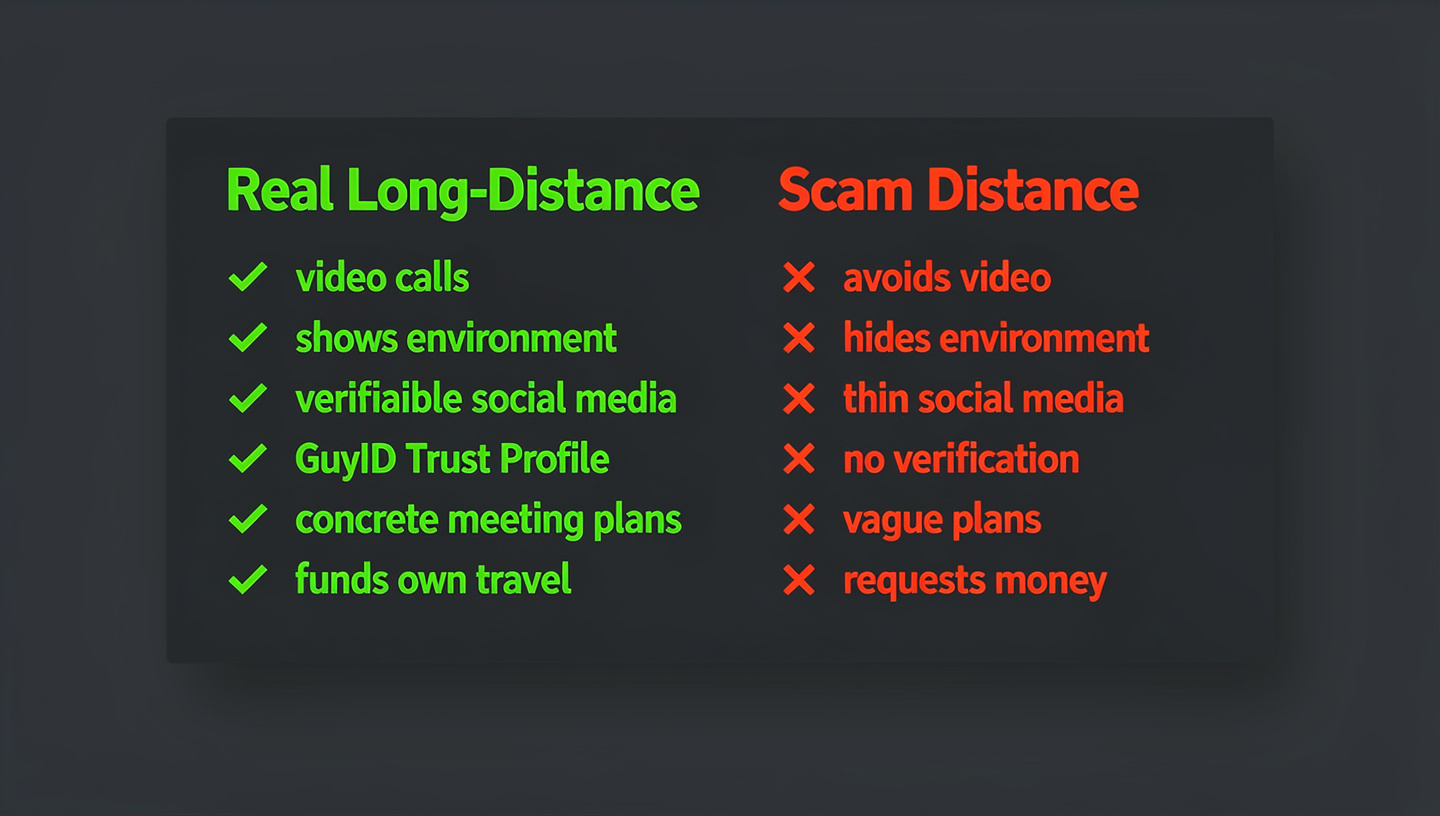
Real long-distance partners: video call regularly and willingly, share their physical environment (apartment tour, neighborhood walk, workplace mention), have verifiable social media presence in their claimed location, can provide a GuyID Trust Profile with government ID confirmed, have friends and family who can confirm their identity (social vouches), make concrete plans to meet with specific dates and logistics, and fund their own travel when the meeting happens.
Distance as Scam Cover
Scam-operated “long-distance” partners: avoid or limit video calls, never show their physical environment, have thin or absent social media in their claimed location, can’t provide identity verification, have no friends or family you can cross-reference, make perpetual vague plans that never materialize, and request money for travel that never happens.
The Decisive Test
“Share your GuyID Trust Profile so I can confirm your identity. Since we can’t meet in person yet, I need government-verified identity before we go further.”
A genuine long-distance partner cooperates — because they understand that distance makes verification more important, not less. A scam operator deflects, delays, or dismisses — because producing a government-verified identity is the one thing their operation can’t do. The request itself is the filter. The response is the answer.
Summary: Trust Verification When You Can’t Meet in Person
Long-distance dating safety requires the highest verification diligence in dating — because distance removes the definitive reality check (physical meeting) while amplifying every risk factor (emotional intensity, digital manipulation, extended extraction window). Romance scams are long-distance by design. Pig butchering operations are long-distance by default. Catfish sustain deception through distance indefinitely.
The framework: screen every match with GuyID free tools before engaging (60 seconds). Request a GuyID Trust Profile within the first week — critically important for long-distance, where government-verified identity is the substitute for in-person confirmation you can’t yet perform. Video call weekly with active deepfake testing. Monitor for distance-specific red flags. Maintain the absolute financial rule: never met in person → never send money. And when you finally meet, follow first date safety protocol — public place, friend informed, own transportation, brief initial meeting.
Long-distance dating can lead to genuine, lasting relationships. Millions of couples met online across distances and built real lives together. The key is maintaining verification proportional to risk — and the risk in long-distance dating is the highest of any configuration. The tools exist to manage it. The proactive approach works especially well for long-distance: verify first, invest emotionally second, meet in person third. In that order — never reversed.
GuyID Trust Profiles provide what long-distance dating lacks: government-verified identity + social vouching + Trust Tiers — checkable from any distance via one link. Plus 60+ free screening tools. Women check for free. Verify before investing emotionally.
Frequently Asked Questions: Long-Distance Dating Safety
Is long-distance dating safe?
Should I send money to a long-distance partner I haven’t met?
How can I verify someone’s identity from a distance?
What are the biggest red flags in long-distance dating?
How often should we video call in a long-distance relationship?
How do I know if the distance is real or a scam excuse?
What precautions should I take when finally meeting?

Founder, GuyID · Dating Safety Researcher · 13+ Years in Data Analytics
Ravishankar Jayasankar is the founder of GuyID, a consent-based dating trust verification platform. With 13+ years in data analytics and a deep focus on consumer trust, Ravi built GuyID to close the safety gap in digital dating. His research found that 92% of women report dating safety concerns — validating GuyID’s mission to make online dating safer through proactive, consent-based verification. GuyID offers government ID verification, social vouching, a Trust Tiers system, and 60+ free interactive safety tools.