

Free Tools
Catfish Probability Detector
Check whether a dating profile has suspicious identity or photo signals.
Dating Bio Red Flag Detector
Review a bio for scam, pressure, or trust-warning language.
Dating Safety Checklist
Use free GuyID tools before moving from chat to a real date.
Next step
Create your GuyID trust profile
Share consent-based trust signals before a date without turning the conversation into an interrogation.
Red flags are only useful if you see them clearly — and the brain’s infatuation bias is specifically designed to blur them. A structured assessment tool provides the structured framework that emotional investment alone can’t: an objective checklist you complete ABOUT your relationship rather than FROM inside the fog of attachment, giving you the external perspective that friends try to provide but that only you can fully evaluate. This guide provides a comprehensive relationship red flags worksheet covering five assessment dimensions, a scored relationship red flags quiz for quantified evaluation, and the action framework for what to do with your results — because recognizing red flags is only valuable if you act on the recognition rather than filing it under “things I’ll address later” while the patterns deepen.
NavigateTable of Contents15 sections
Why a Relationship Red Flags Worksheet Works Better Than Intuition Alone
Your intuition about your relationship is valuable — but it’s also compromised by the neurochemistry of attachment. According to the American Psychological Association’s research on cognitive biases in romantic attachment, the infatuation stage actively suppresses critical evaluation of your partner — reducing your brain’s threat detection sensitivity for the specific person you’re bonded to while maintaining it for everyone else. This means you can accurately identify red flags in your friend’s relationship while simultaneously minimizing identical patterns in your own. A structured checklist bypasses this bias by converting subjective feelings into objective behavioral indicators that can be evaluated with the same clarity you’d apply to someone else’s situation.
Research from the National Library of Medicine on structured assessment tools in relationship evaluation confirms that checklist-based evaluation produces more accurate relationship health assessments than unstructured self-reflection — because the checklist ensures that every relevant dimension is evaluated rather than only the dimensions that your attachment bias allows you to see. The areas you SKIP on an unstructured assessment are often the areas where the most significant red flags exist — precisely because your brain is protecting the attachment by avoiding the topics that would threaten it. A structured checklist doesn’t allow that selective avoidance: it presents every dimension equally and requires you to evaluate each one on its own merits regardless of what your attachment system would prefer you overlook.
The practical benefits of using a relationship red flags worksheet extend beyond the assessment itself. First, the worksheet creates a RECORD that you can revisit later — because your memory of the relationship will be distorted by whatever emotional state you’re in when you recall it (missing them makes you remember the good times; anger makes you remember only the bad), while the written assessment captures the balanced evaluation you made when you were deliberately trying to be objective. Second, the worksheet provides LANGUAGE for concerns you may have felt but couldn’t articulate — “I walk on eggshells” names an experience that many people endure without ever having the vocabulary to describe it to a friend, therapist, or even themselves. Third, the worksheet creates ACCOUNTABILITY: once you’ve documented the patterns in writing, the knowledge becomes harder to dismiss than the vague unease that existed before you put words to it. The abusive relationship quiz and emotionally abusive test provide complementary assessments that deepen the evaluation this worksheet initiates.
The Relationship Red Flags Worksheet: 5-Dimension Assessment
This relationship red flags worksheet evaluates your relationship across five dimensions that research has identified as the most reliable indicators of relational health or dysfunction. Each dimension targets a different aspect of the relationship: how you communicate, how equally you’re treated, how trustworthy your partner’s behavior is, how emotionally safe you feel, and whether the behavioral trajectory is improving or deteriorating over time. Evaluating all five dimensions simultaneously is important because dysfunction in one area often masks itself as a different problem — for example, what feels like a “communication issue” (Dimension 1) may actually be a respect issue (Dimension 2) where your partner doesn’t VALUE your perspective enough to engage with it honestly, or a trust issue (Dimension 3) where they avoid conversations that might reveal information they’re concealing.
For each statement, mark YES (this describes my relationship regularly), SOMETIMES (this happens occasionally but not as a consistent pattern), or NO (this doesn’t apply to my experience). Be honest with your PATTERN — not your best day or worst day but your typical experience across weeks and months of the relationship. If you find yourself wanting to qualify every answer with “but they’re not always like that” — notice that impulse without acting on it, because the qualifier itself may be the minimization pattern that this worksheet is designed to bypass.
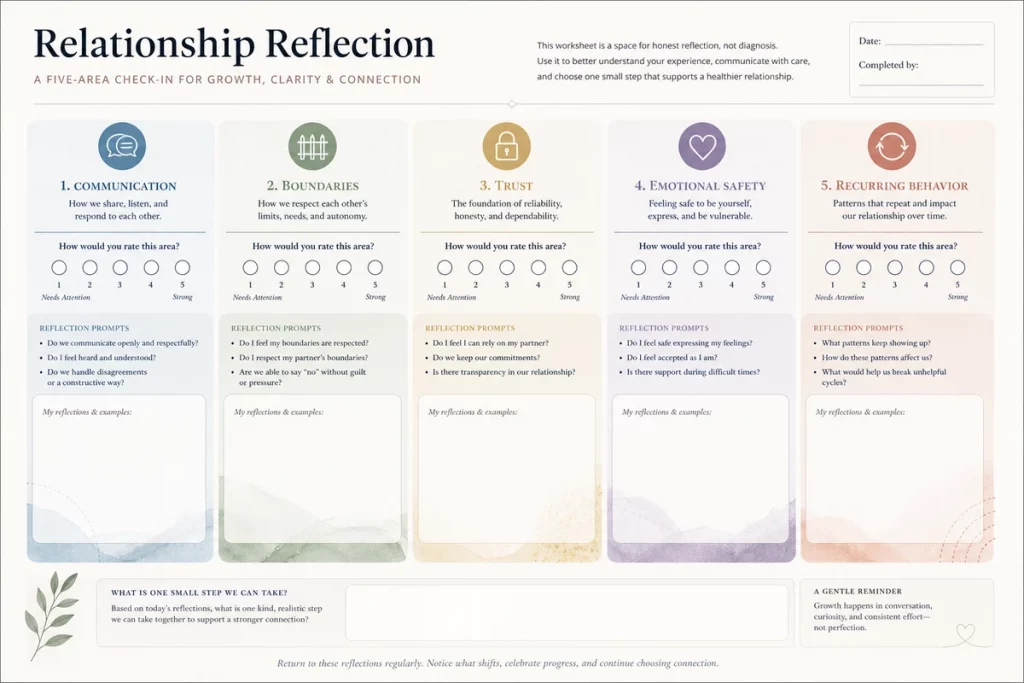
Dimension 1: Communication Patterns
☐ My partner uses anger, silence, or emotional withdrawal to end conversations they don’t want to have.
☐ When I raise a concern, the conversation shifts to MY behavior rather than addressing the original issue (deflection).
☐ My partner says things during arguments that they later deny or claim I misunderstood (gaslighting).
☐ I edit what I say to avoid triggering my partner’s negative reaction.
☐ Our conflicts rarely reach genuine resolution — they just end when one of us (usually me) gives in.
Dimension 2: Respect and Equality
☐ My partner makes decisions that affect both of us without consulting me.
☐ My opinions, feelings, or preferences are routinely dismissed or minimized.
☐ My partner criticizes my appearance, intelligence, competence, or character — even “jokingly.”
☐ I feel like I’m constantly trying to earn approval that is never sustainably given.
☐ My partner compares me unfavorably to others (exes, friends, colleagues, strangers).
Dimension 3: Trust and Transparency
Trust isn’t a feeling — it’s a behavioral assessment based on accumulated evidence of consistency between words and actions. This dimension of the relationship red flags worksheet evaluates whether your partner’s behavior provides the evidence that trust requires or whether the pattern produces the persistent uncertainty that erodes trust over time. Secrecy, lies, monitoring, and defensive reactions to reasonable questions all indicate a trust infrastructure that can’t support healthy partnership — regardless of how intensely the person claims to love you when the trust-testing moments aren’t happening.
☐ My partner is secretive about their phone, social media, schedule, or finances.
☐ I’ve discovered significant lies or omissions about their history, behavior, or current activities.
☐ My partner monitors my communications, location, or social media — framing it as concern.
☐ I feel I can’t trust what they tell me — their words and actions frequently don’t align.
☐ My partner reacts with anger or accusation when I ask reasonable questions about their behavior.
Dimension 4: Emotional Safety
Emotional safety is the foundation that every other relationship dimension rests on. Without feeling safe to be yourself, express your needs, and bring your authentic emotions to the relationship, no amount of chemistry, shared interests, or mutual attraction can produce a sustainable partnership. This dimension evaluates whether your partner’s presence creates safety or whether it produces the vigilance, self-monitoring, and anxiety that indicate your nervous system has classified the relationship as a threat rather than a haven. The emotional abuse symptoms guide provides additional depth on the specific indicators this dimension evaluates.
☐ I feel anxious about my partner’s mood when I come home or before checking my phone.
☐ I walk on eggshells to avoid triggering their anger, criticism, or withdrawal.
☐ My self-esteem has decreased since this relationship began.
☐ I feel isolated from friends or family — either through my partner’s discouragement or through the relationship consuming all my energy.
☐ The “good times” feel disproportionately good — almost addictively so — compared to what a stable relationship should feel like.
Dimension 5: Behavioral Patterns
This is the most diagnostically significant dimension of the relationship red flags worksheet because it evaluates TRAJECTORY rather than snapshot — not just what’s happening now but whether the pattern is improving, stable, or deteriorating over time. Relationships where concerning behaviors are decreasing (the person is genuinely learning and growing) have fundamentally different prognoses from relationships where concerning behaviors are increasing (the early restraint is giving way to the actual personality). Temporary change that reverts to baseline after confrontation is particularly diagnostic — because it proves the person CAN change (they demonstrated it) but WON’T sustain the change (it lasted only long enough to relieve the pressure), indicating that the harmful behavior is the default and the improvement is the performance rather than the reverse.
☐ My partner’s behavior has gotten worse over time — what started as occasional has become frequent.
☐ They promise to change after confrontation but the changes are temporary — lasting days or weeks before the pattern returns.
☐ My partner uses threats (leaving, self-harm, exposing secrets, involving others) to control my behavior.
☐ I’ve changed fundamental aspects of myself (appearance, friendships, career, hobbies, beliefs) to accommodate my partner’s preferences.
☐ I’ve considered leaving but feel unable to — due to fear, financial dependency, shame, or the belief that the relationship is the best I can do.
The Scored Relationship Red Flags Quiz
Convert your worksheet answers to numbers: YES = 2, SOMETIMES = 1, NO = 0. Add your total across all 25 statements.
| Score | Assessment | Recommended Action |
|---|---|---|
| 0-8 | Healthy — Normal imperfection without concerning patterns | Maintain the green flags; revisit this worksheet annually |
| 9-18 | Concerning — Patterns present that warrant attention and conversation | Address specific concerns directly; consider individual or couples therapy |
| 19-30 | Significant Red Flags — Multiple harmful patterns across dimensions | Individual therapy first; safety assessment if Dimension 4-5 scores are high |
| 31-50 | Severe — Pervasive dysfunction suggesting systematic harm | Contact the National Domestic Violence Hotline (1-800-799-7233) for safety planning guidance |
Dimension-specific interpretation matters. A total score of 15 distributed evenly across all five dimensions suggests moderate relational dysfunction that may be addressable through communication and therapy. A total score of 15 concentrated in Dimensions 4-5 (Emotional Safety and Behavioral Patterns) suggests a more serious dynamic where safety evaluation should precede relationship improvement attempts — because the patterns in these dimensions indicate that the relationship may not be safe enough for the honest communication that improvement requires. The abusive relationship quiz provides additional assessment depth specifically for situations where Dimension 4-5 scores are elevated.
Compare your results with complementary assessments. This relationship red flags worksheet evaluates partner behavior patterns. The emotionally abusive test evaluates abuse-specific indicators across five dimensions. The Stockholm syndrome quiz evaluates whether trauma bonding is affecting your ability to leave. The attachment style quiz evaluates whether your own attachment patterns are contributing to the dynamic. Together, these assessments provide a comprehensive picture that any single tool alone can’t complete — because relationship health is multidimensional and the most accurate evaluation uses multiple lenses rather than relying on any single framework.
What to Do With Your Relationship Red Flags Worksheet Results
Healthy range (0-8): Your relationship has normal imperfections without concerning patterns — which is genuinely good news worth celebrating rather than dismissing. No relationship is perfect, and a healthy score doesn’t mean the absence of ALL friction; it means the friction occurs within a framework of mutual respect, honest communication, and genuine care. Continue investing in the green flags that sustain healthy partnerships. Revisit this assessment annually or during major life transitions (new jobs, moves, parenthood, family stress) when relational patterns sometimes shift under pressure.
Concerning range (9-18): Patterns are present that deserve direct conversation and potentially professional support. Start by identifying WHICH dimensions scored highest — this tells you WHERE the dysfunction concentrates and therefore what kind of intervention is most appropriate. If Communication is the highest-scoring dimension, the intervention is communication skills work (potentially through couples therapy with a Gottman-trained therapist). If Trust is highest, the intervention requires honest conversation about the specific behaviors producing distrust — and the partner’s willingness to provide transparency rather than defensiveness in response to your concerns. If Respect is highest, the intervention requires evaluating whether the disrespect is a skill deficit (they don’t know how to show respect because it wasn’t modeled for them) or a value deficit (they don’t BELIEVE your perspective deserves equal weight to theirs) — because skill deficits are addressable through learning while value deficits are structural problems that rarely change through conversation alone.
The boundary-setting guide provides the framework for raising concerns productively: “I’ve noticed [specific behavior] happening regularly, and it’s affecting me. Can we talk about it?” A partner who responds with curiosity (“I didn’t realize — tell me more about what you’re experiencing”) and accountability (“You’re right, I have been doing that — I want to work on it”) is demonstrating that the concerning patterns are addressable through communication and mutual effort. A partner who responds with defensiveness (“You’re overreacting”), deflection (“What about what YOU do?”), or anger (“I can’t believe you’d accuse me of that”) is demonstrating that the patterns may be structural rather than incidental — and their response to your concern becomes additional data that the next reassessment of this relationship red flags worksheet will capture with even more clarity.
Significant red flags (19-30): Individual therapy BEFORE couples therapy — this distinction matters because at this score level, the patterns suggest systematic dynamics where couples therapy may inadvertently reinforce harm if the harmful partner uses sessions to gather information about your vulnerabilities, perform accountability without genuine change, or triangulate the therapist into their version of events. A trauma-informed individual therapist helps you see the full pattern clearly from outside the attachment fog, rebuild the self-trust that the relationship patterns may have eroded through gaslighting and deflection, and develop a plan that centers YOUR safety and wellbeing rather than the relationship’s preservation. Tell one trusted person about your assessment results — breaking the secrecy that the manipulation tactics guide identifies as a primary control mechanism in harmful relationships. Secrecy about the dynamics serves the harmful pattern; transparency about the dynamics serves your recovery.
Severe range (31-50): Safety planning is the priority — not because you must leave immediately but because having a plan ensures you CAN leave safely when you’re ready. Contact the National Domestic Violence Hotline (1-800-799-7233) for confidential, expert guidance on creating a safety plan that includes financial preparation (separate account, access to documents), housing identification (where you’ll go and who can help), communication planning (how to maintain safety during and after separation), and support coordination (who knows the plan and can assist when the time comes). Individual therapy with a trauma-informed practitioner provides the sustained professional support that navigating this score level requires — because the patterns this score reveals have typically been operating long enough to produce the trauma bonding and learned helplessness that make independent decision-making feel impossible even when the intellectual recognition of the harm is clear.
For future connections: Use this relationship red flags worksheet as an early-detection framework by evaluating new connections against the same 25 indicators at the 3-month mark — before the attachment deepens enough to activate the minimization bias that makes later assessment unreliable. The patterns this worksheet evaluates don’t appear at full intensity on date one; they emerge gradually through the early toxicity signs that are visible within the first three months if you know what to look for. Verify identity through GuyID’s free screening tools before investing emotionally. Share your Date Mode link through GuyID. Use the green flags guide alongside this worksheet to evaluate new connections through BOTH lenses — because the pattern recognition this assessment builds, combined with the verified trust that GuyID provides, creates a comprehensive framework that makes unhealthy patterns visible before they have the opportunity to deepen into the entrenched dynamics this worksheet was designed to assess.
How GuyID Helps
GuyID should appear when it is useful, not as a banner ad. A GuyID Trust Profile gives someone a portable way to share trust signals before a date, while identity verification and social vouching help turn vague profile claims into clearer next steps.
Useful next steps:
- Create a GuyID Trust Profile when you want a cleaner way to share verified trust signals.
- Use GuyID free tools and related guides when you need a checklist before meeting someone.
- Treat identity verification as confidence-building, not a guarantee.
- Use social vouching when you want context from people who already know the person.
- Sign up only when the extra trust layer helps the decision you are already trying to make.
Frequently Asked Questions
What are the biggest red flags in a relationship?
The most diagnostically significant red flags: you feel afraid of your partner’s reactions (emotional safety violation), their behavior has escalated over time (pattern progression), they use threats to control your behavior (coercion). You’ve become isolated from friends and family (isolation), and promises to change produce only temporary improvement before the pattern returns (performative accountability). These patterns predict the most serious relationship trajectories and warrant professional evaluation regardless of how many positive qualities the partner also demonstrates.
How many red flags are too many?
There’s no universal number — context matters. A single red flag in Dimension 5 (behavioral threats, inability to leave) may be more significant than several flags in Dimension 1 (communication friction). The assessment score provides calibrated guidance: 0-8 is healthy, 9-18 is concerning but potentially addressable, 19-30 suggests systematic patterns requiring professional evaluation, and 31-50 indicates safety-planning priority. The pattern matters more than the count — scattered minor concerns differ fundamentally from concentrated severe ones.
Should I show this worksheet to my partner?
If your score is in the healthy-to-concerning range (0-18) and your relationship includes open communication, sharing the worksheet could open a productive conversation: “I found this assessment helpful. Would you be willing to do it too so we can compare perspectives?” If your score is in the significant-to-severe range (19+), share with a therapist or the National Domestic Violence Hotline (1-800-799-7233) first — because sharing with a harmful partner may produce escalated control rather than genuine reflection.
Can a red-flags worksheet diagnose abuse?
No. A worksheet can organize observations, dates, and repeated patterns, but it cannot diagnose a person or determine your safety. Use it to support a conversation with someone you trust or a qualified service. Contact emergency or specialist support when threats, coercion, stalking, or violence are present.