Reader Briefing
Reader Briefing
Start here if you need a practical read on is your dating app safe? the 2026 security assessment: who should use verification, what signals to check, and what to do before moving from online interest to an in-person plan.
Who this is for
- People meeting someone from a dating app or social platform.
- Readers preparing for a first in-person date.
- Anyone checking identity, profile consistency, and trust signals.
- People trying to avoid romance scams, fake profiles, or pressure tactics.
You’ll learn
- How to evaluate identity signals without treating any single check as certainty.
- Which trust signals matter and how to weigh them together.
- How to spot inconsistencies, pressure, or behavior patterns that deserve caution.
- How to move from online conversation to a safer first meeting.
- Where GuyID tools fit into a quick pre-date screening workflow.
- When to slow down, ask for more context, or walk away.
Bottom line
Verification reduces uncertainty; it does not guarantee future behavior. Use a layered approach: confirm identity signals, compare profile consistency, ask for a short video call, keep early plans public, and slow down when someone pressures you to skip normal safety steps.
Key takeaways
- Identity verification improves confidence, not certainty.
- Patterns matter more than isolated incidents.
- Verify before meeting privately or sharing sensitive details.
- A short video call can reveal many inconsistencies.
- Pressure to skip reasonable safety steps is useful information.
Free Tools
Catfish Probability Detector
Check whether a dating profile has suspicious identity or photo signals.
Dating Bio Red Flag Detector
Review a bio for scam, pressure, or trust-warning language.
Dating Safety Checklist
Use free GuyID tools before moving from chat to a real date.
Next step
Create your GuyID trust profile
Share consent-based trust signals before a date without turning the conversation into an interrogation.
You trust dating apps with your real name, your photos, your location, your sexual orientation, your messaging history, and your behavioral patterns — but is your dating app safe enough to deserve that trust? The gap between the data dating apps collect and the security they provide to protect that data has grown wider every year since the first swipe. From data breaches exposing millions of users to location-tracking vulnerabilities that enable stalking, the question of whether your dating app safe practices match the sensitivity of the information you’ve shared is no longer hypothetical — it’s urgent. This guide evaluates the major platforms on actual security criteria, identifies the specific vulnerabilities most users don’t know about, and provides the practical framework for protecting yourself regardless of which app you use.
NavigateTable of Contents18 sections
What Dating Apps Actually Collect: The Data You’ve Already Shared
Before asking whether your dating app safe standards are being met, you need to understand what you’ve already given away. According to research from the National Library of Medicine on digital privacy in dating contexts, the average dating app user has shared the following categories of sensitive information — often without realizing the full scope:
Identity data: Full name, age, gender, sexual orientation, photos (which contain metadata including location coordinates if not stripped), and sometimes government ID (for apps with verification features). This identity package is sufficient for identity theft, stalking, or targeted harassment if exposed through a breach or exploited by a malicious match.
Location data: Your real-time GPS coordinates, your home neighborhood (inferred from login patterns), your workplace area (inferred from weekday location clustering), and your movement patterns. Some apps share precise distance from other users — which, through a technique called trilateration (measuring the distance from three known points), can pinpoint your exact home or workplace address within meters. This location data is the most physically dangerous category because it enables stalking by anyone with access to it, whether through the app’s legitimate features or through security vulnerabilities.
Behavioral data: Who you swipe right on (revealing your “type”), how quickly you respond to messages (revealing your interest level), what times you’re active (revealing your schedule), and your messaging content (revealing personal details, plans, and sometimes explicit material). Behavioral data creates a comprehensive psychological profile that is extraordinarily valuable to advertisers and extraordinarily dangerous if accessed by stalkers, romance scammers, or malicious third parties. This profile is more detailed than what most people share with their closest friends — and it’s held by companies whose primary business model is monetizing attention, not protecting privacy.
Social graph data: Your connections to other users, shared contacts (if you’ve connected Facebook or phone contacts), mutual friends, and relationship patterns. This social data can reveal affairs, closeted sexual orientation, or other sensitive relationship information that users would not voluntarily disclose — making its exposure through breaches or data-sharing agreements particularly harmful. The National Domestic Violence Hotline has specifically warned about how dating app data can be weaponized in technology-facilitated intimate partner abuse — where an abusive partner uses the target’s dating app data (accessed through shared devices, password theft, or monitoring software) to track, harass, or control them.
The cumulative risk. Individually, each data category represents manageable exposure. Combined, they create a comprehensive digital portrait more intimate than what most people share with close friends — your appearance, location, schedule, desires, communication patterns, and behavioral tendencies all available to any entity that accesses the database. Is your dating app safe enough to hold this portrait? The answer depends on security infrastructure that most users never evaluate because the onboarding process is designed to collect maximum data with minimum friction — which is the opposite of informed consent about the sensitivity of what you’re sharing.
Vulnerabilities That Make Your Dating App Unsafe
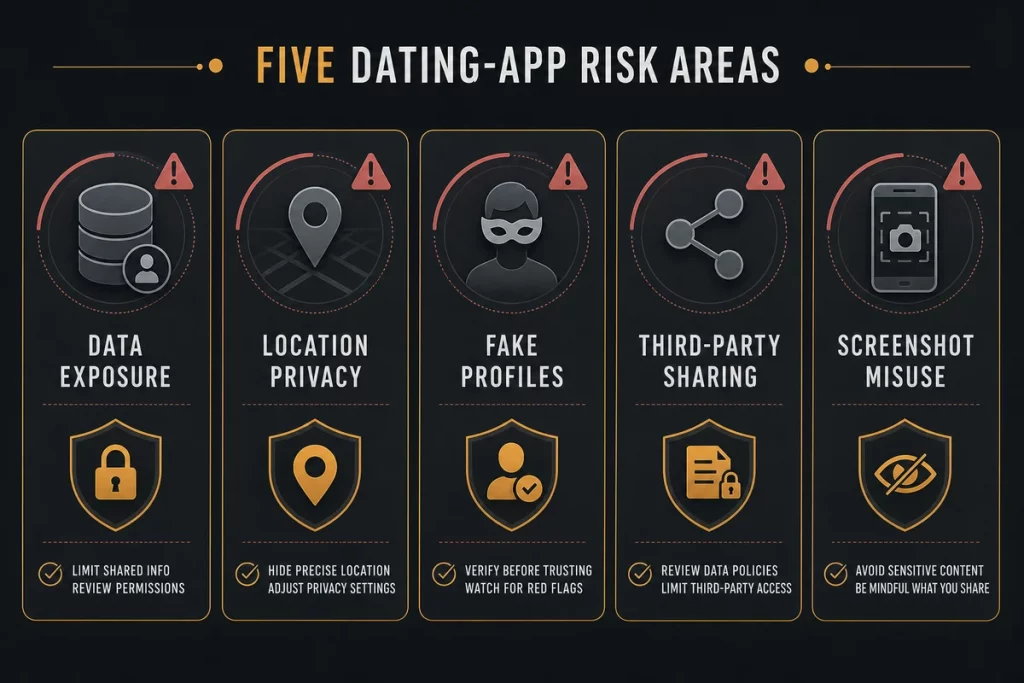
Data Breaches
Dating platforms have experienced breaches and privacy incidents involving account details, profile content, messages, and other sensitive data. Historical incidents do not by themselves establish the current security of any app, and no online service is immune from risk. Review the platform’s recent security disclosures, privacy policy, deletion controls, and response history before deciding what information to share. Keep the most sensitive identity evidence outside ordinary dating profiles.
Location Tracking Vulnerabilities
Multiple security researchers have demonstrated that distance-based matching features can be exploited to triangulate users’ exact locations through a technique called trilateration — measuring the distance from three known points to pinpoint a position. This vulnerability has been documented in apps including Tinder, Grindr, and Bumble (though most have implemented mitigations). The risk: a malicious user could determine your home or workplace address without you ever sharing it deliberately. The American Psychological Association’s research on technology-facilitated abuse identifies location tracking as one of the primary mechanisms by which intimate partner violence extends into digital domains.
Fake Profiles and Identity Fraud
Even apps with verification features struggle to eliminate fake profiles entirely. Romance scammers use stolen photos, fabricated identities, and AI-generated images to create convincing profiles that pass basic verification checks. The dating app safe question applies specifically here: does the platform’s verification actually confirm that the person behind the profile IS the person in the photos? Basic photo verification (selfie matching) is better than nothing but doesn’t prevent identity theft where the scammer has access to the real person’s photos. Government ID verification through independent platforms like GuyID provides the most robust identity confirmation currently available.
Third-Party Data Sharing
Multiple investigations have revealed that dating apps share user data with third-party advertisers, analytics companies, and data brokers — often including sexual orientation, dating preferences, and behavioral data that users would consider deeply private. A 2020 investigation by the Norwegian Consumer Council found that several major dating apps were sharing intimate user data with dozens of third-party companies without adequate user consent. The question isn’t just whether your dating app safe from hackers — it’s whether the app itself is treating your data with the sensitivity it deserves.
Screenshot and Content Exploitation
Messages, photos, and personal information shared within dating apps can be screenshotted and distributed without your consent. Some apps (like Snapchat) notify users of screenshots; most dating apps do not. This means any intimate photo, vulnerable message, or personal detail you share could be captured and used for blackmail, harassment, or public humiliation. The dating app safe assessment must include the recognition that ANYTHING you share within an app should be treated as potentially public — because the platform’s security controls end at the screenshot button.
Platform Safety Assessment: Major Dating Apps Reviewed
| Platform | Verification | Location Safety | Data Handling | Reporting | Overall |
|---|---|---|---|---|---|
| Tinder | Photo verification ✓ | Approximate distance only | Extensive third-party sharing | Robust reporting system | Moderate |
| Bumble | Photo verification ✓ | Approximate distance only | Better than average transparency | Strong reporting + blocking | Above Average |
| Hinge | Photo verification ✓ | Neighborhood-level only | Standard data practices | Good reporting tools | Above Average |
| OkCupid | No verification | City-level location | Detailed data collection | Basic reporting | Below Average |
| Match.com | Optional verification | ZIP code level | Standard data practices | Moderate reporting | Average |
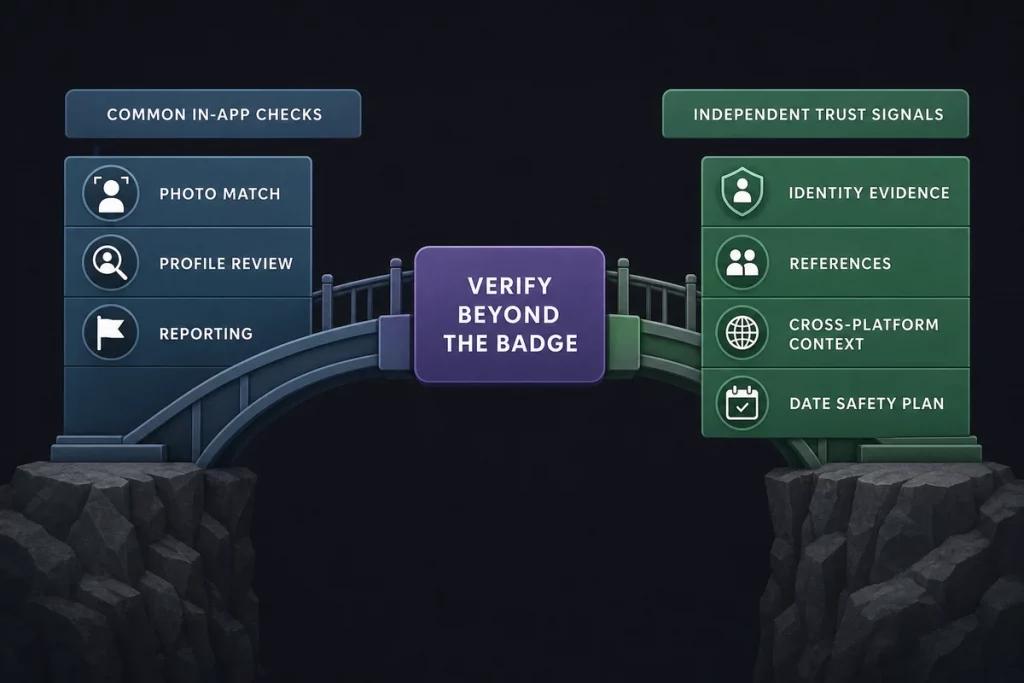
Important caveat: No dating app provides the level of identity verification that truly confirms someone is who they claim to be. Photo verification confirms that the person creating the profile matches the photos — but it doesn’t confirm their real name, their background, or their intentions. This is precisely the gap that GuyID fills: consent-based government ID verification that goes beyond photo matching to confirm actual identity — giving every user the ability to verify matches independently regardless of which platform they met on. The dating app safe question has a straightforward practical answer: use the app for discovery, use GuyID for verification.
Is Your Dating App Safe? How to Protect Yourself on Any Platform
Minimize the data you share. Don’t connect your Instagram, Spotify, or Facebook to your dating profile — each integration shares additional personal data that expands your vulnerability surface. Use your first name only. Avoid photos that reveal your workplace, home, or daily routine locations. Don’t share your phone number until you’ve verified the person’s identity through independent means. The less data you provide through the app, the less data exists to be exposed through breaches, screenshots, or malicious use by matches.
Use a unique email address. Create a dedicated email for dating apps that isn’t connected to your primary personal or professional accounts. If that email is compromised in a breach, the damage is contained rather than providing access to your broader digital identity. This simple but effective step — which takes 2 minutes — eliminates one of the most common identity-linking vectors that data breaches exploit.
Limit precise location when practical. Use the broadest setting that still supports the features you choose. Where the operating system allows it, consider granting location only while using the app, and review permissions after app updates. Some safety or accessibility needs may require different settings, so understand the tradeoff rather than following a universal rule.
Reverse image search every match before meeting. Upload their profile photos to Google Images or TinEye to check whether the photos appear elsewhere under a different name — which is the primary indicator of a stolen-photo catfish profile. This takes 30 seconds per match and eliminates the most common form of dating app fraud. Our comprehensive romance scammer detection guide provides the complete pre-date verification checklist.
Verify identity through GuyID before meeting in person. Government ID verification confirms that the person you’ve been messaging is a real, verified individual — not a stolen identity, not a catfish, and not a scammer operating behind a fabricated profile. Share your Date Mode link and ask your match to share theirs. A person who refuses independent identity verification before meeting is providing information about their transparency — and that information is worth taking seriously.
Report suspicious behavior aggressively. Every major dating app has reporting tools — use them. Report fake profiles, scam attempts, harassment, and any behavior that feels unsafe. Reporting doesn’t just protect you; it improves the platform for every user by training the app’s algorithms to identify and remove harmful accounts. Under-reporting is one of the primary reasons dating apps remain less safe than they could be — because undetected harmful accounts continue operating when users don’t report them.
Use video calls before meeting in person. A five-minute video call confirms that the person matches their photos in real time — eliminating the most basic catfishing scenarios. It also provides behavioral data (how they communicate live, whether their personality matches their messaging persona) that text-based communication can’t provide. Consider this a mandatory pre-date step: anyone who refuses a brief video call before an in-person meeting is providing data about their transparency that should factor into your dating app safe assessment of that specific individual.
Meet in public for the first several dates. This guideline appears in every dating safety resource because it remains the single most effective physical safety measure. Public venues provide witnesses, staff intervention capability, and the social accountability that prevents most harmful behavior. Don’t accept invitations to private locations until trust has been established through multiple in-person meetings, identity verification, and the consistent demonstration of the green flags that indicate genuine trustworthiness. Our first date guide provides the complete safety framework for initial meetings.
Maintain transportation independence. Drive yourself or use rideshare so you can leave on your own terms at any point. Accepting a ride from someone you met through an app — regardless of how well the date is going — removes your ability to exit independently, which is a boundary worth maintaining throughout early dating. Share your rideshare trip details with a friend for additional accountability.
Trust your instincts even when you can’t explain them. If something feels wrong — a vague unease, an inconsistency you can’t quite articulate, a behavioral pattern that triggers discomfort — trust it. Your nervous system processes threat signals faster than your conscious mind can articulate them, and the “gut feeling” that something is off is your subconscious pattern recognition flagging data that your analytical mind hasn’t caught up to yet. In the dating app safe context, erring on the side of caution has minimal cost (one missed connection) while ignoring instincts has potentially significant cost (physical, emotional, or financial harm).
Why Third-Party Verification Is the Missing Piece
Dating platforms balance safety controls with privacy, cost, accessibility, user experience, and business objectives. A photo check or profile review can reduce some abuse without proving identity, intentions, relationship status, or future behavior. Treat native verification as one signal, read what the badge actually represents, and use independent context before moving a connection into a private or high-trust setting.
Third-party verification — specifically GuyID’s consent-based government ID verification — resolves this conflict because it operates independently of the dating platform’s commercial incentives. When you verify through GuyID, the verification confirms your actual identity through government documentation rather than just matching a selfie to a profile photo. The verification is portable across all dating platforms: verify once, use everywhere. And the consent-based model means YOU control your verification — sharing it when you choose, with whom you choose, for the purpose you choose.
The Trust Score system adds additional layers beyond ID verification: social vouching from people who know you, behavioral consistency tracking, and progressive trust-building that produces a comprehensive trust profile far more robust than any single verification check. The result: every match who has a GuyID Trust Profile has been verified at a level that no dating app’s native features currently provide — transforming the dating app safe question from “does this platform protect me?” to “has this specific PERSON been independently verified?”
For first dates, share your Date Mode link — a shareable verification page that demonstrates your verified status and provides your date with the confidence that you are who you claim to be. The green flags guide identifies transparency and verification willingness as among the strongest positive indicators when evaluating potential partners — because someone willing to verify their identity is someone with nothing to hide.
How GuyID Helps
GuyID should appear when it is useful, not as a banner ad. A GuyID Trust Profile gives someone a portable way to share trust signals before a date, while identity verification and social vouching help turn vague profile claims into clearer next steps.
Useful next steps:
- Create a GuyID Trust Profile when you want a cleaner way to share verified trust signals.
- Use GuyID free tools and related guides when you need a checklist before meeting someone.
- Treat identity verification as confidence-building, not a guarantee.
- Use social vouching when you want context from people who already know the person.
- Sign up only when the extra trust layer helps the decision you are already trying to make.
Frequently Asked Questions
Which dating app is the safest?
Bumble and Hinge currently lead among major platforms for safety features — including photo verification, robust reporting systems, and better-than-average data transparency. However, no dating app provides the level of identity verification that truly confirms someone is who they claim to be. For comprehensive verification, supplement any dating app with GuyID’s free government ID verification tools — which confirm actual identity rather than just matching a selfie to profile photos.
Can dating apps track my location?
Many dating apps use location to support nearby matching, but the permission model and displayed precision vary. Review the app’s explanation and your phone’s permission settings. Consider approximate or while-in-use access where those options meet your needs, avoid sharing home or workplace details in profile content, and reassess permissions after updates.
Do dating apps sell my data?
Multiple investigations have documented dating apps sharing user data — including sexual orientation, dating preferences, and behavioral patterns — with third-party advertisers and data brokers. While apps frame this as “sharing for service improvement” rather than “selling,” the practical result is that your intimate data reaches companies you never consented to engage with. Read privacy policies carefully, minimize the data you share, and use dedicated email addresses for dating app accounts to limit cross-platform data linking.
How do I spot fake profiles on dating apps?
Red flags include: professionally shot photos that look like stock images, very limited photo variety (1-2 photos only), profiles with minimal text, rapid escalation to off-platform communication, and reluctance to video call. Use reverse image search on profile photos — if they appear on other sites under different names, the profile is fraudulent. The romance scammer guide provides the complete detection framework.
Is it safe to share my phone number on a dating app?
Not until you’ve verified the person’s identity independently. Your phone number can be used to find your full name, address, social media profiles, and other personal information through reverse lookup services. Keep communication within the dating app until you’ve met in person at least once AND verified their identity through GuyID or equivalent independent verification. If you must share a number before meeting, consider using a Google Voice or secondary number that isn’t connected to your primary identity.