

Reader Briefing
Reader Briefing
Start here if you need a practical read on transactional relationships: when love becomes a ledger: who should use verification, what signals to check, and what to do before moving from online interest to an in-person plan.
Who this is for
- Readers preparing for a first in-person date.
- Anyone checking identity, profile consistency, and trust signals.
- Online daters improving conversations, profiles, or match screening.
You’ll learn
- How to evaluate identity signals without treating any single check as certainty.
- Which trust signals matter and how to weigh them together.
- How to move from online conversation to a safer first meeting.
- Where GuyID tools fit into a quick pre-date screening workflow.
- How to compare options using practical safety and trust criteria.
- When to slow down, ask for more context, or walk away.
Bottom line
Verification reduces uncertainty; it does not guarantee future behavior. Use a layered approach: confirm identity signals, compare profile consistency, ask for a short video call, keep early plans public, and slow down when someone pressures you to skip normal safety steps.
Key takeaways
- Identity verification improves confidence, not certainty.
- Verify before meeting privately or sharing sensitive details.
- A short video call can reveal many inconsistencies.
- Pressure to skip reasonable safety steps is useful information.
- Use GuyID tools to turn vague concerns into specific checks.
Free Tools
Catfish Probability Detector
Check whether a dating profile has suspicious identity or photo signals.
Dating Bio Red Flag Detector
Review a bio for scam, pressure, or trust-warning language.
Dating Safety Checklist
Use free GuyID tools before moving from chat to a real date.
Next step
Create your GuyID trust profile
Share consent-based trust signals before a date without turning the conversation into an interrogation.
“I did this for you, so you owe me that.” “I paid for dinner three times — when are you going to step up?” “I supported you through your crisis, and now you won’t even do this one thing for me.” When relationships transactional patterns dominate, love stops being about genuine care and becomes an accounting system — every gesture tracked, every favor recorded, every imbalance weaponized. Transactional dynamics aren’t always obvious because they often disguise themselves as fairness: who could argue against wanting things to be “equal”? But there’s a critical difference between healthy reciprocity (both people contributing generously because they want to) and relationships transactional scorekeeping (both people tracking contributions because they feel they have to). This guide explains what makes relationships transactional, why the pattern is so destructive, and how to build the genuine generosity-based partnership that transactional dynamics prevent.
NavigateTable of Contents24 sections
What Makes Relationships Transactional?
Relationships transactional dynamics operate on an exchange model: every action has a corresponding expected return, every favor creates a debt, and every imbalance requires correction. The underlying logic — “I give to get” — transforms genuine care into a currency system where nothing is freely given and everything carries an implicit price tag. According to the American Psychological Association’s research on exchange theory in relationships, transactional patterns predict lower satisfaction, higher conflict, and faster relationship deterioration than generosity-based patterns — because the constant monitoring of fairness produces the very resentment it’s designed to prevent.
The transactional mindset differs from healthy relationship awareness in a crucial way: healthy partners notice patterns of contribution and address imbalances through communication (“I’ve been feeling like I’m carrying more of the household load — can we redistribute?”). Relationships transactional patterns skip the communication and go straight to scorekeeping — maintaining a mental ledger that tracks every contribution, every sacrifice, and every perceived slight, then deploying that ledger as leverage when the balance tips unfavorably. The ledger never balances, because each partner counts their own contributions in full while discounting their partner’s — a cognitive bias that ensures the transactional system generates perpetual dissatisfaction rather than the fairness it claims to pursue.
Understanding what makes relationships transactional requires recognizing that the behavior often masquerades as reasonable expectations. “I want things to be fair” sounds healthy. “I want us both to contribute equally” sounds mature. But when “fair” means “I’m tracking everything and you owe me,” and “equally” means “your contributions must match mine in my subjective assessment or I’ll withhold,” the reasonable language conceals a dynamic that prevents genuine intimacy — because intimacy requires giving freely, and transactional systems ensure nothing is ever free.
10 Signs Your Relationship Has Become Transactional
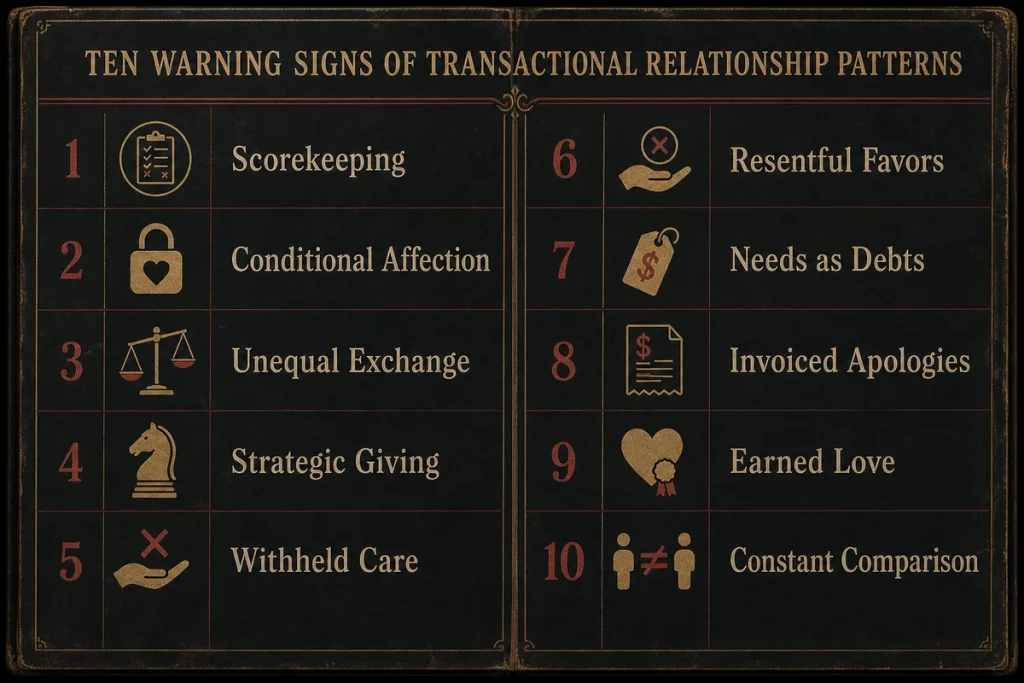
1. Scorekeeping Is Constant
One or both partners may maintain a running tally of contributions: “I cooked three nights this week,” “I planned our last vacation,” or “I’ve initiated intimacy most of the time lately.” Tracking is not inherently unhealthy when it supports practical planning or exposes a real imbalance. It becomes transactional when the tally is used to establish leverage, demand repayment, or turn care into a debt.
2. Affection Has Conditions
Warmth, attention, physical affection, and emotional engagement are withdrawn when the transactional “balance” is perceived as unfavorable — and restored when the partner “pays up.” This conditional affection operates as the emotional currency of relationships transactional dynamics: love isn’t freely given; it’s dispensed in proportion to what’s been received. If this pattern sounds like emotional manipulation — it is. Conditional affection is a control tool regardless of whether the person deploying it recognizes it as such.
3. Favors Come With Strings
“I helped you move, so you need to come to my work event.” “I listened to your problems all week, so you owe me a weekend with my friends without complaining.” When favors are performed with the explicit or implicit expectation of specific reciprocation, they’re not favors — they’re investments with expected returns. Genuine generosity doesn’t attach conditions; it gives because giving is its own reward. When every “nice thing” arrives with invisible strings, the relationship operates as a contract rather than a connection.
4. Past Contributions Are Weaponized
“After everything I’ve done for you…” can convert past generosity into a debt during an unrelated disagreement. One instance may reflect frustration or poor communication; a repeated pattern of invoking favors to control decisions is more concerning. Focus on whether care is freely chosen, whether expectations were discussed, and whether either person can say no without punishment.
5. Financial Tracking Is Granular
“I paid last time, so can you cover this one?” may be a reasonable request when partners are coordinating shared costs. The pattern becomes harmful when exact comparisons are used to shame, control, or demand emotional repayment. Discuss budgets, income differences, and expectations directly instead of treating equal dollar amounts as the only definition of fairness.
6. Resentment Builds Over Perceived Imbalances
One partner feels they’re giving “more” — more effort, more emotional labor, more financial contribution, more time — and the resentment about this perceived imbalance poisons interactions that have nothing to do with the imbalanced area. The resentment isn’t addressed through direct conversation; it leaks into unrelated conflicts, producing arguments about dishes that are actually about perceived unfairness in the entire relational structure.
7. Giving Feels Obligatory Rather Than Generous
In healthy relationships, giving produces joy — you WANT to cook for your partner, support their goals, or plan something special because their happiness contributes to yours. In relationships transactional dynamics, giving feels like a tax — obligatory, monitored, and performed to maintain the balance rather than because you genuinely want to. When you catch yourself giving with resentment rather than pleasure, the transactional pattern has replaced genuine generosity with reluctant duty.
8. Needs Are Framed as Debts
“I need you to attend this family dinner” becomes “You owe me — I went to YOUR family dinner last month.” Legitimate needs are reframed as withdrawals from the transactional account rather than genuine requests for support. This reframing makes every need feel transactional because every request carries the implicit reminder that compliance creates a future debt while refusal creates a current violation of “fairness.”
9. Apologies Come With Invoices
“I’m sorry I was late — but you were late last week too.” “I apologize for forgetting, but you forgot our anniversary last year.” The apology is immediately offset by a counter-charge that neutralizes accountability. In relationships transactional patterns, genuine accountability is impossible because every acknowledgment of fault is immediately balanced against the partner’s fault history — producing a net-zero where neither person actually takes responsibility for anything.
10. Love Feels Earned Rather Than Given
The fundamental marker of relationships transactional dynamics: the persistent sense that love, attention, and care must be earned through sufficient contribution rather than existing as the baseline of the relationship. If you feel like your partner’s love is contingent on your output — that a week of insufficient contribution would result in withdrawal of affection — you’re experiencing the defining feature of a transactional relationship. Love in healthy relationships is the foundation; in transactional ones, it’s the reward.
Why People Develop Transactional Relationship Patterns
Childhood modeling. If you grew up in a household where love WAS conditional — where parental affection correlated with achievement, obedience, or performance — transactional relating is the only model you absorbed. The child who learned “I’m loved when I’m useful” becomes the adult who believes all love operates on an exchange basis, because they’ve never experienced the alternative. This childhood origin doesn’t excuse the pattern in adult relationships — but it contextualizes it in ways that inform the therapeutic work required to break it.
Prior relationship betrayal. People who gave generously in previous relationships and were exploited — by partners who took without reciprocating, by narcissistic partners who consumed their generosity without returning it, or by players who accepted their investment without genuine commitment — often develop transactional patterns as self-protection. “I won’t give more than I receive” is a reasonable-sounding boundary that actually prevents the vulnerability genuine connection requires. The bad breakup recovery guide addresses how unprocessed betrayal produces protective patterns that damage subsequent relationships.
Anxious attachment. Anxiously attached individuals often develop transactional monitoring as an anxiety-management strategy: “If I can track whether they’re giving as much as I am, I can assess whether they’re going to leave.” The scorekeeping provides an illusion of control in a dynamic that feels inherently uncertain. The problem: the monitoring itself produces the relational friction that increases the probability of the very outcome the anxious person fears, creating a self-fulfilling cycle where protective vigilance drives partners away.
Cultural messaging. Pop psychology and social media relationship content frequently reinforce transactional framing: “know your worth,” “don’t settle for less than you deserve,” “if he wanted to, he would.” While these messages contain valid kernels about not tolerating exploitation, their oversimplified application produces a consumer mentality toward relationships — evaluating partners based on what they provide rather than who they are. The cultural shift from “relationships require mutual investment and grace” toward “relationships should deliver specific returns on my emotional investment” has normalized the transactional mindset that makes genuine intimacy harder to achieve.
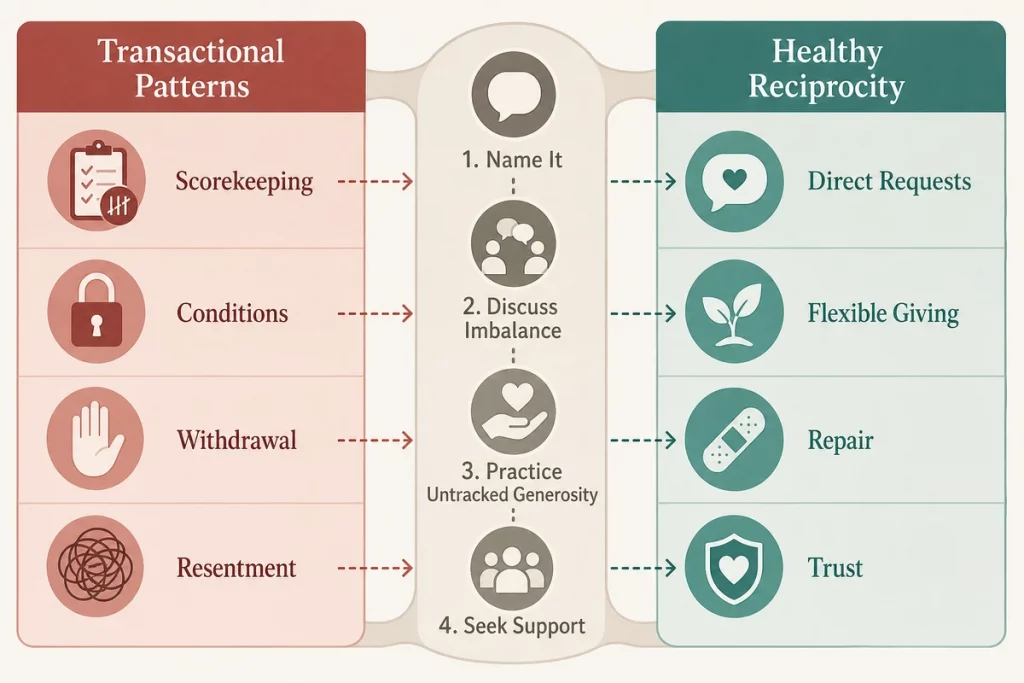
Relationships Transactional vs. Healthy Reciprocity
| Transactional | Healthy Reciprocity |
|---|---|
| Tracks every contribution precisely | Trusts that both people are contributing in their own ways |
| “I did X, so you owe me Y” | “I did X because I wanted to” |
| Imbalance produces resentment silently | Imbalance is addressed through direct conversation |
| Love is the reward for contribution | Love is the foundation; contribution flows from it |
| Giving feels like obligation | Giving feels like expression of care |
| Each person focuses on what they GIVE | Each person focuses on what they RECEIVE (with gratitude) |
| Apologies are offset by counter-charges | Apologies are genuine and standalone |
The critical distinction is purpose and flexibility. Healthy reciprocity allows partners to discuss real imbalances without converting every act into leverage. Transactional patterns are more rigid: contributions are monitored because trust is low and repayment is expected. Scorekeeping can intensify resentment when each person experiences effort differently. The boundary-setting guide provides a framework for discussing genuine imbalances directly.
The Damage Transactional Dynamics Cause
Intimacy dies. Genuine intimacy requires giving freely — sharing vulnerability, offering support, expressing love without expectation of specific return. Relationships transactional patterns eliminate free giving by attaching conditions to everything, which means intimacy — which by definition cannot be conditional — cannot exist within the transactional framework. The relationship may look functional from the outside (both people contribute, conflicts are “resolved” through negotiation), but the interior experience is contractual rather than intimate: two people managing an arrangement rather than sharing a life.
Resentment becomes permanent. The transactional ledger never balances because each partner’s subjective valuation of contributions differs. She counts emotional labor; he doesn’t recognize it as labor. He counts financial provision; she takes it for granted. The permanent imbalance produces permanent resentment — a low-grade relational poison that accumulates over years until it corrodes the connection entirely. The deflection guide and stonewalling guide describe the communication breakdowns that transactional resentment typically produces.
Generosity becomes impossible. In a transactional system, every generous act is suspected of having ulterior motives — because within the system, it does. “Why are they being so nice? What do they want?” The suspicion prevents the receiver from enjoying the gesture and prevents the giver from experiencing the joy of genuinely free generosity. Over time, both partners stop trying to be generous because generosity is either weaponized (stored for future deployment) or suspected (interpreted as manipulative). The relationship settles into a minimum-viable-contribution dynamic where both people do just enough to avoid triggering the other’s scorekeeping alarm — which is the exact opposite of the abundant, overflowing care that characterizes deeply satisfying partnerships.
Breaking the Transactional Pattern
Name the pattern to your partner. “I’ve noticed that we’ve been tracking who does what — and it’s making both of us resentful rather than generous. I want us to stop keeping score and start trusting that we’re both giving our best.” Naming the pattern as a shared dynamic (not accusing the partner of being transactional while positioning yourself as generous) creates collaborative awareness rather than defensive conflict.
Practice untracked generosity. Deliberately do something for your partner without recording it, mentioning it, or expecting acknowledgment. Cook their favorite meal, handle a chore they hate, plan something thoughtful — and then let it go. Don’t add it to the mental ledger. Don’t bring it up later. The practice of genuinely free giving — repeated consistently — rewires the transactional neural pathways by providing the direct experience that giving without expectation produces its own reward through the joy of making someone you love happy.
Address imbalances directly, not through ledgers. When a genuine imbalance exists (one person IS carrying more load), address it through direct communication: “I’m feeling overwhelmed by the household responsibilities and I need us to redistribute.” This is NOT transactional — it’s healthy boundary-setting that addresses the structural issue rather than accumulating resentment about it. The difference: transactional patterns store imbalance as leverage; healthy communication resolves imbalance through conversation.
Therapy for entrenched patterns. When transactional dynamics have operated for years, both partners have developed deeply reinforced monitoring habits that self-help approaches may not penetrate. Couples therapy — specifically Emotionally Focused Therapy (EFT), which targets the attachment insecurity underlying most transactional patterns — provides the structured intervention that helps both partners understand WHY they monitor (usually fear of exploitation or abandonment), develop trust in the other’s good faith, and practice the generosity-based relating that replaces scorekeeping with genuine care. The National Domestic Violence Hotline can provide referrals if the transactional patterns have escalated into emotional manipulation or control.
For new relationships. Watch for transactional patterns early — they’re easier to address in the first months than after years of entrenchment. A partner who tracks contributions on the third date will maintain a comprehensive ledger by year three. Look for green flags around generosity: does this person give freely, express gratitude for your contributions, and address imbalances through conversation rather than withdrawal? Use GuyID’s free screening tools for identity verification and share your Date Mode link through GuyID — because trust-verified connections create the security foundation that makes generosity-based relating possible from the start.
How GuyID Helps
GuyID should appear when it is useful, not as a banner ad. A GuyID Trust Profile gives someone a portable way to share trust signals before a date, while identity verification and social vouching help turn vague profile claims into clearer next steps.
Useful next steps:
- Create a GuyID Trust Profile when you want a cleaner way to share verified trust signals.
- Use GuyID free tools and related guides when you need a checklist before meeting someone.
- Treat identity verification as confidence-building, not a guarantee.
- Use social vouching when you want context from people who already know the person.
- Sign up only when the extra trust layer helps the decision you are already trying to make.
Frequently Asked Questions
What does it mean when relationships are transactional?
Relationships transactional means the partnership operates on an exchange model where every action has an expected return, every favor creates a debt, and contributions are tracked rather than freely given. Love, attention, and care are conditional — dispensed in proportion to what’s received rather than given as the baseline of the connection. The hallmarks: scorekeeping, conditional affection, weaponized past contributions, and the persistent sense that love must be earned rather than given.
Is it bad to want fairness in a relationship?
No — wanting fairness is healthy. The distinction: addressing imbalances through direct conversation (“I need us to share this load more evenly”) is healthy reciprocity. Tracking contributions on a mental ledger and deploying the tally during arguments is transactional scorekeeping. Both involve awareness of fairness — but one addresses imbalance constructively while the other accumulates it as resentment and leverage. Fairness pursued through communication builds connection; fairness pursued through monitoring erodes it.
How do I stop being transactional in my relationship?
Name the pattern collaboratively with your partner. Practice untracked generosity (give without recording or expecting return). Address genuine imbalances through direct conversation rather than scorekeeping. Explore the underlying insecurity that drives the monitoring — often fear of exploitation rooted in childhood or previous relationships. Consider Emotionally Focused Therapy (EFT) if the pattern is entrenched. The shift from transactional to generous relating is a practice, not a decision — it requires consistent effort over months, not a single conversation.
Can a transactional relationship become healthy?
Yes — when both partners recognize the pattern, understand its origins, and commit to replacing scorekeeping with trust-based generosity. Couples therapy (particularly EFT) has the strongest evidence base for this transformation because it addresses the attachment insecurity that drives most transactional monitoring. The key: both partners must participate. One person can’t unilaterally transform a transactional dynamic — because giving freely while the other continues scorekeeping produces exploitation, not health.
How do I spot transactional tendencies in someone I’m dating?
Watch for repeated patterns: emphasizing date spending to create obligation, tracking initiation as leverage, bringing up old favors during unrelated disputes, or withdrawing affection when repayment is not provided. Any one comment needs context; the concern is a persistent exchange system that limits free choice. Use the green flags guide to compare those patterns with gratitude, direct requests, and flexible reciprocity.