

Reader Briefing
Reader Briefing
Start here if you need a practical read on stonewalling in a relationship: how to recognize and address it: who should use verification, what signals to check, and what to do before moving from online interest to an in-person plan.
Who this is for
- Readers preparing for a first in-person date.
- Anyone checking identity, profile consistency, and trust signals.
- Online daters improving conversations, profiles, or match screening.
You’ll learn
- How to evaluate identity signals without treating any single check as certainty.
- Which trust signals matter and how to weigh them together.
- How to move from online conversation to a safer first meeting.
- Where GuyID tools fit into a quick pre-date screening workflow.
- When to slow down, ask for more context, or walk away.
- How to turn the article’s advice into a concrete next step.
Bottom line
Verification reduces uncertainty; it does not guarantee future behavior. Use a layered approach: confirm identity signals, compare profile consistency, ask for a short video call, keep early plans public, and slow down when someone pressures you to skip normal safety steps.
Key takeaways
- Identity verification improves confidence, not certainty.
- Verify before meeting privately or sharing sensitive details.
- A short video call can reveal many inconsistencies.
- Pressure to skip reasonable safety steps is useful information.
- Use GuyID tools to turn vague concerns into specific checks.
Free Tools
Catfish Probability Detector
Check whether a dating profile has suspicious identity or photo signals.
Dating Bio Red Flag Detector
Review a bio for scam, pressure, or trust-warning language.
Dating Safety Checklist
Use free GuyID tools before moving from chat to a real date.
Next step
Create your GuyID trust profile
Share consent-based trust signals before a date without turning the conversation into an interrogation.
Stonewalling in a relationship doesn’t announce itself with a single dramatic moment — it erodes connection gradually, one refused conversation at a time, until the partner being stonewalled stops trying to communicate and the relationship exists in a state of functional silence. If your attempts to discuss problems, express needs, or resolve conflicts are consistently met with shutdown, withdrawal, or the impenetrable blankness of a partner who has left the conversation without leaving the room, you’re experiencing stonewalling in a relationship — one of the most reliable predictors of relationship failure identified in 40+ years of couples research. This guide builds on our stonewalling meaning guide with the specific relational dynamics, long-term consequences, and practical intervention strategies for couples where stonewalling has become an established pattern.
NavigateTable of Contents14 sections
How Stonewalling in a Relationship Develops
Stonewalling in a relationship rarely appears overnight — it develops through a predictable escalation that John Gottman’s research at the University of Washington documented across thousands of couples:
Stage 1: Unresolved conflicts accumulate. Small disagreements go unaddressed because the couple lacks effective conflict resolution skills. Resentment builds beneath the surface as issues stack up without resolution. Neither partner has the tools to process disagreement constructively, so disagreements are either fought destructively (criticism, contempt) or avoided entirely. This accumulation creates the conditions for stonewalling in a relationship because each unresolved issue adds emotional weight to subsequent conversations — making every new conflict feel disproportionately overwhelming because it carries the backlog of everything that came before.
Stage 2: Conflicts become overwhelming. As accumulated resentment makes every conversation feel heavier, one partner (statistically, more often the male partner) begins experiencing Diffuse Physiological Arousal (DPA) during conflict — heart rate exceeding 100 BPM, cortisol flooding, and prefrontal cortex shutdown. The body’s threat-detection system interprets the conversation as dangerous, and the nervous system’s protective response is withdrawal. The first instances of withdrawal often occurs here — not as deliberate strategy but as physiological overwhelm that the person may not fully understand or control.
Stage 3: Stonewalling becomes the default. Without intervention, the overwhelm-driven withdrawal becomes habitual — the brain learns that shutdown reduces the distressing physiological arousal, reinforcing the behavior through negative reinforcement (the discomfort stops when they withdraw). What began as occasional overwhelm solidifies into the primary conflict response. The pattern at this stage operates on autopilot: the mere anticipation of conflict — even imagining a difficult conversation — triggers the withdrawal response before the conversation even begins. According to the American Psychological Association’s research on habitual behavioral patterns, behaviors that are reinforced through negative reinforcement mechanisms become extremely resistant to voluntary change without structured intervention — which is why “just talk to me” is ineffective once stonewalling has reached the habitual stage.
Stage 4: The partner adapts by suppressing their needs. The pursued partner — exhausted from attempting conversations that produce only shutdown — gradually stops trying. They learn that expressing needs leads to rejection, so they suppress their needs to avoid the stonewalling response. This adaptation superficially feels like “peace” and “resolution” to the stonewaller (the conflicts stop) but is actually resignation — the relationship has entered a state of profound functional disconnection where both partners coexist without any genuine emotional engagement or meaningful communication. Stonewalling in a relationship at this final stage has achieved what it was designed (physiologically, not consciously) to achieve: the elimination of the distressing stimulus (conflict). But it has eliminated the stimulus by eliminating the connection itself.
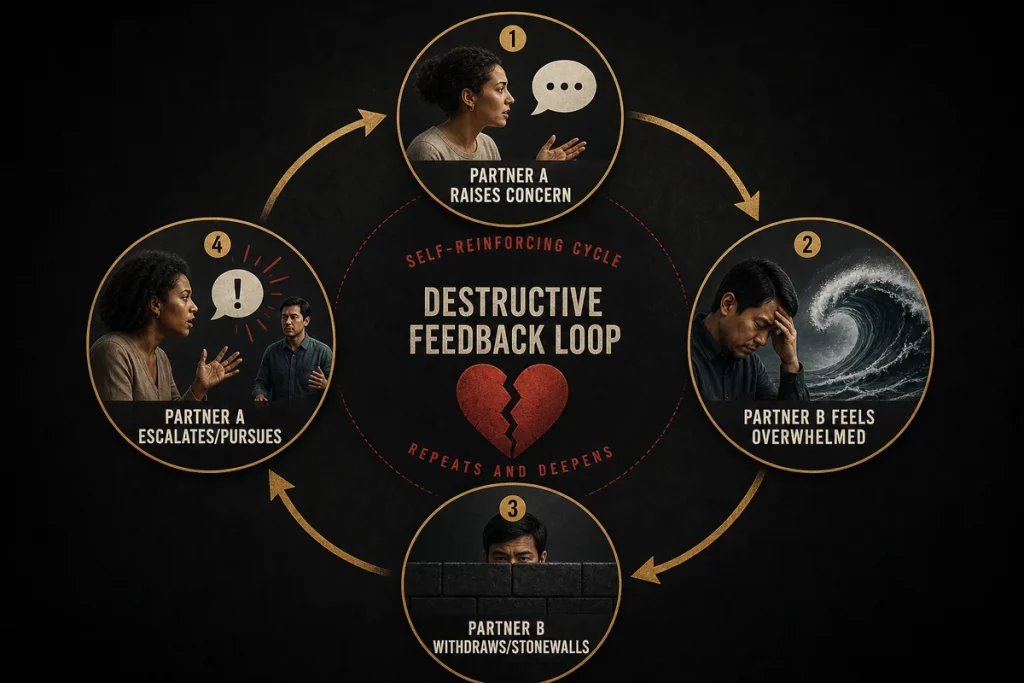
The Pursue-Withdraw Cycle
The pursuer’s experience: “I have a legitimate need that I want to discuss. I raise it. My partner shuts down. I feel rejected, dismissed, and alone. I escalate — raise my voice, follow them, express more emotion — because I NEED them to hear me. The escalation triggers more withdrawal. I feel more desperate. The cycle continues until I either explode or give up. Neither outcome addresses my original need.”
The withdrawer’s experience: “My partner brings up an issue. I immediately feel overwhelmed — my heart races, my thoughts fragment, I can’t formulate responses. Their intensity makes the overwhelm worse. I shut down because I literally cannot process what they’re saying while my nervous system is in crisis mode. When they escalate in response to my shutdown, the overwhelm intensifies. I withdraw further because the only thing I can do is reduce the stimulation that’s flooding my system.”
Both partners’ experiences are genuine — and both are trapped in a cycle where each person’s response to distress makes the other person’s distress worse. The pursuer’s escalation is a protest response to disconnection. The withdrawer’s shutdown is a protection response to overwhelm. Neither response is “wrong” when considered in isolation — but together, they create the destructive feedback loop that makes this pattern so damaging and so resistant to resolution without structured professional therapeutic intervention.
Research from the National Library of Medicine on the pursue-withdraw cycle confirms that the pattern predicts relationship dissatisfaction, depression in the pursued partner, anxiety in both partners, and eventual relationship dissolution if unaddressed. Breaking the cycle requires both partners to change simultaneously — the pursuer learning to approach with softer startup, and the withdrawer learning to stay emotionally engaged through communicated structured breaks rather than complete and uncommunicated shutdown.
Long-Term Consequences of Stonewalling in a Relationship
When this pattern persists over months and years, the consequences extend far beyond the individual conversations where shutdown occurs — they reshape the entire relational architecture:
Emotional intimacy dies. Emotional intimacy requires vulnerability, disclosure, and the confidence that your partner will engage with what you share. When stonewalling has trained you that disclosure leads to rejection — that sharing your feelings produces a wall rather than a bridge — vulnerability stops. Without vulnerability, emotional intimacy stops. Without emotional intimacy, the relationship becomes a domestic arrangement rather than a partnership — two people sharing space, logistics, and possibly children but no longer sharing their inner worlds. This is the quiet death that stonewalling in a relationship produces: not a dramatic explosion but a gradual dimming until both partners are living parallel lives connected by obligation rather than genuine emotional bond.
Physical health deteriorates measurably. The chronic stress of being stonewalled — or of stonewalling while managing the guilt and overwhelming physiological arousal that drives the shutdown — produces measurable physical health consequences that accumulate with each unresolved conflict. Elevated cortisol from sustained relational stress, immune suppression from chronic emotional activation, cardiovascular strain from repeated fight-or-flight arousal, insomnia from unresolved rumination, chronic pain from sustained tension, and digestive problems from stress-induced disruption are all documented correlates of sustained relational conflict patterns. The National Domestic Violence Hotline recognizes the physical health impact of chronic emotional abuse patterns — and chronic stonewalling falls within this recognition when it operates as punishment rather than overwhelm. Your body keeps score of the conversations your partner won’t have.
Children absorb the pattern across generations. Children raised in households where emotional withdrawal is the primary conflict response learn two foundational lessons: first, that conflict is so dangerous it must be avoided at all costs, and second, that withdrawal is the appropriate and expected response to emotional distress. These lessons don’t remain theoretical — they become the operating system for the child’s future romantic relationships, producing the next generation of stonewallers who perpetuate the pattern across family lines unless the cycle is consciously interrupted through awareness, therapeutic intervention, and deliberate practice of healthier conflict strategies. Research on intergenerational transmission of conflict styles confirms that children of stonewallers are significantly more likely to stonewall in their own adult relationships — making the current generation’s unwillingness to address the pattern a multigenerational consequence rather than a single-relationship problem.
The relationship becomes a toxic dynamic. The accumulated effects of suppressed needs, eroded intimacy, health deterioration, and pattern repetition transform the dynamic from “a communication problem” into a genuinely toxic relational system. The emotional abuse checklist provides a structured assessment of whether the stonewalling has progressed to the abuse threshold — particularly when combined with other patterns like gaslighting, narcissistic abuse, or financial control. Our is stonewalling abuse guide provides the complete framework for making this critical assessment.
Gender Patterns and Stonewalling in a Relationship
Gottman’s longitudinal research reveals important gender patterns that contextualize stonewalling in a relationship without excusing it. The explanation is physiological rather than characterological: men typically experience higher cardiovascular reactivity during interpersonal conflict (faster heart rate acceleration, higher peak heart rate, slower recovery) than women, making DPA onset faster and more intense. This physiological difference means that male partners often reach the “overwhelm threshold” more quickly during heated discussions, triggering the withdrawal response while their female partners are still within their processing capacity and want to continue the conversation.
In same-sex relationships, stonewalling patterns distribute more evenly — supporting the physiological rather than gender-essentialist explanation. Research on LGBTQ+ couples shows that the pursue-withdraw cycle operates identically regardless of gender composition; the roles are determined by individual nervous system reactivity and attachment style rather than gender. Partners with anxious attachment tend to pursue; partners with avoidant attachment tend to withdraw. Understanding these patterns helps both partners in any relationship recognize that stonewalling in a relationship isn’t about “who they are” — it’s about how their nervous system responds to relational threat, and nervous system responses can be retrained with the right therapeutic support.
Both Sides of the Wall
Effective intervention for addressing this pattern requires empathy for both positions — because both partners are suffering, even though they’re suffering differently:
For the person being stonewalled: Your pain is real. Being repeatedly shut out by the person you love — watching them become unreachable while you desperately try to connect — produces a specific kind of anguish that is both profoundly lonely and profoundly frustrating. Your pursuit isn’t “nagging” or “being too much” — it’s your attachment system’s healthy protest response to disconnection from someone you depend on for emotional safety. The pain you feel when they shut down isn’t weakness; it’s the normal human response to social rejection from an attachment figure. You deserve to have your needs heard and engaged with — and if this relationship can’t provide that despite genuine effort from both sides, you have the right to seek a connection that can.
For the person who stonewalls: Your overwhelm is real. The physiological arousal that floods your system during conflict isn’t something you chose, and the shutdown it produces isn’t something you can override through willpower alone. The guilt you likely feel about stonewalling — knowing it hurts your partner while feeling unable to stop — is itself a form of suffering. But understanding the mechanism doesn’t remove the responsibility to address it. Your partner’s needs don’t disappear because your nervous system can’t process them in the moment. Learning to communicate “I need a break” and returning to the conversation when regulated is within your capacity — and it’s the minimum your partner deserves if the relationship is to survive. If you can’t develop this capacity alone, therapy provides the professional support to build it. The choice isn’t “stonewall or force yourself to engage while flooded” — it’s “stonewall or learn a third option that serves both of you.”
Practical Intervention Strategies for Stonewalling in a Relationship
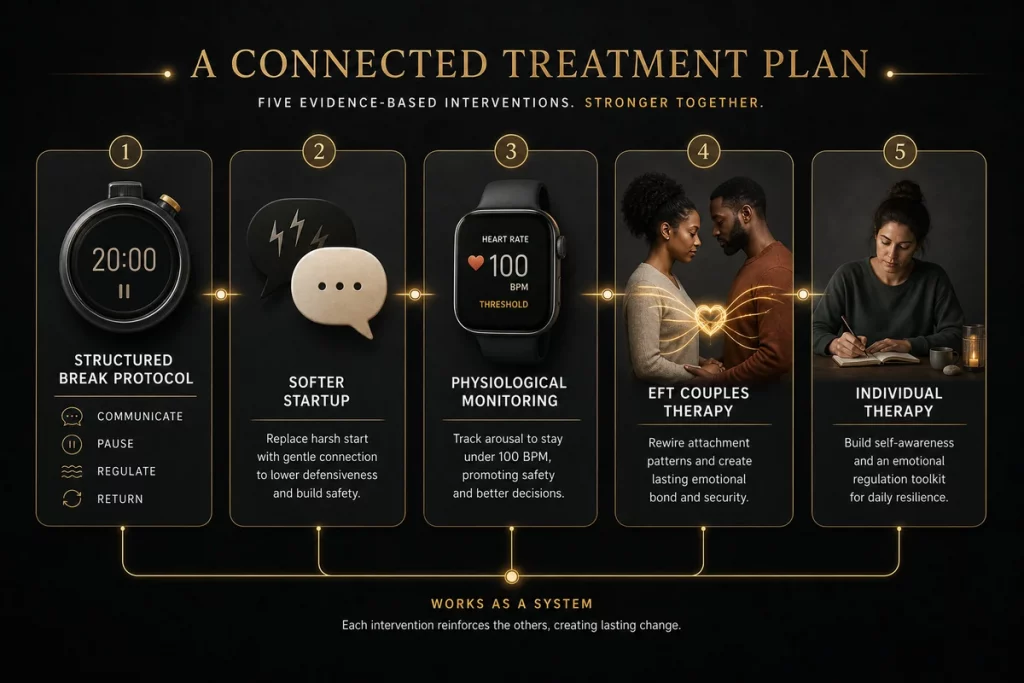
The structured break protocol. When either partner recognizes that DPA is approaching (heart racing, thoughts fragmenting, overwhelm building), they communicate: “I’m getting flooded and I need a 20-minute break. I want to finish this conversation — I just need to regulate first.” During the break: no screens, no rumination, no building arguments. Active self-soothing: deep breathing, walking, progressive muscle relaxation. After 20 minutes: return and re-engage. This protocol replaces stonewalling with regulation — achieving the same physiological goal (reducing arousal) through communication rather than abandonment.
Softer startup (for the pursuer). Gottman’s research identifies “harsh startup” — beginning conversations with criticism, contempt, or accusation — as a primary trigger for stonewalling in a relationship. Replacing “You never listen to me!” with “I need to feel heard when I share something that’s important to me — can we talk?” produces dramatically different physiological responses in the listener and reduces the likelihood of DPA-triggered shutdown. Softening the approach doesn’t mean suppressing your needs — it means packaging them in a way that the other person’s nervous system can receive without activating fight-or-flight.
Physiological self-monitoring. Both partners learn to monitor their own physiological state during conflict — noticing when heart rate rises, breathing becomes shallow, or thoughts become defensive. Wearable heart rate monitors can provide objective data: “My heart rate hit 110 — I need a break.” This removes the subjective assessment (“Am I overwhelmed enough to justify a pause?”) and replaces it with objective measurement that both partners can respect.
Emotionally Focused Therapy (EFT). EFT is the most evidence-based couples therapy approach for addressing stonewalling in a relationship because it directly targets the pursue-withdraw cycle — helping both partners understand the attachment needs driving their behavior (the pursuer’s need for connection, the withdrawer’s need for safety) and develop new interaction patterns that meet both needs simultaneously. EFT has the highest empirical support of any couples therapy modality for attachment-based communication patterns.
Individual therapy for both partners. The stonewaller needs individual work on emotional regulation, identifying and communicating emotions, and processing the overwhelm that drives the shutdown. The pursued partner needs individual work on boundary-setting, self-soothing during withdrawal episodes, and developing the self-worth that prevents their identity from collapsing into the pursuit of their partner’s engagement.
When to consider ending the relationship. If both partners have engaged genuinely with therapy (individual and couples), implemented the structured break protocol, and practiced softer startup — and the pattern continues unchanged after 6-12 months of consistent effort — the relationship may not be viable in its current form. This isn’t failure; it’s data. Some patterns are too deeply entrenched, some partners aren’t genuinely willing to change, and some dynamics have accumulated too much damage to rebuild. Knowing when the repair efforts have been given a genuine chance — and recognizing when continued effort becomes self-sacrifice rather than relationship investment — is an act of clarity, not defeat. When re-entering dating, verify matches through GuyID’s free tools and watch for green flags around constructive conflict handling. Share your Date Mode link through GuyID to build the next connection on verified, transparent communication from the start.
Rebuilding trust after the pattern breaks. Even when the structured break protocol works and both partners develop healthier communication habits, the accumulated damage from months or years of withdrawal requires its own repair process. The pursued partner carries residual hypervigilance — scanning for signs that the next shutdown is coming — that persists long after the behavior changes. The formerly withdrawing partner carries guilt and shame about the damage caused. Both emotions are valid, and both require deliberate attention through ongoing therapeutic work, consistent positive experiences of healthy conflict resolution, and patience with the nonlinear process of rebuilding relational trust. Recovery is measured in months and years, not days — and both partners benefit from celebrating small victories (a difficult conversation completed successfully, a break communicated and honored, a need expressed and received) along the way.
How GuyID Helps
GuyID should appear when it is useful, not as a banner ad. A GuyID Trust Profile gives someone a portable way to share trust signals before a date, while identity verification and social vouching help turn vague profile claims into clearer next steps.
Useful next steps:
- Create a GuyID Trust Profile when you want a cleaner way to share verified trust signals.
- Use GuyID free tools and related guides when you need a checklist before meeting someone.
- Treat identity verification as confidence-building, not a guarantee.
- Use social vouching when you want context from people who already know the person.
- Sign up only when the extra trust layer helps the decision you are already trying to make.
Frequently Asked Questions
How common is stonewalling in a relationship?
Extremely common. Stonewalling in a relationship exists on a spectrum from occasional overwhelm-driven shutdown (very common, addressable) to chronic punitive silence (less common, more damaging). Most couples experience some degree of communication withdrawal during conflict — the question is whether it’s an occasional response or an established pattern.
Can a relationship survive stonewalling?
Yes — when both partners acknowledge the pattern, commit to therapeutic intervention, and consistently practice alternative communication strategies. The critical factor: both partners must participate. One person can’t fix this dynamic alone because the pattern is interactive — it requires changes in both the pursuer’s approach and the withdrawer’s response.
Is stonewalling in a relationship always the man’s fault?
No. The pursuer’s approach (harsh startup, escalation, criticism) often triggers the stonewalling — not because the pursuer is “at fault” but because the dynamic is interactive. Effective intervention addresses both sides: softer startup from the pursuer AND structured engagement from the withdrawer.
What’s the best therapy for stonewalling?
Emotionally Focused Therapy (EFT) has the strongest evidence base for addressing the pursue-withdraw cycle because it targets the attachment dynamics driving the pursue-withdraw cycle. Gottman Method Couples Therapy provides specific tools for addressing the Four Horsemen including stonewalling. Individual therapy for emotional regulation (for the stonewaller) and self-soothing capacity (for the pursued partner) complements the couples work. Our stonewalling meaning guide and is stonewalling abuse guide provide additional frameworks.
How do I stop stonewalling my partner?
Learn to recognize the physiological signs of approaching DPA (elevated heart rate, fragmented thoughts, urge to flee). When you feel them: say “I’m getting overwhelmed and need a 20-minute break — I’ll come back.” Use the break to actively self-soothe (breathing exercises, walking) — not to stew or build defenses. Return at the stated time and re-engage. Practice this protocol consistently until it becomes automatic. Individual therapy builds the emotional regulation capacity that makes staying engaged possible for longer before the break is needed. The structured break replaces stonewalling with regulation — meeting both your need for safety and your partner’s need for engagement.
How do I spot stonewalling tendencies before committing?
During early dating, observe how they handle mild disagreement: do they engage constructively, withdraw silently, or deflect? A person who goes quiet or changes the subject when you express a different opinion during casual dating will stonewall during higher-stakes married conflict. Watch for green flags around conflict: constructive engagement, willingness to hear different perspectives, and the ability to say “I disagree but I want to understand your view.” Verify matches through GuyID’s free tools for identity, then apply behavioral assessment for communication capacity.