

Reader Briefing
Reader Briefing
Start here if you need a practical read on when to say i love you: readiness before timing: who should use verification, what signals to check, and what to do before moving from online interest to an in-person plan.
Who this is for
- Readers preparing for a first in-person date.
- Anyone checking identity, profile consistency, and trust signals.
- People trying to avoid romance scams, fake profiles, or pressure tactics.
- Online daters improving conversations, profiles, or match screening.
You’ll learn
- How to evaluate identity signals without treating any single check as certainty.
- Which trust signals matter and how to weigh them together.
- How to spot inconsistencies, pressure, or behavior patterns that deserve caution.
- How to move from online conversation to a safer first meeting.
- Where GuyID tools fit into a quick pre-date screening workflow.
- When to slow down, ask for more context, or walk away.
Bottom line
Verification reduces uncertainty; it does not guarantee future behavior. Use a layered approach: confirm identity signals, compare profile consistency, ask for a short video call, keep early plans public, and slow down when someone pressures you to skip normal safety steps.
Key takeaways
- Identity verification improves confidence, not certainty.
- Patterns matter more than isolated incidents.
- Verify before meeting privately or sharing sensitive details.
- A short video call can reveal many inconsistencies.
- Pressure to skip reasonable safety steps is useful information.
Free Tools
Catfish Probability Detector
Check whether a dating profile has suspicious identity or photo signals.
Dating Bio Red Flag Detector
Review a bio for scam, pressure, or trust-warning language.
Dating Safety Checklist
Use free GuyID tools before moving from chat to a real date.
Next step
Create your GuyID trust profile
Share consent-based trust signals before a date without turning the conversation into an interrogation.
Quick Answer
Say “I love you” when the words describe your present experience, you have enough real-world knowledge to mean them, and you can offer them without demanding an identical response. There is no correct number of dates or months.
Before saying it, ask yourself what you mean. Are you naming affection, growing attachment, exclusive commitment, or a long-term promise? The phrase feels safer when the meaning is honest and the listener is free to respond in their own time.
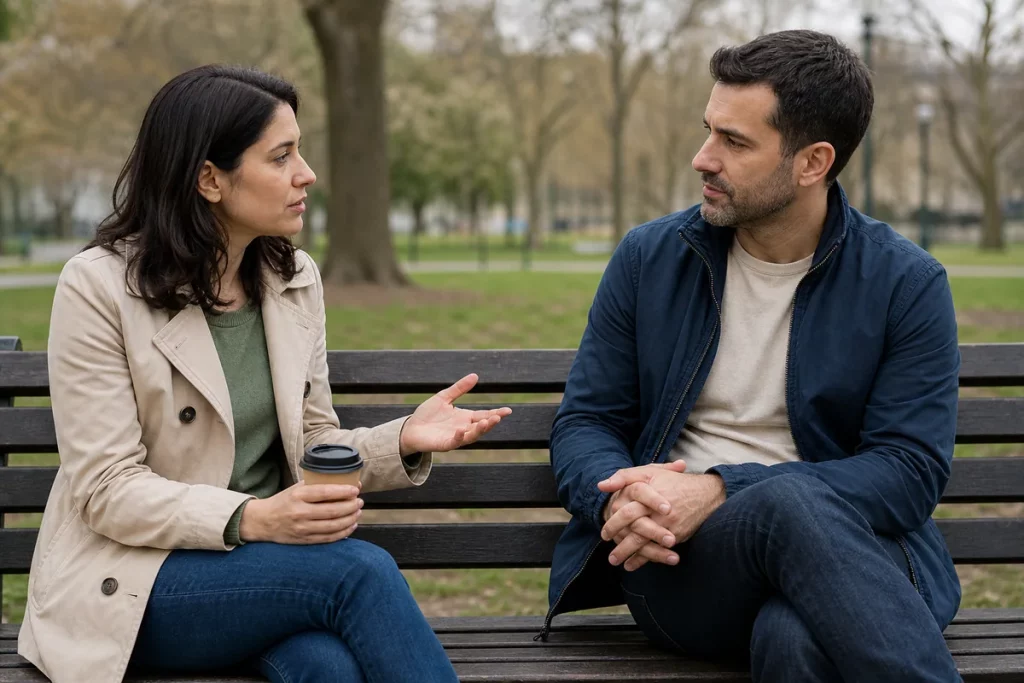
Name what you feel before deciding what you want the other person to say back.
NavigateTable of Contents26 sections
There Is No Magic Date
Search advice often offers a deadline: after a certain number of weeks, before a particular anniversary, or only after exclusivity. Those rules can make uncertainty feel manageable, but they cannot know your relationship.
Research on love confessions found that saying and hearing “I love you” can carry different meanings depending on who says it and when it is said. In a series of studies on communicating commitment, researchers examined expectations about who says the phrase first and how its timing can influence interpretation. The findings do not create a schedule for modern couples, nor do they cover every gender, culture, orientation, or relationship structure.
Timing matters because context gives the words meaning:
- After several consistent months, the phrase may name an attachment both people already recognize.
- During an intense first week, it may express genuine emotion but imply knowledge that has not yet been earned.
- Immediately before sex, it may feel connected to desire, reassurance, or pressure.
- During a conflict, it may be a repair attempt—or a way to avoid the actual issue.
- After a boundary, it may be welcome reassurance—or a tactic to change the answer.
The calendar is one piece of context. Behavior is the stronger one.
What Do You Mean by I Love You?
“I love you” can mean:
- I feel deep affection.
- I am emotionally attached.
- I want an exclusive relationship.
- I intend to stay and work through difficulty.
- I see a long-term future.
- I feel tenderness right now.
- I want reassurance that you feel the same.
None of these meanings is inherently wrong, but they are not interchangeable. Confusion grows when the speaker means “I feel close to you” and the listener hears “I am making a lifelong promise.”
Try finishing these sentences privately:
- When I say love, I mean…
- I know this feeling is more than excitement because…
- I do not yet know…
- I hope the words change…
- If they are not ready, I will…
If your honest answer is “I need them to say it so I can stop feeling anxious,” talk about the uncertainty directly. The intentional dating guide can help you ask what the relationship is becoming without using a declaration as a test.
Signs You May Be Ready to Say It
Readiness is not certainty about the future. It is enough clarity to speak truthfully in the present.
You may be ready when:
- you have seen the person in ordinary settings, not only ideal dates;
- your feeling survives a disagreement or disappointment;
- you can distinguish who they are from who you hope they become;
- you respect their pace and boundaries;
- you can say the words without attaching a demand;
- you understand the current relationship agreement;
- your actions already show care, reliability, and accountability;
- the phrase will clarify your experience rather than manufacture a commitment.
Perceived partner responsiveness involves feeling understood, validated, and cared for, which is more informative than a phrase without supporting behavior. A review of responsiveness in romantic interactions emphasizes listening and responses that communicate understanding, validation, and care.
Compare the declaration with the evidence:
| Words | Supporting behavior |
|---|---|
| “I care about you” | Makes room for your needs and perspective |
| “I want a future” | Discusses practical plans honestly |
| “You can trust me” | Keeps agreements and repairs mistakes |
| “I accept you” | Does not punish boundaries or independence |
| “I love you” | Treats your well-being as important in daily choices |
Love does not require perfection. It does require enough reality that you are speaking to a person, not a projection.

The best setting is private enough for honesty and calm enough for either response.
Reasons to Wait
Waiting can be caring when it protects accuracy and choice. Consider slowing down if:
- you have known each other only through intense messaging or a holiday-like setting;
- important facts about availability, exclusivity, identity, or current partners remain unclear;
- you want the phrase to stop someone from leaving;
- you are hoping it will secure sex, exclusivity, housing, forgiveness, or access;
- the relationship cycles through idealization and withdrawal;
- one person has significant professional, financial, immigration, or housing power over the other;
- you cannot imagine tolerating “I’m not there yet”;
- your behavior and the words would sharply contradict each other.
Strong early feelings can be real. They are not the same as detailed knowledge. You can honor the feeling without escalating the promise:
“I’m feeling very close to you, and I want to keep learning what this can become.”
Review green flags in a relationship and relationship red flags side by side. Affection should not make controlling behavior less important.
How to Say I Love You Without Pressure
Choose an ordinary, unhurried moment. Avoid making the first declaration:
- during sex;
- while either person is intoxicated;
- in public where the listener must perform;
- during a major argument;
- immediately after they set a boundary;
- as part of a gift, proposal, or financial commitment that makes refusal costly.
Then say what is true:
“I’ve realized I love you. You do not have to answer on my timeline—I wanted to be honest.”
Or, if the meaning needs context:
“I love you. For me, that means I care deeply about you and want to keep building this thoughtfully. I’m not asking us to make a new decision tonight.”
Do not dilute sincerity with a long disclaimer. One clear sentence of freedom is enough. Then listen.
If you also want a relationship change, separate the conversations:
“I love you. I’d also like to talk this weekend about what commitment means to each of us.”
This prevents the listener from having to agree to an undefined package in one emotional moment.
How to Respond if They Do Not Say It Back
A delayed response is not automatically rejection. It may mean:
- they feel affection but use the word differently;
- they need more time;
- they were surprised;
- they are cautious after a previous relationship;
- they care but do not share the same feeling;
- they are uncertain about the relationship.
Respond without punishing honesty:
“Thank you for hearing me. You do not need to say it before you mean it.”
Later, you can ask:
- “How did that land for you?”
- “What does love mean to you?”
- “Do you feel we are moving in the same direction?”
Do not repeatedly prompt, sulk, withdraw affection, threaten to leave in the moment, or use sex and gifts as leverage. If the mismatch continues, you may need a decision—not a forced confession.

If the answer is uncertain, regulate first and seek perspective before making a major decision.
Use the boundary-setting guide if the conversation becomes repetitive or coercive. You can respect another person’s pace and still decide that indefinite ambiguity does not work for you.
Love, Attachment, and Commitment Are Related but Different
Love is a feeling and orientation toward another person. Attachment is an emotional bond. Commitment is an intention and pattern of decisions that help maintain a relationship. They can develop together, but not always.
Commitment can reduce uncertainty when partners’ intentions become clearer, but a declaration is not the same as a fully developed commitment. The commitment research review describes commitment as a process supported by dedication, mutuality, and repeated evidence.
This distinction explains several confusing experiences:
- You can love someone and know the relationship is incompatible.
- You can feel attached to someone who treats you poorly.
- You can be committed before you are ready to use the word love.
- You can hear “I love you” from someone whose actions do not protect the relationship.
- You can need time without being emotionally unavailable.
Do not ask the phrase to carry every question. Discuss exclusivity, plans, sex, money, family, and expectations in their own words.
How to Handle Common Love-Confession Situations
The meaning of “I love you” depends partly on the situation around it. A thoughtful approach does not require perfect conditions. It does require enough calm, privacy, and freedom for both people to understand what is being offered.
You feel it before exclusivity has been discussed
Love and exclusivity are separate conversations. If you want both, say both clearly rather than hoping the emotional declaration will silently create a dating agreement.
You might say: “I am falling in love with you. I also want an exclusive relationship, but I do not want to assume those mean the same thing to you. How are you thinking about us?”
The other person may share the feeling and not want exclusivity, or want exclusivity without using the word love yet. That is not a semantic problem. It is information about the relationship being offered.
You are not sure whether it is love or intensity
Early attraction can be sincere and consuming. Before choosing the biggest available word, compare the feeling with what you know. Have you seen this person tired, disappointed, responsible for a mistake, or attentive when the focus is not on romance? Do you admire their choices as well as enjoy their attention?
You do not have to suppress the feeling while knowledge catches up. Use language that fits the evidence: “I feel very close to you,” “I am falling for you,” or “This is becoming important to me.” Smaller words can be more honest, not less brave.
You are afraid saying it first gives away power
Emotional honesty creates exposure, but withholding solely to make the other person go first turns intimacy into a contest. Protect yourself through boundaries and observation, not strategic silence.
Choose a moment when you can leave or take space afterward. Tell a friend if you expect to feel vulnerable. Remind yourself that a different response will be painful information, not proof that speaking honestly was a mistake.
Power becomes a concern when someone uses the declaration to demand sex, exclusivity, forgiveness, access, or an immediate answer. A freely offered feeling does not create a debt.
Your partner says it very early
Do not argue about whether their feeling is “real.” Ask what the words mean and watch what follows.
“Thank you for telling me. What does love mean to you at this point?” can reveal whether they are naming emotion, assuming a commitment, or trying to accelerate the relationship. You can acknowledge the disclosure and set your pace: “I care about you, and I am not ready to use that word yet.”
Be especially attentive if early intensity arrives with pressure to isolate, share passwords, combine money, move, or overlook boundaries. The concern is not the sentence alone; it is the pattern around it.
You said it during conflict
Love can be relevant during repair, but it cannot replace accountability. If “I love you” ended the argument without addressing harm, return to the issue later.
Try: “I meant what I said about loving you. We still need to discuss what happened, what each of us needs, and how we will prevent a repeat.” Care and responsibility should support each other.
If the phrase is repeatedly used to stop questions, reverse blame, or make boundaries seem unloving, focus on the pattern rather than debating the speaker’s internal feeling.
You are long-distance or have mostly communicated online
Deep connection can develop at a distance, but online intensity may leave parts of daily compatibility untested. A declaration can be honest while still requiring caution about travel, money, identity, and future plans.
Keep practical decisions separate. Verify the person through normal, consent-based steps; use live video; maintain independent travel and accommodation where possible; and never send money because an emotional milestone appears to prove trust. Love is not identity verification or a guarantee of future conduct.
The words carry different cultural or family meanings
Some people use “I love you” readily. Others reserve it for permanent commitment or rarely heard it growing up. Neither style automatically shows more depth.
Ask about the personal meaning without demanding a performance: “What did people in your family say instead?” or “What actions make you feel loved?” Then decide whether your communication styles can meet without one person constantly guessing.
The goal is not identical timing. It is a shared understanding of what the words do—and do not—promise.
A Readiness Check
Before saying it, answer:
- What exactly am I trying to communicate?
- What evidence do I have about this person beyond chemistry?
- Am I offering information or requesting a decision?
- Can they decline to respond without consequences?
- Does my behavior support the words?
- Is there a safer or clearer moment?
- If our feelings differ, what will I need next?
The relationship-readiness quiz can help organize your thinking, but no score can determine whether the moment is right.
How GuyID Helps
GuyID should appear when it is useful, not as a banner ad. A GuyID Trust Profile gives someone a portable way to share trust signals before a date, while identity verification and social vouching help turn vague profile claims into clearer next steps.
Useful next steps:
- Create a GuyID Trust Profile when you want a cleaner way to share verified trust signals.
- Use GuyID free tools and related guides when you need a checklist before meeting someone.
- Treat identity verification as confidence-building, not a guarantee.
- Use social vouching when you want context from people who already know the person.
- Sign up only when the extra trust layer helps the decision you are already trying to make.
Frequently Asked Questions
How long should you wait before saying I love you?
There is no required period. Wait until the phrase reflects more than an intense first impression and you can offer it without demanding the same words back.
Is one month too soon to say I love you?
One month may be early in terms of knowledge, even when the feeling is sincere. Ask what you mean, what you still do not know, and whether a less absolute description would be more accurate.
Should I say I love you first?
Yes, if you mean it and can tolerate an honest response. Going first is not a loss of power; using the declaration to force reassurance is the problem.
What if they say thank you instead?
Treat it as an imperfect but honest response. Give the moment space, then ask later how they understood what you shared and whether your relationship goals align.
Can someone love you but not want commitment?
Yes. Feelings do not automatically create compatible intentions. Ask what relationship the person is actually offering, then decide whether its expectations and limits fit your needs.
Is saying I love you during sex meaningful?
Saying it during sex may be sincere, but arousal and vulnerability can make interpretation difficult. Revisit the words later in a calm setting before assuming they changed the relationship agreement.
Conclusion
The right time to say “I love you” is not the moment a calendar gives permission. It is the moment honesty, knowledge, behavior, and freedom line up well enough for the words to be real.
Say what you mean. Leave room for a different pace. Then evaluate the relationship by what happens after the sentence: listening, consistency, repair, and choices that make care visible.