
Reader Briefing
Reader Briefing
Start here if you need a practical read on how to vet someone before a first date without being weird: who should use verification, what signals to check, and what to do before moving from online interest to an in-person plan.
Who this is for
- People meeting someone from a dating app or social platform.
- Readers preparing for a first in-person date.
- Anyone checking identity, profile consistency, and trust signals.
- People trying to avoid romance scams, fake profiles, or pressure tactics.
You’ll learn
- How to evaluate identity signals without treating any single check as certainty.
- Which trust signals matter and how to weigh them together.
- How to spot inconsistencies, pressure, or behavior patterns that deserve caution.
- How to move from online conversation to a safer first meeting.
- Where GuyID tools fit into a quick pre-date screening workflow.
- How to compare options using practical safety and trust criteria.
Bottom line
Verification reduces uncertainty; it does not guarantee future behavior. Use a layered approach: confirm identity signals, compare profile consistency, ask for a short video call, keep early plans public, and slow down when someone pressures you to skip normal safety steps.
Key takeaways
- Identity verification improves confidence, not certainty.
- Patterns matter more than isolated incidents.
- Verify before meeting privately or sharing sensitive details.
- A short video call can reveal many inconsistencies.
- Pressure to skip reasonable safety steps is useful information.
Free Tools
Catfish Probability Detector
Check whether a dating profile has suspicious identity or photo signals.
Dating Bio Red Flag Detector
Review a bio for scam, pressure, or trust-warning language.
Dating Safety Checklist
Use free GuyID tools before moving from chat to a real date.
Next step
Create your GuyID trust profile
Share consent-based trust signals before a date without turning the conversation into an interrogation.
Introduction
Vetting someone before a first date should not feel like an interrogation. It should feel like a normal part of meeting a stranger from the internet with care, respect, and self-protection. The goal is not to prove that someone is dangerous. The goal is to decide whether the next step is appropriate based on the signals you already have and the signals you can reasonably ask for.
That distinction matters. A first date is usually low commitment, but it is not zero risk. You are sharing time, location, attention, and sometimes personal details with a person you have not met. A good vetting process helps you check basic identity consistency, communication patterns, boundaries, and safety expectations without making the other person feel accused.
This guide gives you scripts, examples, red flags, and a practical decision framework. It is written for people who want to be careful without becoming paranoid, and for people who want to communicate safety standards without killing chemistry.
Quick Answer
The least awkward way to vet someone before a first date is to make the trust check routine, mutual, and proportionate. Start with normal conversation, look for consistency across their profile and messages, ask for one lightweight verification step such as a short video call, and choose a public first-date plan. If they respond respectfully, continue with normal caution. If they avoid every reasonable request, pressure you, or introduce secrecy or money, slow down or stop.

NavigateTable of Contents26 sections
Main Sections
Vetting before a first date is really a trust decision. You are not trying to learn everything about a person. You are trying to answer a smaller question: is there enough consistency, respect, and basic identity confidence to meet in a public place for a limited first date?
That decision should use several light signals instead of one dramatic test. A dating app verification badge may show that a selfie matched a profile photo. A video call may show that the person can appear live and hold a normal conversation. A consistent story across messages may show that basic details are stable. A GuyID trust profile may add consent-based identity and social signals. None of these signals proves intent or future behavior, but together they help reduce uncertainty.
The word “vet” can sound harsh, so the way you frame it matters. Instead of saying, “I need to verify you,” use language that makes the process mutual: “I like to do a quick vibe check before meeting anyone from an app.” That keeps the request practical. It also gives the other person a clear opportunity to show whether they respect reasonable boundaries.
What to Check Before a First Date
The highest-value checks are simple and non-invasive. Look for name consistency, photo consistency, age and location plausibility, communication style, and whether their plans match your safety boundaries. If someone says they live nearby but avoids all local references, changes basic details, or pushes for a private first meeting, that is useful information.
Do not start with sensitive information. You usually do not need a home address, workplace, ID document, family details, or financial history before a first date. In many cases, a short video call, public date plan, and basic profile consistency are enough for a first meeting. Stronger checks make sense when the risk is higher: late-night plans, travel, private locations, long-distance emotional investment, financial claims, or repeated inconsistencies.
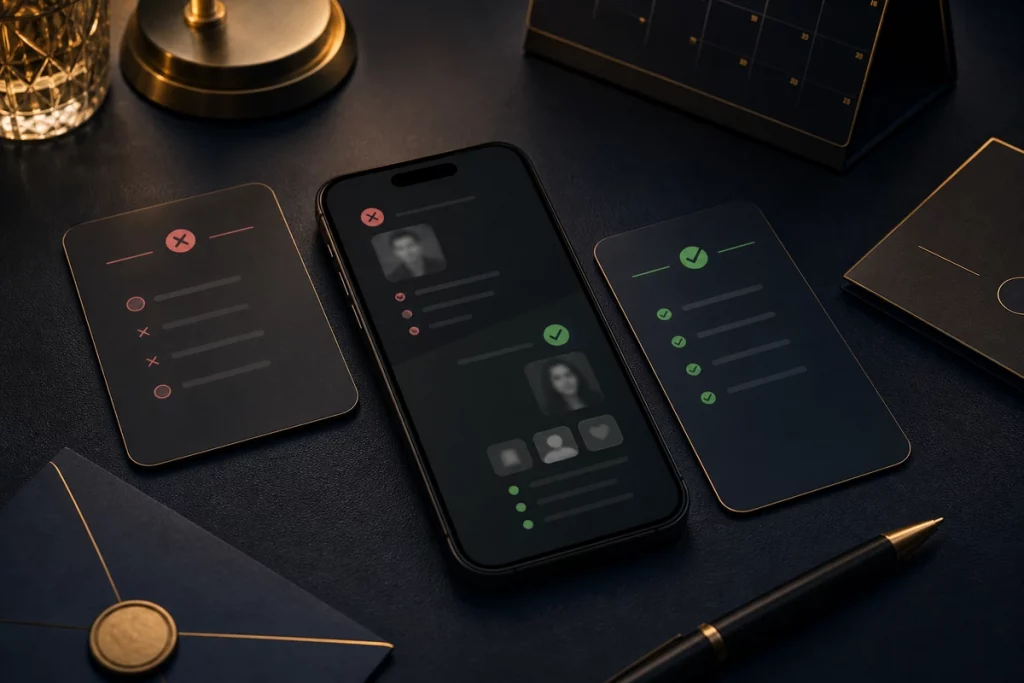
The best vetting question is specific to the next decision. If you are deciding whether to keep messaging, ask for consistency. If you are deciding whether to meet, ask for a short call and a public plan. If you are deciding whether to share personal details, look for stronger evidence and more time.
How to Ask Without Making It Awkward
The safest requests are short, direct, and normal. Try:
“I like to do a quick video call before meeting anyone from an app. Ten minutes is enough. Are you open to that?”
“I am happy to meet, but I keep first dates public and easy to leave. Coffee or a walk near a busy area works for me.”
“Before we move off the app, I prefer to know we are both comfortable with a quick check-in call.”
These scripts work because they do not accuse the other person of lying. They state your standard and give them a reasonable choice. Someone who is genuinely interested may ask questions, suggest a time, or offer a different but still safe option. Someone who reacts with anger, mockery, guilt, or pressure is giving you information about how they handle boundaries.
Examples
- A Hinge match has consistent photos and conversation, but you have not heard their voice. You ask for a ten-minute call before meeting. They agree and suggest tomorrow evening. That is a healthy response.
- A Tinder match says they hate video calls but offers to meet at a crowded coffee shop in the afternoon and keeps the plan easy to leave. That may still be reasonable depending on your comfort level.
- A Bumble match avoids a video call, pushes for a late-night drink near their apartment, and says you are “too paranoid.” That is not just a preference difference; it is a boundary signal.
- A long-distance match says they are serious about you after a week, refuses live video, and introduces an urgent financial problem. That interaction deserves a hard stop.
Practical Advice
Keep the vetting process proportionate. If the next step is a short coffee in a public place, you probably need fewer checks than if the next step involves travel, privacy, or financial trust. The more private, expensive, or emotionally intense the next step becomes, the more evidence you should expect.
Separate awkwardness from danger. Some people are shy on video, private about social media, or slow to share details. That does not automatically mean deception. The pattern matters more than one isolated preference. Repeated avoidance, inconsistent stories, pressure, secrecy, and urgency matter much more than one imperfect answer.
Use your own boundaries instead of debating theirs. You do not need to convince someone that your safety standard is correct. You can simply say, “That does not work for me before a first date.” If they respect it, continue. If they keep pushing, that is the answer.
Expert Insights
Good trust systems are transparent about scope. Identity verification can improve confidence in a specific signal, but it does not prove kindness, compatibility, relationship status, or future behavior. A video call can confirm live consistency, but it does not replace first-date safety habits. A background check can answer some public-record questions, but it can also be excessive for casual screening if the next step is low risk.
The strongest approach is layered. Combine identity signals, behavior signals, social context, and practical date planning. A profile can look real and still behave poorly. A person can pass a video call and still ignore boundaries. A public meeting plan, independent transportation, and a friend check-in remain useful even when the early signals look good.
The second principle is consent. Vetting should not require tricking someone, collecting private information without permission, or pressuring them to disclose sensitive details. A good request is clear. A good response is respectful. A good decision keeps both people in control.
Common Mistakes
- Treating a verification badge as proof that a person is safe.
- Asking for invasive information before it is proportionate to the situation.
- Ignoring the way someone reacts to a reasonable boundary.
- Confusing chemistry with credibility.
- Moving to a private location because the conversation feels exciting.
- Continuing to explain your boundary after the other person has already mocked it.
- Treating one awkward answer as a red flag while ignoring the broader pattern.
Best Practices
Make safety routine. When vetting is framed as something you do with everyone, it feels less personal and less accusatory.
Use one request at a time. A short video call, public date plan, and basic profile consistency check are enough for many first dates. Do not stack five demands at once unless the risk level justifies it.
Prefer reversible steps. A coffee date in a public place is easier to exit than a dinner reservation, private apartment meetup, long drive, or overnight plan. Early dating should preserve choice.
Watch the response, not just the answer. Someone can decline a request respectfully and suggest a safe alternative. Someone else can technically agree while making you feel guilty for asking. The emotional tone is part of the trust signal.
Comparison Table
| Trust Check | Best Use | Low-Awkward Framing | Limitation |
|---|---|---|---|
| Profile consistency | Early screening | “I noticed your profile says…” | Can miss intentional deception |
| Short video call | Before meeting | “I do a quick vibe check before first dates.” | Does not prove intent |
| Public first-date plan | First meeting safety | “I keep first dates public and simple.” | Still requires normal awareness |
| GuyID trust profile | Stronger confidence signal | “Do you use a trust profile?” | Should be interpreted with behavior |
| Background check | Higher-risk decisions | “I use stronger checks before serious steps.” | Often excessive for a casual first date |
Checklist
- Check that profile details are consistent across photos, prompts, messages, and claimed location.
- Ask for one lightweight verification step before meeting.
- Keep the first meeting public, time-limited, and easy to leave.
- Tell a trusted person where you are going.
- Keep your transportation independent.
- Avoid sharing home, workplace, financial, or identity-document details too early.
- Slow down if the person uses urgency, secrecy, guilt, or pressure.
- Treat money, crypto, gift cards, and emergency financial stories as hard-stop signals.
- Use GuyID tools or trust profiles when you want a clearer consent-based signal.
Decision Tree
| Situation | Recommended Next Step |
|---|---|
| They answer directly and respect a short video call request | Continue with normal first-date safety |
| They dislike video calls but suggest a public, low-pressure alternative | Decide based on your comfort and other signals |
| Their story changes across basic details | Ask one clarifying question before meeting |
| They mock your safety boundary | Do not debate; slow down or stop |
| They ask for money, crypto, gift cards, or urgent secrecy | Stop engaging |
| They share a clear GuyID trust profile and respect public-date boundaries | Review the signals and continue proportionately |
Step-by-Step Guide
- Decide what you are actually trying to learn before the first date.
- Review the profile for consistency, not perfection.
- Ask one normal trust question in plain language.
- Suggest a short video call or a public first-date plan.
- Watch whether they respect the request.
- Compare their response with the rest of the pattern.
- Choose continue, slow down, or stop.

When to Slow Down
Slow down when the person avoids every reasonable check, pushes for privacy too quickly, changes basic facts, makes you feel guilty for asking normal safety questions, or tries to move the interaction into urgency. The issue is not that they failed one test. The issue is the pattern.
You can slow down without making a dramatic accusation. Try: “I am not comfortable meeting yet. I prefer to keep chatting here for now.” Or: “That plan does not work for me. I only do first dates in public places.” Clear language protects you from being pulled into a debate about whether your boundary is fair.
Frequently Asked Questions
Is it rude to vet someone before a first date?
No. It becomes rude only when the process is accusatory, invasive, or disproportionate. A short call, public plan, and basic consistency check are normal safety steps.
What is the least awkward first-date safety request?
A brief, mutual video-call request is often easy to explain: you use the same routine before meeting any app match. Offer a reasonable alternative if needed, keep the request proportionate, and respect the other person’s privacy and right to decline.
What if they refuse a video call?
One refusal is not automatically proof of deception. Look at the alternative they offer. A public daytime date may still be reasonable. Anger, pressure, secrecy, or repeated avoidance is different.
Should I ask for their last name before meeting?
You may ask, but the appropriate level of identity disclosure depends on the meeting plan and both people’s privacy boundaries. A public venue, live video conversation, independent transportation, and shared itinerary can reduce risk without requiring unnecessary personal information.
How does GuyID help?
GuyID helps people share consent-based trust signals in a clearer way, including identity confidence and social context, without turning every conversation into an interrogation.
Key Takeaways
- Vetting should feel routine, mutual, and proportionate.
- The response to a reasonable boundary is itself a trust signal.
- A verification badge, video call, or trust profile improves confidence but does not guarantee safety.
- Public plans, independent transportation, and friend check-ins still matter.
- Do not debate with someone who mocks or pressures your safety standards.
Conclusion
Vetting someone before a first date does not have to be weird. The key is to make it normal: ask one respectful question, suggest one lightweight verification step, keep the first meeting public, and watch how the other person responds. Healthy people may have preferences, but they usually respect reasonable boundaries. Risky people often reveal themselves through pressure, secrecy, inconsistency, or urgency.
Use GuyID when you want a clearer, consent-based way to inspect and share trust signals before meeting.
Related Resources
- GuyID trust profiles
- GuyID dating safety tools
- How to Ask for a Video Call Before a First Date
- First Date Safety Tips
- FTC romance scam guidance
- NIST Digital Identity Guidelines
Related Reading
Evidence note
The FTC reported 64,003 romance-scam reports in 2023, with $1.14 billion in reported losses and a $2,000 median reported loss (Federal Trade Commission, 2024).