

Reader Briefing
Reader Briefing
Start here if you need a practical read on how to verify someone you met online before a date: who should use verification, what signals to check, and what to do before moving from online interest to an in-person plan.
Who this is for
- People meeting someone from a dating app or social platform.
- Readers preparing for a first in-person date.
- Anyone checking identity, profile consistency, and trust signals.
- People trying to avoid romance scams, fake profiles, or pressure tactics.
You’ll learn
- How to evaluate identity signals without treating any single check as certainty.
- Which trust signals matter and how to weigh them together.
- How to spot inconsistencies, pressure, or behavior patterns that deserve caution.
- How to move from online conversation to a safer first meeting.
- Where GuyID tools fit into a quick pre-date screening workflow.
- How to compare options using practical safety and trust criteria.
Bottom line
Verification reduces uncertainty; it does not guarantee future behavior. Use a layered approach: confirm identity signals, compare profile consistency, ask for a short video call, keep early plans public, and slow down when someone pressures you to skip normal safety steps.
Key takeaways
- Identity verification improves confidence, not certainty.
- Patterns matter more than isolated incidents.
- Verify before meeting privately or sharing sensitive details.
- A short video call can reveal many inconsistencies.
- Pressure to skip reasonable safety steps is useful information.
Free Tools
Catfish Probability Detector
Check whether a dating profile has suspicious identity or photo signals.
Dating Bio Red Flag Detector
Review a bio for scam, pressure, or trust-warning language.
Dating Safety Checklist
Use free GuyID tools before moving from chat to a real date.
Next step
Create your GuyID trust profile
Share consent-based trust signals before a date without turning the conversation into an interrogation.
Introduction
How to verify someone you met online before a date matters because identity verification, consent, trust, and safety all shape whether a dating interaction feels credible. Readers need more than a definition. They need a practical way to understand the trust decision, recognize weak signals, compare options, and act without exaggerating what any verification workflow can prove.
This guide explains the topic through the GuyID lens: evidence first, user control, transparent limits, and practical next steps. It avoids fear-based claims and focuses on what a reader can inspect, ask, document, and verify before relying on a dating profile or trust signal.
Quick Answer
How to verify someone you met online before a date is the structured process of evaluating whether a dating profile, identity signal, trust score, or verification badge gives enough confidence for the next interaction. A strong approach combines identity verification, social vouching, consent, risk awareness, and clear communication. It does not promise perfect safety; it helps readers make a better-informed decision.
NavigateTable of Contents28 sections
Main Sections

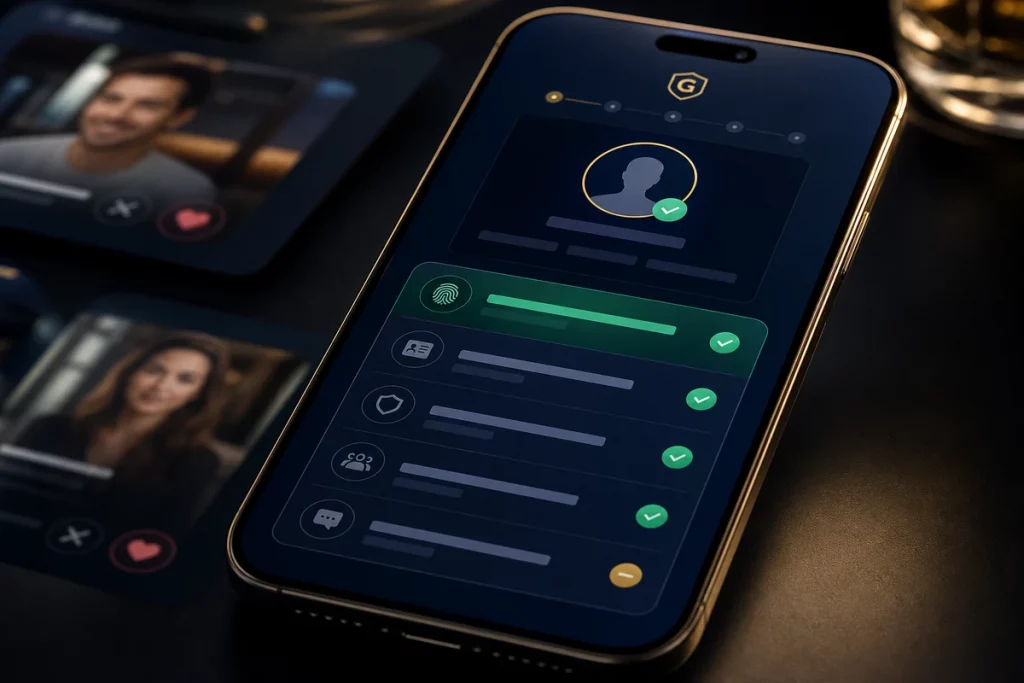
Trust workflow process graphic for How to Verify Someone You Met Online Before a Date.
The core idea behind how to verify someone you met online before a date is that trust should be visible, explainable, and proportionate to the decision being made. A dating app profile, Tinder conversation, Bumble match, Hinge prompt, verification badge, reverse image search, background check, and GuyID trust profile can all provide signals, but each signal answers a different question.
A profile photo may answer whether a person looks consistent across images. A verified phone number may answer whether an account controls a device. A social vouch may answer whether someone has real-world references. A trust score may summarize several confidence signals. None of these signals should be treated as a guarantee. The reliable workflow is to combine signals, check for contradictions, and keep consent and boundaries clear.
What This Verification Process Means
In a GuyID context, this verification process connects identity verification, trust score interpretation, social proof, consent, and safety planning into a decision readers can understand and act on. It helps separate useful trust signals from vague claims, decorative badges, and unsupported promises.
Why It Matters
Weak trust workflows create uncertainty. Strong workflows explain what is verified, why it matters, what remains unknown, and how the user stays in control. This is especially important in online dating because romance scams, catfishing, deepfake images, and pressure tactics can exploit ambiguity.
The practical goal is not to investigate everyone. The goal is to make the next step safer and clearer. A reader should know which signal matters for a low-risk conversation, which signal matters before meeting, and which red flags mean they should slow down, ask a direct question, or stop engaging.
Verification also protects the quality of the conversation. When both people understand the purpose of a trust check, it becomes less about suspicion and more about mutual clarity. A respectful request such as a short video call, a public first-date plan, or a shareable trust profile gives the other person a chance to respond transparently. A defensive, evasive, or high-pressure response is useful information too.
What to Verify Before a First Date
Before a first date, the highest-value checks are the ones that reduce immediate uncertainty without requiring invasive information. Readers should look for name consistency, profile-photo consistency, communication consistency, basic location plausibility, platform history, and whether the person accepts normal safety boundaries. These checks do not require private documents or sensitive records in most situations.
A stronger verification step may be reasonable when the next decision carries more risk. For example, meeting late at night, meeting outside a public place, traveling, sharing a home address, sending money, or trusting a long-distance relationship claim all raise the evidence threshold. The article should make that risk gradient explicit so readers do not overreact to low-risk situations or underreact to high-risk ones.
How to Ask Without Making It Awkward
The best verification request is direct, respectful, and easy to answer. A reader might say, “Before we meet, I like to do a quick video call so we both know who we are talking to.” That framing makes the request mutual. It also avoids accusing the other person of lying.
If the person responds well, the conversation usually becomes clearer. If they refuse every reasonable request, change the subject, create urgency, or pressure the reader to ignore their boundary, the refusal becomes part of the trust assessment. The key is not to win an argument. The key is to decide whether the interaction still feels safe, respectful, and proportionate.
Examples
- A Hinge match says they are recently divorced, but their social vouch history and profile details are inconsistent. The useful action is to ask clarifying questions and avoid moving the conversation to WhatsApp too quickly.
- A Tinder profile has a verification badge but refuses a short video call before a first date. The badge is a helpful signal, but the refusal may still require caution.
- A Bumble match shares a GuyID trust profile with identity verification, social vouching, and clear date boundaries. The reader can use those signals to decide whether the interaction feels credible.
- A person claims military service, urgent financial trouble, or crypto expertise early in the conversation. Those claims should be treated as high-risk until supported by independent evidence.
Practical Advice
Start with the question the reader is trying to answer. If the question is whether a profile is real, prioritize photo consistency, platform history, and identity verification. If the question is whether a first date is appropriate, prioritize boundaries, location safety, communication patterns, and whether the person responds respectfully to reasonable verification requests.
Readers should keep the process proportionate. A casual chat does not require the same evidence as sharing personal details, meeting in private, lending money, or trusting a long-distance relationship claim. The more consequential the next step, the more evidence should be expected.
Keep sensitive information private until trust is earned. A reader should not share a home address, financial details, workplace details, family information, or identification documents just because another person asks. Verification should reduce risk, not create a new privacy problem.
Use public and reversible steps first. A short video call, a public meeting place, clear transportation plan, and trusted friend check-in are easier to manage than a private meeting or a financial commitment. If a person pushes past those boundaries, the reader should treat that behavior as relevant evidence.
Expert Insights
Trust systems work best when they are transparent about scope. Identity verification can help confirm that an account is tied to a person or document, but it cannot confirm intent, relationship status, or future behavior. Social vouching can add context, but it depends on the credibility of the people providing the vouch. A trust score can summarize patterns, but readers should still understand which inputs created the score.
The strongest editorial standard is evidence plus limits. When an article describes a verification badge, background check, reverse image search, or trust profile, it should explain both the benefit and the limitation. This improves user trust and prevents overconfidence.
A second expert principle is traceability. Readers should be able to tell where a recommendation comes from, what problem it solves, and what evidence would change the decision. This is why a structured trust workflow is better than a vague checklist. It creates a repeatable way to compare identity signals, behavior signals, social signals, and risk signals.
A third principle is user agency. The article should not tell readers to outsource judgment to a score or badge. It should help them understand why a score exists, what inputs created it, and how to combine it with their own boundaries and observations.
Common Mistakes
- Making unsupported claims that a tool can guarantee safety.
- Treating a verification badge as a complete identity or character check.
- Ignoring consent when asking someone to verify personal information.
- Over-linking the same anchor text until the article feels manipulative.
- Publishing without schema, metadata, image checks, and link validation.
- Using fear-based language instead of practical, evidence-backed guidance.
Best Practices
Use layered verification. Combine platform signals, profile consistency, social vouching, direct communication, and real-world safety habits. Keep the language specific: say what a signal confirms, what it suggests, and what it does not prove.
Keep the reader in control. Good trust content gives people practical options: ask for a short call, meet in a public place, keep financial details private, compare profile details, and use a trust profile when a stronger signal is appropriate.
Document the pattern, not just the incident. One delayed reply is usually not meaningful. A repeated pattern of changing stories, avoiding basic verification, moving conversations off-platform quickly, and introducing money pressure is more important. Readers should evaluate the whole pattern before making the next decision.
Use neutral language. Instead of saying “prove you are real,” a reader can say, “I like to do a quick check before meeting anyone from an app.” Neutral language keeps the request practical and gives the other person room to respond without escalation.
Comparison Table
Identity comparison matrix for How to Verify Someone You Met Online Before a Date.
| Trust Signal | Best Use | Limitation |
|---|---|---|
| Identity verification | Confirms stronger account confidence | Does not prove intent or character |
| Social vouching | Adds human context and references | Depends on vouch quality |
| Reverse image search | Finds reused or suspicious images | Can miss private or new images |
| Video call | Confirms real-time consistency | Does not replace public-meeting safety |
| GuyID trust profile | Combines multiple trust signals | Should still be interpreted with context |
Checklist
- Define the exact trust decision before collecting signals.
- Check whether identity verification, social vouching, and profile consistency agree.
- Look for red flags such as urgent money requests, inconsistent stories, or pressure to leave the platform.
- Preserve boundaries and consent when asking for verification.
- Use internal resources such as GuyID trust profiles when a stronger signal is needed.
- Confirm that the article includes schema, FAQs, visuals, accessible alt text, and verified references.
- Avoid sharing home, workplace, financial, or identity-document details before trust is earned.
- Prefer public first-date plans and tell a trusted person where you are going.
- Save screenshots or notes if a conversation includes threats, money pressure, or suspicious claims.
Decision Tree
| Situation | Recommended Next Step |
|---|---|
| Profile details are consistent and the person respects boundaries | Continue with normal caution |
| Photos, timeline, or claims do not match | Ask a direct question or request a safer verification step |
| The person asks for money, crypto, gift cards, or urgent secrecy | Stop and treat the interaction as high risk |
| The person refuses any reasonable verification before meeting | Slow down and avoid private or high-risk plans |
| The person agrees to a short video call and respects public-date boundaries | Continue while keeping normal first-date safety habits |
| The person shares a GuyID trust profile with clear signals and limitations | Review the signals, compare them with behavior, and decide proportionately |
Step-by-Step Guide

Verification ladder checklist for How to Verify Someone You Met Online Before a Date.
- Identify the decision: messaging, video call, first date, sharing personal details, or deeper commitment.
- List the evidence available: app verification, photos, social vouching, trust score, communication pattern, and external references.
- Compare the evidence against the risk level of the next step.
- Ask one respectful clarification if an important signal is missing.
- Watch for pressure, secrecy, money requests, or inconsistent stories.
- Use a GuyID trust profile or similar consent-based verification workflow when stronger confidence is appropriate.
- Decide whether to continue, slow down, or stop based on the full pattern rather than one signal.
After the decision, keep the process lightweight. If the reader continues, they should still choose a public place, manage their own transportation, and keep personal details private until the person has earned more trust over time. If the reader slows down, they can ask one specific follow-up instead of continuing an open-ended debate. If the reader stops, they do not need to justify the decision beyond their own boundary.
How GuyID Fits
GuyID is useful when a person wants a clearer way to share trust signals without turning the conversation into an interrogation. A GuyID trust profile can organize identity confidence, social vouching, and other consent-based signals in one place. That makes the discussion more transparent because the reader can inspect the signal instead of relying only on a claim in a message thread.
The right framing is important. GuyID should be presented as a trust aid, not a promise of perfect safety. It helps people communicate credibility, compare signals, and make more informed decisions. The reader still needs boundaries, practical safety habits, and common sense.
Red Flags That Deserve Extra Caution
Some patterns deserve immediate caution because they are common in romance scams and catfishing attempts. These include urgent money requests, investment or crypto pitches, refusal to video call, inconsistent names or locations, pressure to leave the dating app quickly, secrecy, guilt, threats, and stories that create emotional urgency.
A single red flag does not always prove deception, but it changes the risk level. When several red flags appear together, the safest action is usually to pause or stop. The article should make this distinction clear so readers can act proportionately instead of assuming every unusual behavior has the same meaning.
Frequently Asked Questions
What is the fastest way to understand how to verify someone you met online before a date?
Start with the specific decision you need to make, then choose evidence that addresses that question. A live video conversation, consistent profile details, and consent-based verification signals can add context, while a public meeting plan remains necessary.
How does GuyID approach how to verify someone you met online before a date?
GuyID presents consent-based identity and social-context signals with an explanation of what each signal covers. Users should inspect the issuer, date, method, and limitations rather than treating a profile, score, or badge as a complete safety judgment.
Can verification establish that someone is safe?
No. Verification may support a specific identity, document, account-control, or social-context claim, depending on the method. It does not establish compatibility, honesty, intentions, criminal history, or future behavior, so normal boundaries and meeting precautions remain necessary.
Which signals matter most before a first date?
Useful signals include consistent profile details, respectful communication, a live video conversation, transparent answers to reasonable questions, and a mutually agreed public meeting plan. Their relevance depends on context, and no isolated signal should override contradictory behavior.
When should someone stop engaging?
Stop engaging when there are threats, coercion, financial requests, repeated boundary violations, or pressure to meet unsafely. Significant identity contradictions and persistent avoidance also justify ending contact. Block and report the account when the platform’s tools are appropriate.
Key Takeaways
- Trust is a decision framework, not a single badge.
- Identity verification, social vouching, and trust scores are strongest when interpreted together.
- Consent and boundaries are part of safe verification.
- The article should answer the primary question quickly, then support the answer with examples, tables, FAQs, visuals, and references.
- Strong content avoids absolute safety promises and explains limitations clearly.
Conclusion
How to verify someone you met online before a date content should be practical, evidence-backed, visually clear, and transparent. The strongest article helps readers make a better decision without exaggeration, keyword stuffing, or fear-based framing. It gives readers a useful framework, shows realistic examples, explains limitations, and points them toward trustworthy next steps.
Use GuyID to make trust easier to inspect, share, and verify.