Reader Briefing
Reader Briefing
Start here if you need a practical read on how to check fake dating profiles: step-by-step guide: who should use verification, what signals to check, and what to do before moving from online interest to an in-person plan.
Who this is for
- People meeting someone from a dating app or social platform.
- Anyone checking identity, profile consistency, and trust signals.
- People trying to avoid romance scams, fake profiles, or pressure tactics.
- Online daters improving conversations, profiles, or match screening.
You’ll learn
- How to evaluate identity signals without treating any single check as certainty.
- Which trust signals matter and how to weigh them together.
- How to spot inconsistencies, pressure, or behavior patterns that deserve caution.
- How to move from online conversation to a safer first meeting.
- Where GuyID tools fit into a quick pre-date screening workflow.
- How to compare options using practical safety and trust criteria.
Bottom line
Verification reduces uncertainty; it does not guarantee future behavior. Use a layered approach: confirm identity signals, compare profile consistency, ask for a short video call, keep early plans public, and slow down when someone pressures you to skip normal safety steps.
Key takeaways
- Identity verification improves confidence, not certainty.
- Patterns matter more than isolated incidents.
- Verify before meeting privately or sharing sensitive details.
- A short video call can reveal many inconsistencies.
- Pressure to skip reasonable safety steps is useful information.
Free Tools
Catfish Probability Detector
Check whether a dating profile has suspicious identity or photo signals.
Dating Bio Red Flag Detector
Review a bio for scam, pressure, or trust-warning language.
Dating Safety Checklist
Use free GuyID tools before moving from chat to a real date.
Next step
Create your GuyID trust profile
Share consent-based trust signals before a date without turning the conversation into an interrogation.
You’ve matched with someone attractive, their bio sounds great, and the conversation is flowing — but something feels slightly off. Maybe the photos are too polished. Maybe the responses are too perfect. Maybe you just want to be sure before investing more time. Knowing how to check fake dating profiles is the practical skill that separates cautious daters from scam victims. As AI-generated identities become increasingly convincing, checking profiles is no longer optional — it’s the minimum standard for safe online dating.
Start with a quick visual inspection, continue through reverse image search, and finish with behavioral analysis for sophisticated fakes that look polished on the surface. This platform-independent workflow for how to check fake dating profiles takes seconds to minutes per technique and costs nothing. By the end, you’ll be able to evaluate a dating profile’s authenticity with more confidence using practical verification tools.
NavigateTable of Contents35 sections
⚡ Key Takeaways
McAfee’s February 2026 research confirms fake profiles are a mainstream reality — not a rare occurrence.
Reverse image search catches the majority of fakes in 30 seconds
GuyID’s free reverse image search identifies stolen photos, reused AI-generated faces, and stock images — the foundation of most fake profiles. This single technique is the highest-impact check available.
AI fakes require new detection methods
AI-generated photos don’t appear in reverse image search because they’re originals. Detecting them requires visual inspection for AI artifacts, spontaneous photo requests, and identity verification through GuyID.
Check every profile, not just suspicious ones
The proactive approach checks every match as routine. The most dangerous fake profiles are the ones that don’t look fake — they only get caught when checking is systematic, not suspicion-driven.
Verified identity is the only fake-proof confirmation
When AI can fake photos, bios, and even video calls, the only thing it can’t fake is verified real-world identity. GuyID Trust Profiles — government ID + social vouching — provide the definitive confirmation no fake profile can survive.
Quick Visual Check: How to Check Fake Dating Profiles in 10 Seconds
Before reaching for any tool, you can identify many fake profiles through a quick visual scan that takes less than 10 seconds. Learning how to check fake dating profiles starts with training your eye to recognize the patterns that genuine profiles share — and that fake profiles consistently violate.
The Photo Check (5 Seconds)
- Count the photos. Real profiles typically have 4-6 photos showing different settings, outfits, times of day, and activities. A profile with only 1-2 photos, or with 5 photos that all look like the same photoshoot (similar lighting, similar poses, no variety), is suspicious. Scammers have limited photo material — either a small set stolen from one source or a batch generated by AI from the same prompt.
- Look for friends. Real people include at least one group photo — at a party, with friends at a restaurant, at an event. Scammers almost never include group shots because stolen photo sets rarely include the original person’s social context, and AI struggles to generate natural-looking group photos.
- Check for variety in settings. A real person’s camera roll spans their life — home, work, vacations, restaurants, outdoors, gym. If every photo shows the same type of setting (all outdoor, all studio-quality, all identical lighting), the photos may be sourced from a single controlled session rather than an actual life.
- Assess the quality spectrum. Real phone camera rolls include a mix of good and mediocre photos. If every single photo is professionally lit with perfect composition and magazine-quality results, the profile is either a professional model (unlikely) or using curated/generated content (likely).
The Bio Check (5 Seconds)
- Specificity test: Does the bio contain specific, verifiable facts about the person’s life? “Marathon runner, Thai food obsessive, data analyst at Shopify” is specific and checkable. “Love to travel and laugh, looking for my partner in crime” is generic and impossible to verify. Fake profiles overwhelmingly use the second style.
- Length and effort: A completely empty bio on an otherwise polished profile is suspicious — real people who invest effort in photos usually write something. Conversely, an extremely long bio that reads like a sales pitch or essay may be AI-generated or copied from a template.
- Career claims: Military, oil rig worker, international businessman, humanitarian — these are classic romance scammer career claims that explain both impressive lifestyle and inability to meet in person. Suspicion is warranted when you see these specific careers.
🔍
The 10-Second Decision Framework
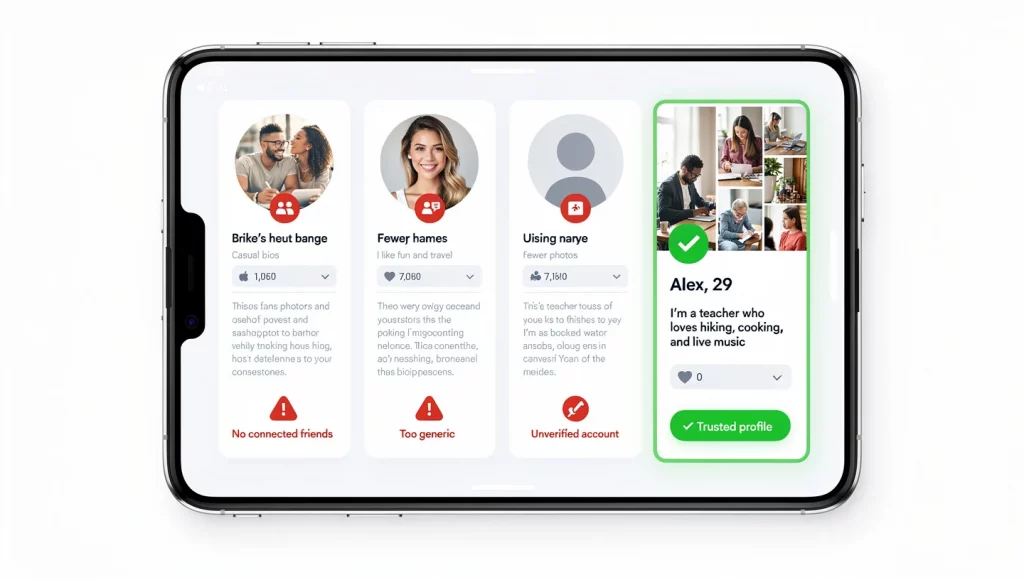
After the visual scan, assign a mental score: Green (varied photos with friends, specific bio, natural quality spectrum) — proceed to matching. Yellow (limited photos or generic bio, but nothing definitively suspicious) — match but run a reverse image search before deepening conversation. Red (1-2 perfect photos, no friends, vague bio with scam-career claims) — skip or reverse image search before matching. This 10-second framework is the fastest way to learn how to check fake dating profiles without any tools.
The Reverse Image Search Method: How to Check Fake Dating Profiles in 30 Seconds
Reverse image search is the single most powerful technique for how to check fake dating profiles — catching more fraud per second of effort than any other method. If you only learn one verification technique, make it this one.
Step-by-Step Process
- Save the profile photo. Screenshot or save the main profile photo to your phone. Most dating apps allow screenshots; if blocked, photograph your screen with another device.
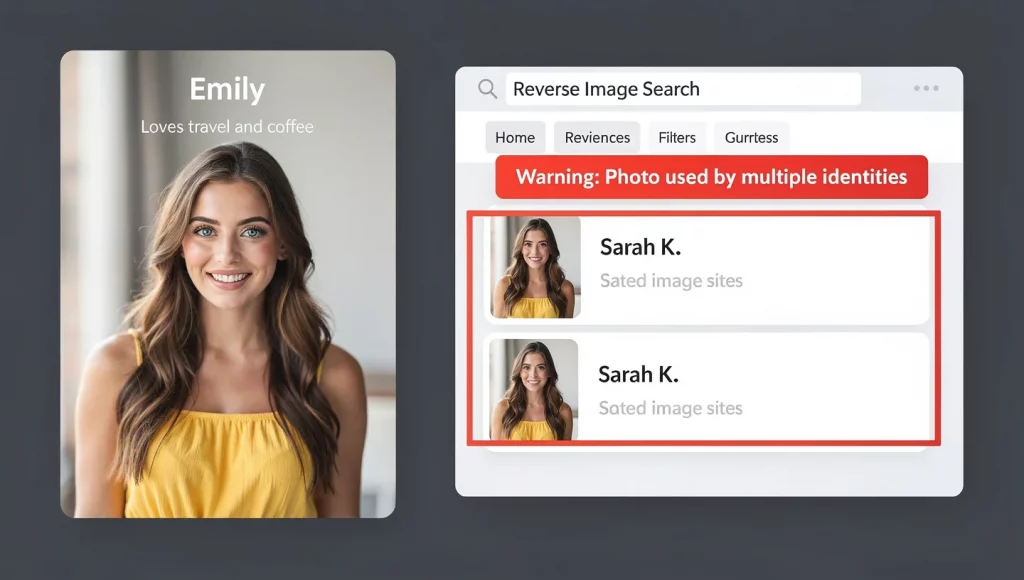
- Upload to GuyID’s reverse image search. This free tool is optimized for dating safety — checking against scam profile databases, stock photo libraries, and web-indexed images. Results appear in seconds.
- Search with Google Lens. Open Google Images, select its camera control, and submit the saved picture. Review both exact matches and visually related results across Google’s index.
- Check TinEye for modified versions. Upload to tineye.com to catch cropped, filtered, or color-adjusted versions of stolen photos that other tools might miss.
- Check Yandex for Eastern European sources. Upload to yandex.com/images for the strongest coverage of Russian and Eastern European social media — a common source for stolen dating profile photos.
How to Interpret Results
| Search Result | What It Means | Action |
|---|---|---|
| Photo appears under a different name on another site | The profile is using stolen photos — definitive fake | Unmatch immediately, report to the dating platform and all relevant agencies |
| Photo appears on a stock photography website | The profile used a purchased or free stock image — definitive fake | Report immediately |
| Same photo appears on multiple dating sites under different names | Scam operation reusing the same identity across platforms | Report to all platforms where it appears |
| Photo found on an Instagram/Facebook under the same name | Positive signal — the person exists on other platforms with matching identity | Proceed with confidence but continue verification |
| No results found | Could be genuine (personal photos not indexed) OR could be AI-generated (no source exists) | Proceed to AI photo detection and additional verification levels |
Critical Rule: Search ALL Photos, Not Just the Main One
Many scammers mix sources — their main photo might be AI-generated (no results), but their secondary photos are stolen from real people (detectable). Run every photo in the profile through reverse image search. Catching even one stolen photo in a set of five confirms the entire profile is fake. This thoroughness is what separates effective from superficial learning of how to check fake dating profiles.
How to Check Fake Dating Profiles Through Bio Analysis
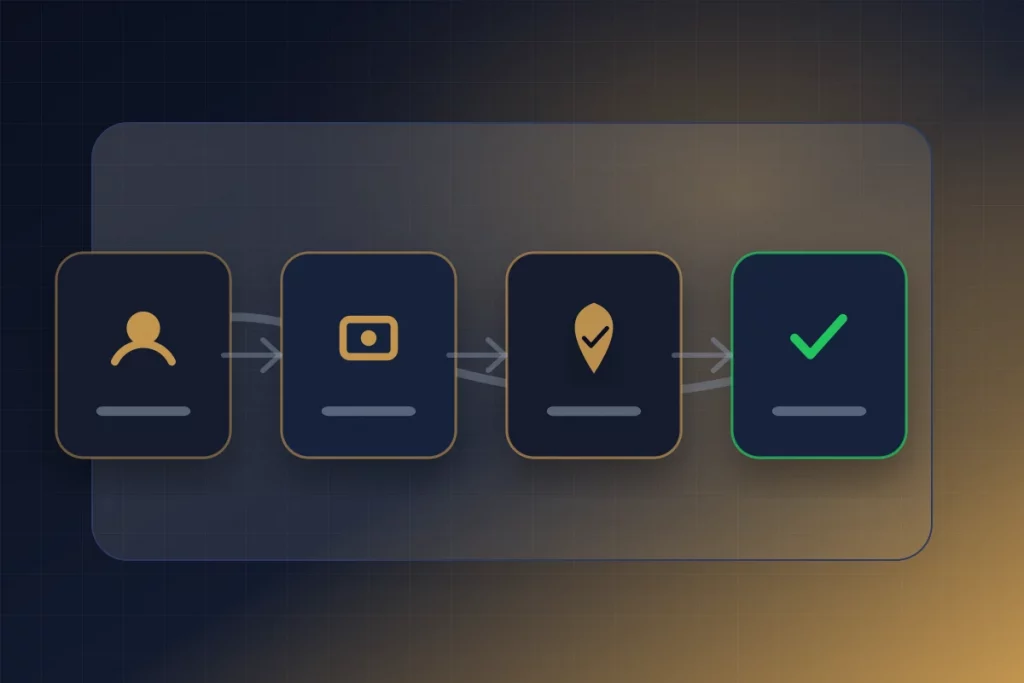
When reverse image search returns no results — which happens with AI-generated photos and genuinely personal photos alike — bio analysis becomes your next detection layer. Learning how to check fake dating profiles through their text catches patterns that photo analysis alone misses.
Use the Bio Red Flag Detector
Run the profile’s bio text through GuyID’s free dating bio red flag detector. This tool identifies language patterns statistically associated with scam profiles, catfish accounts, and manipulation-oriented bios. It catches what human readers often rationalize or overlook — particularly when attracted to the profile.
Manual Bio Red Flag Checklist
- Zero specifics: “I love life, travel, and good conversation” tells you nothing verifiable about the person. Real people can’t help being specific because they’re describing their actual life — “I run a small bakery in Brooklyn, weekend hiker, unreasonably obsessed with Korean dramas.”
- Exclusively emotional language: “Looking for my soulmate” and “ready for something real” are emotional hooks designed to attract, not describe. They substitute emotional appeal for biographical fact — a trade that real profiles rarely make at the expense of all personal detail.
- Scam-associated career patterns: Military deployment, oil rig work, marine engineering, international humanitarian work, “entrepreneur” with no specifics, or “investor” with no firm name. These careers explain wealth (attracting targets), unavailability (justifying no video calls or meetings), and sometimes financial need (setting up future money requests). See our complete romance scammer pattern guide for more career red flags.
- Too-perfect alignment with common desires: A profile that combines “family-oriented,” “financially stable,” “loves to cook,” “good communicator,” and “ready to settle down” is describing a wish list, not a person. Real people have quirks, contradictions, and interests that don’t fit neatly into a “perfect partner” template.
- Grammar inconsistencies: While AI chatbots have eliminated the broken English that used to characterize scam profiles, some fakes still show inconsistencies — alternating between very formal and very casual register, or using phrasing that doesn’t match the claimed nationality (British spellings from a claimed American, American idioms from a claimed European).
AI-Generated Photo Detection: How to Check Fake Dating Profiles in the Deepfake Era
The most challenging dimension of how to check fake dating profiles in 2026 is detecting AI-generated photos that have no original source to find through reverse image search.
Visual AI Detection Techniques
- Skin texture analysis: AI-generated skin is often unnaturally smooth — lacking the pores, minor blemishes, unevenness, and texture that real skin displays at normal photo resolution. Zoom into the face and compare the skin quality to what you’d expect from a smartphone selfie. If it looks like professional retouching on every photo, AI generation is more likely than consistent professional photography.
- Background inspection: AI struggles with complex backgrounds. Zoom into the area behind the person and look for: text that doesn’t form readable words (shop signs, book titles, screens), architectural impossibilities (windows that change size, walls at wrong angles), vegetation with unnatural patterns (branches connecting impossibly, leaves that merge into surfaces), and crowd faces that are smeared, distorted, or missing features.
- Accessory and detail check: Earrings that don’t match between ears, necklaces that merge into skin at the edges, glasses frames that bend incorrectly, watch faces showing nonsensical displays, and buttons or zippers that don’t align. AI generates these elements statistically rather than physically, creating subtle impossibilities.
- Hands and fingers: Despite massive improvements, AI still struggles with hands. Count the fingers (should be exactly 5 per hand). Check for impossible bending angles, merged digits, fingers that fade into backgrounds, and hands holding objects in physically impossible ways. Hands are the most reliable remaining visual tell for AI-generated images in 2026.
- Eye reflections: In a real photo, both eyes reflect the same light source at the same angle. AI-generated eyes sometimes show different reflections, asymmetric catchlights, or an unnaturally uniform iris pattern. Compare the reflections in the left and right eye — they should be mirror images from the same light source.
- The “uncanny valley” feel: Sometimes you can’t identify a specific artifact, but the photo feels slightly wrong — too perfect, too smooth, too magazine-quality for a casual dating profile. Trust that instinct. Your brain’s visual processing system detects anomalies that your conscious analysis can’t articulate. The feeling that something is “off” about a photo is a valid signal when learning how to check fake dating profiles.
The Spontaneous Photo Test
The most effective anti-AI verification technique: ask for a specific, spontaneous selfie. “Can you send me a photo holding up two fingers and pointing at something blue?” A real person can do this in 10 seconds from anywhere. No current AI can generate an on-demand photo matching specific spontaneous criteria. Any delay in producing the photo (suggesting it’s being generated) or refusal to comply is a significant red flag.
This technique works because AI excels at generating prepared content but cannot respond to unpredictable, real-world requests in real time. The spontaneous photo test exploits this fundamental limitation and will remain effective regardless of how AI image quality improves.
Behavioral Red Flags That Expose Fake Profiles During Interaction
Learning how to check fake dating profiles extends beyond the profile itself into how the person behind it behaves. Even profiles that pass visual and text analysis can reveal themselves through behavioral patterns during messaging.
Messaging Pattern Red Flags
- Instant, constant responses at all hours: AI chatbots operating scam profiles can send 60+ messages in 12 hours (McAfee Labs, 2026). If someone responds instantly regardless of time of day, never seems unavailable for work or sleep, and produces lengthy, perfectly composed messages within seconds of receiving yours — you may be talking to an AI-assisted operation rather than a real person.
- Generic emotional intensity without personal specifics: “I feel such a deep connection with you” after 24 hours of messaging. “I’ve never felt this way about anyone.” “You’re different from everyone else.” These love-bombing scripts are deployed from templates — they substitute emotional intensity for the personal specifics (remembering specific details from your conversation, referencing shared experiences) that characterize genuine developing connections.
- Avoidance of verifiable specifics: When you ask “What restaurant did you go to?” and they say “a great Italian place.” When you ask “What neighborhood do you live in?” and they say “downtown area.” When you ask “What project are you working on?” and they say “something exciting.” Each answer is plausible but unverifiable — by design.
- Rapid push to move off-platform: Requesting to move to WhatsApp or personal phone within the first few messages is one of the most consistent behavioral indicators of a fake profile with scam intent. The move serves the scammer’s operational needs (escaping platform monitoring) while being framed as relationship progression.
- Refusal to video call: The most definitive behavioral red flag when learning how to check fake dating profiles. A person who texts constantly but consistently refuses or deflects video call requests — citing broken cameras, bad internet, work restrictions, or scheduling conflicts that never resolve — is hiding their visual identity because it doesn’t match the profile.
The Catfish Probability Check
Use the GuyID catfish probability detector for an objective risk assessment that considers multiple signals simultaneously. When you’re attracted to someone, your brain actively rationalizes away individual red flags — “everyone has a bad camera sometimes,” “some people just don’t like video calls.” The catfish detector evaluates the full picture objectively, catching the pattern that your emotionally invested brain downplays.
Platform-Specific Fake Profile Patterns: How to Check on Each App
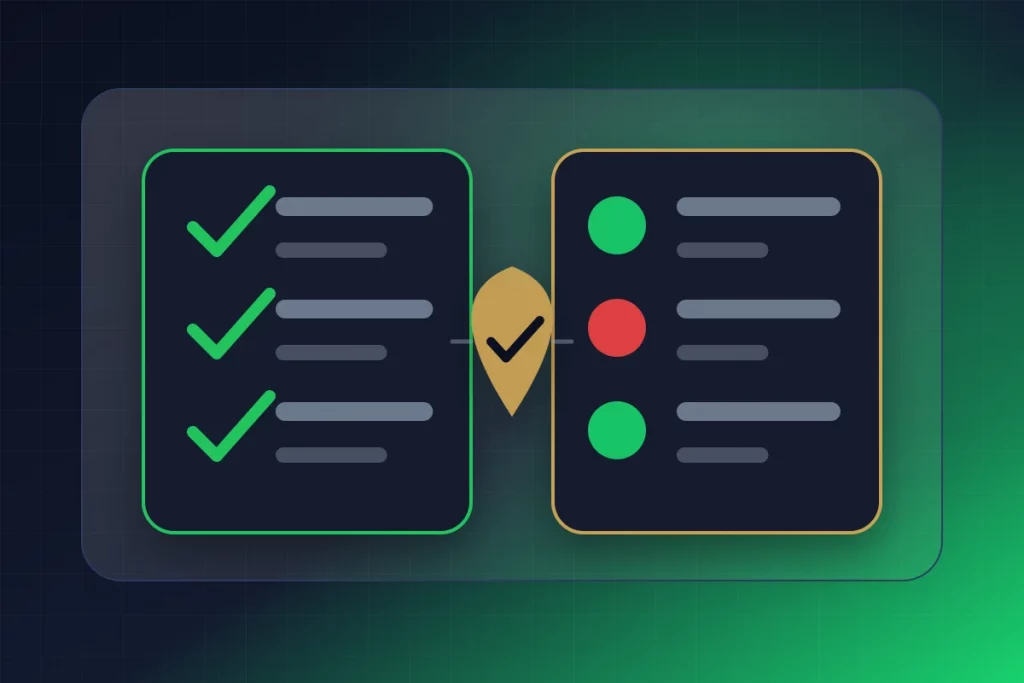
Different dating apps have different fake profile characteristics because each platform’s design creates specific exploitation opportunities. Knowing the platform-specific patterns sharpens your ability to understand how to check fake dating profiles on whichever app you use.
Tinder Fakes
Tinder’s swipe-based model creates a high-volume, low-scrutiny environment where fake profiles thrive. Common Tinder fake patterns include: profiles with verification badges but AI-generated photos (badge confirms liveness, not photo authenticity), bot accounts that immediately send links to external websites within the first message, and profiles that push for WhatsApp migration within the first few messages.
Bumble Fakes
Bumble’s women-message-first design means fake female profiles must wait for the real woman to message first (since the scammer targets men by creating attractive female profiles). This creates a slightly different dynamic — the fake profile is designed to attract likes and matches, then engages when the target (woman) sends the first message. Bumble fakes tend to be more polished than Tinder fakes because the platform’s design rewards quality over volume. Look for the same signs — limited photo variety, generic bios, rapid off-platform pressure — but expect a slightly more sophisticated presentation.
Hinge Fakes
Hinge’s prompt-based profile format provides additional fake-detection signals. Genuine profiles answer Hinge’s prompts with specific, personality-revealing responses. Fake profiles answer generically: “A life goal of mine: to be happy” or “I’m looking for: someone who gets me.” The gap between generic prompt answers and the detailed, quirky, specific answers that real people give is one of the clearest signals when checking fake dating profiles on Hinge.
POF Fakes
POF’s weaker verification, older-skewing demographic, and free messaging create the lowest barrier environment for scam operations. Apply maximum scrutiny to every POF match: reverse image search every photo, analyze every bio, and insist on video calls before any emotional investment.
Facebook Dating Fakes
Facebook Dating fakes are often the most convincing because they’re backed by Facebook accounts with years of history. Hacked Facebook accounts — taken over by scammers — inherit the original user’s entire social proof: friends, posts, photos, check-ins, and years of activity. When checking a Facebook Dating profile, look for recent behavioral changes: suddenly posting very different content, sudden changes in writing style, new friends from unexpected regions, and activity patterns that don’t match the account’s historical behavior.
The Conversation Test: Catching Fakes Through Strategic Messaging
One of the most effective methods for how to check fake dating profiles is testing the person behind the profile through strategic conversation — questions designed to reveal whether you’re talking to a real person with a real life or a scammer following a script.
The Specificity Escalation
Start with normal getting-to-know-you questions, then gradually escalate the specificity of your follow-ups. This technique catches both human scammers and AI chatbots because fabricated answers collapse under sustained detail pressure.
- Level 1 (Normal): “What do you do for work?” — Any scammer or bot can handle this. Generic answer expected.
- Level 2 (Specific): “Oh cool, what’s your team like? How many people?” — Requires remembering a fabricated detail and building on it consistently.
- Level 3 (Verifiable): “That’s interesting — what floor is your office on? I have a friend who works near [area], do you know [restaurant name]?” — Real answers are instantly verifiable. Fabricated answers are either vague or incorrect about real locations.
- Level 4 (Spontaneous): “Send me a photo of your lunch right now! I want to see what you’re eating 😄” — This real-time request requires physical existence and cannot be answered with pre-prepared content or AI generation.
A real person answers all four levels naturally, with increasing specificity and organic detail. A scammer or bot performs well at Level 1, adequately at Level 2, begins deflecting at Level 3, and either refuses or produces delayed responses at Level 4.
The Contradiction Test
Introduce a deliberate contradiction based on something they previously told you. “Wait, last week you said you live in Brooklyn — but earlier today you mentioned your commute from New Jersey?” A real person catches the confusion immediately and clarifies. A scammer managing multiple targets may not remember what they told you versus another target, and either confirms the contradiction or smoothly explains it away without the emotional reaction (confusion, mild irritation) that a genuine person would display.
The Local Knowledge Test
Ask about their claimed city with progressively specific local knowledge questions. “What’s your favorite restaurant in [their city]?” is Level 1. “Oh I’ve heard of that area — is it near the park with the big fountain?” (inventing a fictional landmark) is the trap. If they agree that the restaurant is near a fountain you made up, they don’t actually live where they claim.
Advanced Checks: When Basic Methods Aren’t Enough
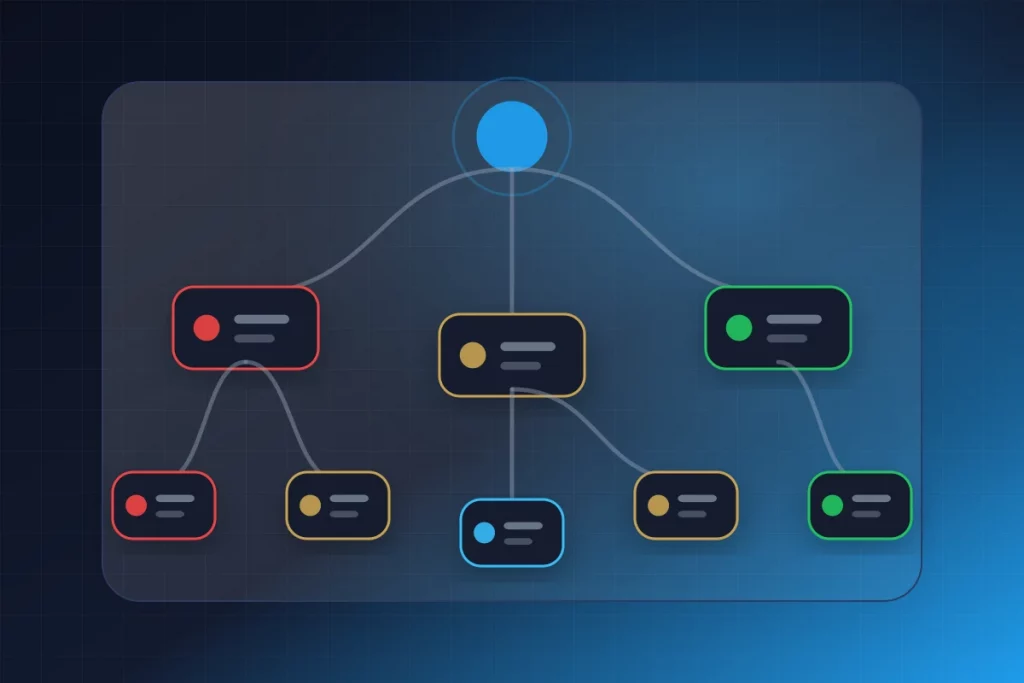
For matches that pass basic visual inspection, reverse image search, bio analysis, and conversation testing — but you want additional confirmation before meeting — these advanced techniques provide the highest level of certainty in how to check fake dating profiles.
Video Call with Active Testing
A video call is the single most effective advanced check — because the majority of fake profiles simply cannot produce the real person depicted in the photos. Request a video call within the first week and use the active deepfake detection techniques: full head turns (causes deepfake distortion), hand across face (causes overlay flickering), room/lighting changes (forces software adaptation), and spontaneous actions. A genuine person handles all of these naturally. A deepfake or excuses reveal the fake.
Social Media Cross-Reference
Search their claimed name on LinkedIn, Instagram, and Facebook. Cross-reference their dating app claims (age, career, location, lifestyle) against their public digital footprint. Inconsistencies — different age on LinkedIn, different city on Instagram, no employer match — indicate fabrication. See our complete verification guide for the detailed social media cross-reference process.
GuyID Trust Profile Request
For an additional consent-based check, ask whether they will share a GuyID Trust Profile link. Read the profile signal by signal: confirm which identity checks were completed, whether independent people supplied vouches, and whether the details remain consistent with the dating profile and conversation. Treat the result as corroborating evidence rather than proof of good intentions; verification reduces uncertainty but cannot eliminate it.
The request itself is also a test: a genuine person understands and cooperates with reasonable safety requests. A person operating a fake profile deflects, makes excuses, or disappears. Either response gives you the information you need.
What to Do When You Find a Fake Dating Profile
Once you’ve confirmed a profile is fake through these techniques for how to check fake dating profiles, take these steps to protect yourself and others.
If No Money Was Exchanged
- Do not confront the fake profile. This alerts the scammer and serves no protective purpose. They’ll delete the profile and create a new one.
- Report to the dating platform. Use the in-app reporting function with as much detail as possible — mention the reverse image search results, the specific red flags you identified, and any evidence of scam behavior. This helps the platform remove the profile before it targets more vulnerable users.
- Report to the FBI’s IC3 at ic3.gov if the profile showed scam intent (love-bombing, off-platform pressure, financial requests). Even without money lost, your report contributes to pattern identification that helps catch scam networks.
- Block and move on. Don’t invest further time or emotional energy on a confirmed fake.
If Money Was Exchanged
Follow the complete romance scammer reporting process immediately: contact your bank for potential financial recovery, report to IC3, FTC, the dating platform, and any social media platforms involved. Time is critical — wire transfer recalls have the highest success rate within 24 hours.
Summary: The Complete Fake Profile Detection Checklist
Knowing how to check fake dating profiles is a systematic process that becomes quick and automatic with practice. Here’s the complete checklist organized by speed and effort.
🟢 10-Second Visual Scan (Every Profile You See)
☐ Photo variety — different settings, outfits, times of day?
☐ Group photos — any friends visible?
☐ Quality spectrum — mix of good and casual photos?
☐ Bio specificity — concrete details vs. vague platitudes?
☐ Career claims — military/oil rig/international = flag
Use this as a quick first-pass screen for obvious inconsistencies.
🟡 30-Second Reverse Image Search (Every Match)
☐ GuyID reverse image search — main photo
☐ Google Images — supplementary check
☐ All photos searched (not just main photo)
☐ Results interpreted per the results table above
Use this to investigate stolen photos and reused profile images.
🔵 2-Minute Deep Analysis (Matches You’re Interested In)
☐ GuyID bio red flag detector
☐ GuyID catfish probability detector
☐ AI photo characteristics check
☐ Social media cross-reference (LinkedIn, Instagram, Facebook)
Use this to examine AI-image indicators and more sophisticated profile inconsistencies.
🟣 Advanced Verification (Before Meeting)
☐ Video call with active deepfake testing
☐ Spontaneous selfie request
☐ GuyID Trust Profile link request
☐ Check Trust Tier, ID status, social vouches
Time: 5-15 min | Cost: Free to check | Catches: everything
Learning how to check fake dating profiles is a practical dating skill. Systematic checks can surface conflicting names, reused photos, implausible profile details, and resistance to live interaction before you invest more trust. No single test proves that a person is safe, but combining independent signals gives you a stronger basis for deciding whether to continue, pause, or report the account.
Make checking a habit. Use GuyID’s free safety tools on every match. Request verified trust profiles before meeting. Share this guide with anyone who dates online. The fake profiles won’t disappear — but your vulnerability to them can.
Check Any Dating Profile for Free — Right Now
GuyID provides 60+ free safety tools: reverse image search, catfish probability detection, bio red flag analysis, and the only Level 3 identity verification that confirms who someone actually is. Women check trust profiles for free.
Try Free Safety Tools
Learn About GuyID