Reader Briefing
Reader Briefing
Start here if you need a practical read on signs of a romance scammer in person: 20 red flags: who should use verification, what signals to check, and what to do before moving from online interest to an in-person plan.
Who this is for
- People meeting someone from a dating app or social platform.
- Readers preparing for a first in-person date.
- Anyone checking identity, profile consistency, and trust signals.
- People trying to avoid romance scams, fake profiles, or pressure tactics.
You’ll learn
- How to evaluate identity signals without treating any single check as certainty.
- Which trust signals matter and how to weigh them together.
- How to spot inconsistencies, pressure, or behavior patterns that deserve caution.
- How to move from online conversation to a safer first meeting.
- Where GuyID tools fit into a quick pre-date screening workflow.
- When to slow down, ask for more context, or walk away.
Bottom line
Verification reduces uncertainty; it does not guarantee future behavior. Use a layered approach: confirm identity signals, compare profile consistency, ask for a short video call, keep early plans public, and slow down when someone pressures you to skip normal safety steps.
Key takeaways
- Identity verification improves confidence, not certainty.
- Patterns matter more than isolated incidents.
- Verify before meeting privately or sharing sensitive details.
- A short video call can reveal many inconsistencies.
- Pressure to skip reasonable safety steps is useful information.
Free Tools
Catfish Probability Detector
Check whether a dating profile has suspicious identity or photo signals.
Dating Bio Red Flag Detector
Review a bio for scam, pressure, or trust-warning language.
Dating Safety Checklist
Use free GuyID tools before moving from chat to a real date.
Next step
Create your GuyID trust profile
Share consent-based trust signals before a date without turning the conversation into an interrogation.
Most dating safety advice focuses on catching scammers online — but what happens when a scammer actually shows up? The signs of a romance scammer in person are different from the digital red flags you’ve been taught to watch for, and recognizing them could mean the difference between a safe first date and a devastating financial or emotional trap. While the majority of romance scammers never meet their targets face-to-face, a growing subset — particularly those running pig butchering investment scams and long-con emotional extraction operations — do meet in person to cement trust before the financial exploitation phase begins.
This guide covers every sign of a romance scammer in person — behavioral patterns, conversational tells, evasion tactics, financial manipulation in face-to-face settings, and the verification steps that confirm whether someone is genuine before you’re emotionally or financially exposed.
NavigateTable of Contents28 sections
⚡ Key Takeaways
Meeting in person doesn’t mean they’re legitimate
A growing number of romance scammers — particularly pig butchering operators and long-con artists — meet in person specifically to cement trust before financial exploitation. An in-person meeting is not automatic proof of authenticity.
Evasiveness about personal details is the #1 in-person tell
Scammers meeting in person cannot provide consistent, verifiable personal details — where they live, where they work, who their friends are — because their identity is partially or fully fabricated.
Controlling the environment is a power play
Scammers choose private, isolated meeting locations. They resist meeting your friends or going to places where you’re known. They control the narrative by controlling the setting.
Financial requests accelerate after in-person meetings
The in-person meeting builds trust that makes subsequent financial requests dramatically more effective. If money requests begin shortly after meeting — even plausible ones — recognize the pattern.
Verify identity BEFORE meeting, not after
Use GuyID’s free safety tools and ask for a verified trust profile before any in-person meeting. Confirming identity beforehand makes in-person red flags easier to detect because you have a baseline of verified truth.
When Romance Scammers Actually Meet in Person: Understanding the Exception
Before examining the specific signs of a romance scammer in person, it’s important to understand which types of scammers actually show up to in-person meetings — because the vast majority don’t. Traditional romance scammers operating from overseas scam compounds in Nigeria, Myanmar, or Cambodia will never meet you.
The scammers who do meet in person typically fall into several categories. First, domestic romance scammers — people who are physically present in your city but use fake or embellished identities on dating apps to manipulate multiple targets simultaneously for money, housing, gifts, or emotional exploitation. These are not overseas criminal networks — they’re individuals who exploit the dating app ecosystem locally.
Second, pig butchering operators with local operatives. Some sophisticated pig butchering networks employ local representatives who meet targets in person to establish trust, then introduce the fake investment platform. The in-person meeting dramatically increases the victim’s confidence in the “investment” because they’ve met the person recommending it.
Third, catfish daters — people who use significantly misleading profiles (outdated photos, false career claims, fabricated life details) to secure dates they wouldn’t get honestly. While not always financially motivated, catfish daters share many behavioral patterns with financial scammers and the signs of a romance scammer in person apply equally to both.
Understanding which type you might encounter changes how you interpret the signs of a romance scammer in person. The domestic manipulator exhibits different patterns than the pig butchering operative, who behaves differently from the catfish. This guide covers the warning signs common to all three variants.
Behavioral Signs of a Romance Scammer in Person
The most reliable signs of a romance scammer in person are behavioral patterns that reveal a fabricated or manipulative identity. These are actions and reactions — not just words — that genuine people don’t exhibit.
Evasiveness About Verifiable Personal Details
This is the single most consistent sign of a romance scammer in person. When you ask specific, verifiable questions — “What street do you live on?” “Which office is yours at the company?” “What’s your friend group like?” “Where did you go to school?” — a scammer provides vague or deflecting answers. They’ll say “I live near downtown” rather than naming a street. They’ll describe their job in general terms rather than naming specific colleagues, projects, or workplace details. They’ll claim to be “private” about their address and workplace — framing evasion as a personality trait rather than a deception tactic.
A genuine person answering these questions would provide specific, verifiable details without hesitation — because those details are true. “I live on Oak Street, near the coffee shop.” “I work in the marketing department at Acme Corp — my office is on the 4th floor.” Specificity is easy when you’re telling the truth. Evasiveness is necessary when you’re fabricating.
Test this by asking progressively more specific questions about the same topic across the date. If you ask about their work, follow up with: “Oh, what’s your commute like?” “What did you have for lunch at the office today?” “How many people are on your team?” Each follow-up question requires additional fabrication — and fabricated details become inconsistent under sustained questioning. Real details remain consistent because they’re drawn from memory, not invention.
Inconsistencies Between Online and In-Person Persona
Pay close attention to whether the person in front of you matches the person you’ve been messaging. Signs of a romance scammer in person often emerge as discrepancies between their digital and physical identity. Their age may appear different from what they claimed. Their accent may not match their claimed background. Their knowledge of their supposed profession may be superficial — they talk about being an investment banker but can’t discuss markets with any depth, or they claim to be a doctor but stumble over basic medical terminology.
Career fabrication is one of the most common signs of a romance scammer in person. Scammers claim impressive careers to attract targets — finance, medicine, tech, military — but their actual knowledge of these fields is shallow. If someone claims to be a software engineer, ask what language they code in. If they claim to work in finance, ask about their firm’s recent performance. These aren’t interrogation tactics — they’re the natural curiosity of someone getting to know a potential partner. A real professional answers enthusiastically. A fabricator deflects or provides surface-level answers that don’t withstand follow-up questions.
Excessive Charm Combined with Controlled Disclosure
A genuine person on a first date is somewhat nervous. They share some things, hold back others, occasionally say something awkward, and display the natural imperfections of human interaction. A scammer performing a role is more likely to be consistently, smoothly charming — making strong eye contact, saying exactly the right things, complimenting you with rehearsed precision, and maintaining an energy level that feels polished rather than natural.
Simultaneously, notice what they share about themselves. Scammers practice “controlled disclosure” — they share emotional-sounding personal stories (deceased parent, difficult childhood, past heartbreak) that generate sympathy and bonding, while avoiding factual details that could be verified. They’ll tell you a moving story about losing their father but can’t name the hospital. They’ll describe their childhood home in emotional terms but can’t name the neighborhood. The emotions are performed; the facts are withheld.
Conversational Red Flags: What Romance Scammers Say (and Don’t Say) in Person
The specific language patterns during in-person meetings reveal signs of a romance scammer in person that text-based communication can hide. Face-to-face conversation exposes fabrication in ways that carefully composed WhatsApp messages never do.
Redirecting Personal Questions
Scammers are trained to redirect conversations away from their own verifiable details and toward emotional topics that build bonding without exposure. If you ask “Where exactly do you work?” and they respond with “You know what, let’s not talk about work — tell me more about your passions,” this redirect serves their operational needs, not the conversation’s natural flow. One redirect is normal — everyone has topics they’d rather discuss on a first date. Multiple redirects every time you ask for concrete personal information is a pattern indicating fabrication.
Future-Pacing Without Present Grounding
Scammers talk extensively about the future — where you’ll travel together, the life you’ll build, how special your connection is — while providing remarkably little concrete information about their present life. This technique, called future-pacing, creates emotional investment in a shared vision that doesn’t require the scammer to reveal verifiable facts. If someone spends more time describing your future together than describing their actual current life, that imbalance is one of the signs of a romance scammer in person.
Name-Dropping Without Substance
Some scammers bolster their fabricated identity by mentioning impressive-sounding connections, experiences, or achievements — but the details don’t withstand scrutiny. “I was at a conference with the CEO of [major company]” — but they can’t describe the conference, the venue, or what the CEO talked about. “I just got back from Tokyo” — but they can’t name a single restaurant, neighborhood, or experience from the trip. The name-drops create an impression of success; the lack of supporting detail reveals the fabrication.
Emotional Intensity Disproportionate to the Interaction
If someone you’re meeting for the first (or second) time in person tells you they’re falling in love with you, that you’re their soulmate, or that they’ve never felt this way — this in-person love-bombing is a significant red flag. In-person love-bombing is even more potent than digital love-bombing because the physical presence — eye contact, touch, proximity — amplifies the neurochemical response. But the sentiment is equally manufactured. Genuine romantic feelings develop over multiple interactions over weeks. Declarations of deep love during a first meeting are performance, not authentic emotion.
“A genuine person on a first date is a complex mixture of excitement, nervousness, hope, and self-consciousness. A scammer on a first date is a performance — smooth, charming, emotionally intense, and strategically vague. The absence of vulnerability is itself a form of vulnerability to detect.”

Evasion and Control Tactics: Signs of a Romance Scammer Controlling the Setting
How a person manages the logistics of an in-person meeting reveals important signs of a romance scammer in person. Scammers prefer environments they can control and situations where they dictate the terms.
Location Control
- Insisting on private or isolated meeting locations: A scammer may push for meetings at their home, your home, a hotel, or a quiet restaurant where they control the environment. Public, well-lit, populated venues make it harder for them to maintain their performed persona and easier for you to leave if you feel uncomfortable. If they resist your suggestions for busy public places, note that resistance.
- Avoiding your familiar territory: If they consistently refuse to meet near your neighborhood, your favorite restaurant, or any place where you might run into people you know, they may be avoiding exposure to your social network — people who might ask questions that challenge their fabricated identity.
- Reluctance to meet your friends or family: Even casually mentioning “my friend works near there, maybe we’ll run into her” may produce visible discomfort in a scammer. Every additional person who meets them is a potential exposure point. Genuine daters are typically happy to meet your social circle eventually — scammers avoid it.
Information Control
- Not sharing their home address: By the second or third date, a genuine person is comfortable sharing general proximity of where they live, even if not their exact address. A scammer avoids this because their claimed address may not exist, they may live in a completely different area, or their home environment would contradict their claimed lifestyle.
- Keeping their phone screen hidden: Scammers managing multiple targets keep their phone screen tilted away from you during dates. Notifications from other targets, dating app messages, or scam operation group chats would blow their cover instantly. If someone seems unusually protective of their phone screen during a date — consistently angling it away, turning it face-down, or stepping away to respond to messages — consider what they might be hiding.
- Avoiding being photographed together: Scammers don’t want photographic evidence linking them to their targets, especially evidence that could be shared on social media and seen by other targets. If they consistently avoid selfies, group photos, or tagging on social media, this is one of the signs of a romance scammer in person.
Pace Control
- Pushing physical intimacy early: Some scammers use physical intimacy as a manipulation accelerant — sex creates oxytocin bonding that deepens attachment faster than any conversation. If someone pushes for physical intimacy on the first or second date with an urgency that feels performative rather than organic, they may be using intimacy as a tool for accelerated emotional control.
- Creating artificial urgency: “I’m only in town for a few days,” “My schedule is crazy next month,” or “I have to travel for work soon.” These time pressures — real or fabricated — force the relationship to progress faster than it naturally would, reducing your time for critical evaluation and independent verification.
Financial Manipulation in Person: When the Ask Comes Face-to-Face

Financial manipulation in person is one of the most definitive signs of a romance scammer in person, and it’s particularly dangerous because the in-person context makes money requests feel more legitimate and harder to refuse than digital requests.
The “Natural” Expense Sharing Trap
Unlike the dramatic emergency stories common in digital romance scams, in-person financial exploitation often begins more subtly. The scammer “forgets their wallet” on a date. They suggest expensive activities and let you pay. They casually mention financial stress and see how you respond. These aren’t necessarily scam indicators in isolation — anyone can forget a wallet. But when a pattern emerges where you’re consistently covering expenses while they describe a lifestyle they apparently can’t afford, the manipulation is becoming visible.
The Post-Meeting Financial Pivot
The most dangerous financial pattern is when money requests begin shortly after in-person meetings — not during the meetings themselves. The scammer meets you, deepens the emotional connection through physical presence and intimacy, and then — within days of the meeting — introduces a financial need via WhatsApp or text. The in-person meeting served its purpose: it built the trust layer that makes the subsequent financial request dramatically more effective.
“We just met and it was amazing — and now they need help with a medical bill” is a pattern that should immediately trigger your awareness of signs of a romance scammer in person. The timing is not coincidental. The meeting was the investment; the money request is the return.
Investment Introduction in Person
For pig butchering operations with local operatives, the in-person meeting is specifically designed to introduce the fake investment platform with maximum credibility. The scammer shows you the platform on their phone, demonstrates their own “profits,” and frames investing together as a shared activity that strengthens the relationship. The physical demonstration — watching them navigate the (fake) platform in real-time — creates a false sense of legitimacy that screen-sharing over video call cannot match.
⚠️
The In-Person Money Rule
The same rule applies in person as online: never provide money, invest in platforms, or share financial information with someone you haven’t independently verified through government ID and social vouching. An in-person meeting feels like verification — but it only confirms that a physical person exists, not that their identity, intentions, or financial recommendations are legitimate. Verify through GuyID before meeting, and maintain financial boundaries regardless of in-person chemistry.
The Catfish Variant: When They Don’t Match Their Profile
A common category of signs of a romance scammer in person involves the catfish scenario — showing up and discovering the person doesn’t match their dating profile. While not all catfish are financial scammers, the deception reveals a willingness to manipulate that should be taken seriously.
Appearance Discrepancies
They appear significantly older than their profile photos. Their body type doesn’t match. Their hair color or style is completely different. They look like a vaguely similar but distinctly different person. These discrepancies indicate that the profile photos were either heavily filtered, years outdated, or potentially stolen from someone else — each scenario involving deliberate deception.
Identity Discrepancies
More concerning than appearance changes are identity discrepancies. If their name, career, age, or life details don’t match what they told you online, you’re dealing with someone who constructed a false identity to attract you. The deception may be “minor” (shaving five years off their age) or major (using a completely different name), but any deliberate identity falsification is a red flag that should make you question everything else they’ve told you.
How to Respond
If someone shows up and doesn’t match their profile, you have every right to end the date immediately. You are not obligated to give them “a chance” despite the deception. Their decision to deceive you was made before you met — your decision to leave is a proportionate response. If you choose to stay and talk, maintain full awareness that you’re interacting with someone who has already demonstrated willingness to manipulate you — and adjust your trust accordingly.
First Date Safety Checklist: Protecting Yourself When Meeting Someone New

Beyond recognizing signs of a romance scammer in person, these safety practices protect you physically and financially during any first meeting with someone from a dating app.
🟢 Before the Date
☐ Run their photos through GuyID’s reverse image search
☐ Complete at least one video call to confirm they match their photos
☐ Ask for a verified GuyID Trust Profile link
☐ Tell a friend who you’re meeting, where, and when
☐ Share your match’s profile photo with your friend
☐ Set a check-in time — “I’ll text you at 8pm”
🟡 During the Date
☐ Meet in a public, well-lit, populated location
☐ Arrange your own transportation — don’t get picked up
☐ Watch for evasiveness about personal details
☐ Note inconsistencies between online and in-person persona
☐ Monitor for love-bombing intensity disproportionate to the interaction
☐ Keep your drink in your sight at all times
🔴 Red Lines — Leave Immediately If
☐ They don’t match their profile photos
☐ They pressure you to go to a private/isolated location
☐ They ask for money or mention financial opportunities
☐ They become aggressive when you set boundaries
☐ They refuse to let you leave or create situations where leaving is difficult
☐ Your instinct tells you something is wrong
How to Verify Someone Before Meeting in Person
The best defense against signs of a romance scammer in person is verifying their identity before you ever sit across from them. Pre-meeting verification eliminates the scammer’s primary advantage — the trust that in-person presence creates.
Verification Stack (Complete Before Any In-Person Meeting)
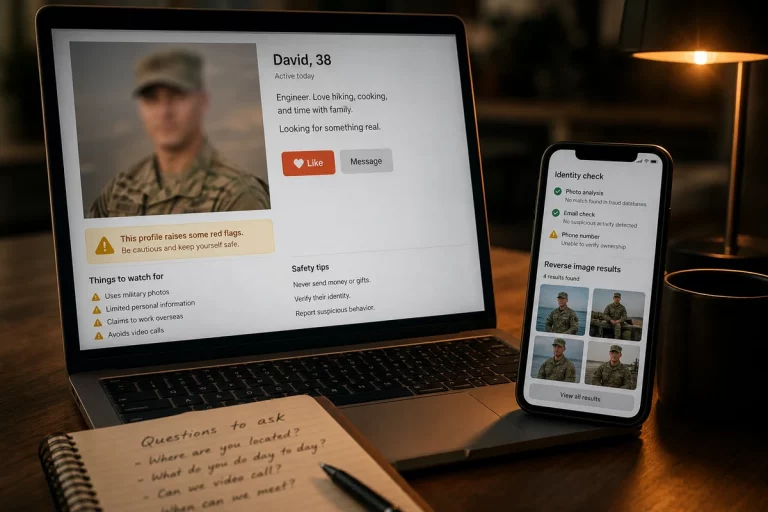
- Reverse image search: Run all their dating profile photos through GuyID’s free reverse image search, Google Images, TinEye, and Yandex. If their photos appear under different names, you know before meeting that their identity is fabricated.
- Catfish probability analysis: Use the catfish probability detector for an objective, data-driven risk assessment based on multiple profile signals. This provides a second opinion when your emotions may be influencing your judgment.
- Video call verification: At least one video call before meeting confirms they match their photos and can interact naturally. Use the active deepfake detection techniques — full head turns, hand-over-face movements — to ensure the video is authentic.
- Social media cross-reference: Search their name on LinkedIn, Instagram, and Facebook. A real person has years of authentic digital history with real connections, tagged photos, and consistent biographical details. A fabricated identity has thin, recently created, or inconsistent social media.
- GuyID Trust Profile review: Ask whether they are willing to share a GuyID Date Mode link. Review the identity checks and independent vouches it actually contains, then compare those signals with the person’s behavior and the details shared during your conversations. A Trust Profile can add useful evidence before a meeting, but it does not guarantee character, intentions, or safety.
Completing this verification stack before meeting means that any signs of a romance scammer in person are easier to detect because you have a verified baseline to compare against. When you’ve confirmed someone’s name, photo, workplace, and social connections before sitting down across from them, inconsistencies in their in-person behavior become immediately apparent.
Summary: Recognizing Signs of a Romance Scammer in Person
The signs of a romance scammer in person cluster around five core patterns: evasiveness about verifiable personal details, inconsistencies between online and in-person identity, environmental and informational control tactics, emotional intensity disproportionate to the relationship stage, and financial manipulation that begins during or shortly after in-person meetings.
Recognizing signs of a romance scammer in person requires a different mindset than online detection. In person, the scammer’s physical presence creates a powerful trust signal that can override the analytical thinking you’d apply to a text conversation. The warmth of eye contact, the chemistry of physical proximity, and the social pressure of a face-to-face interaction all work in the scammer’s favor. Your defense must be prepared before you sit down — through pre-meeting verification that establishes a baseline of truth.
The most important sign of a romance scammer in person is the gap between emotional generosity and factual specificity. A genuine person shares real facts about their life freely while taking time to develop emotional depth. A scammer does the opposite — flooding you with emotional intensity while withholding the concrete, verifiable details that would confirm or expose their identity. If someone gives you their heart in the first meeting but not their last name, their street address, or the name of a single friend — that asymmetry tells you everything.
Verify before meeting. Use GuyID’s free safety tools for reverse image search and catfish detection. Complete at least one video call. Ask for a verified GuyID Trust Profile. Tell a friend your plans. And if the signs of a romance scammer in person appear during the meeting — evasiveness, inconsistency, control tactics, or financial requests — trust those signals over the chemistry, leave, and review the romance scam statistics to remind yourself that professional scam operations target daters every day. Your caution isn’t paranoia — it’s proportionate to the threat.
Verify Before You Meet — Not After
GuyID helps you confirm someone’s identity through government ID verification and social vouching before you ever sit down across from them. 60+ free safety tools, portable trust profiles, and verification that eliminates uncertainty. Women check for free.
Try Free Safety Tools
Get Verified on GuyID
Frequently Asked Questions
Do romance scammers ever meet in person?
What is the biggest sign of a romance scammer in person?
How should I prepare for a first date with someone from a dating app?
What should I do if my date doesn’t match their dating profile?
Why would a scammer bother meeting in person?
How can I tell the difference between a nervous date and a scammer?
Should I share my home address with a dating match?
Can I verify someone’s identity before meeting them?
Evidence note
The FTC reported 64,003 romance-scam reports in 2023, with $1.14 billion in reported losses and a $2,000 median reported loss (Federal Trade Commission, 2024).