
Free Tools
Catfish Probability Detector
Check whether a dating profile has suspicious identity or photo signals.
Dating Bio Red Flag Detector
Review a bio for scam, pressure, or trust-warning language.
Dating Safety Checklist
Use free GuyID tools before moving from chat to a real date.
Next step
Create your GuyID trust profile
Share consent-based trust signals before a date without turning the conversation into an interrogation.
This guide provides the 8 methods that actually work without a credit card, explains what each one reveals, and covers the specific application for dating safety — where knowing who someone really is can be the difference between a great connection and a dangerous encounter.
NavigateTable of Contents23 sections
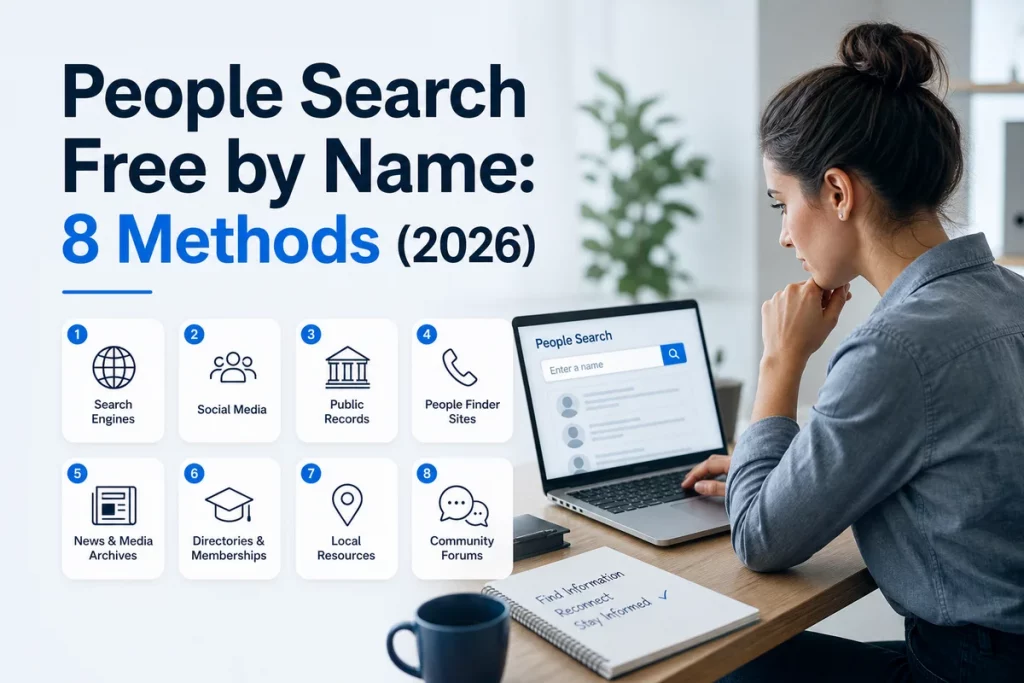
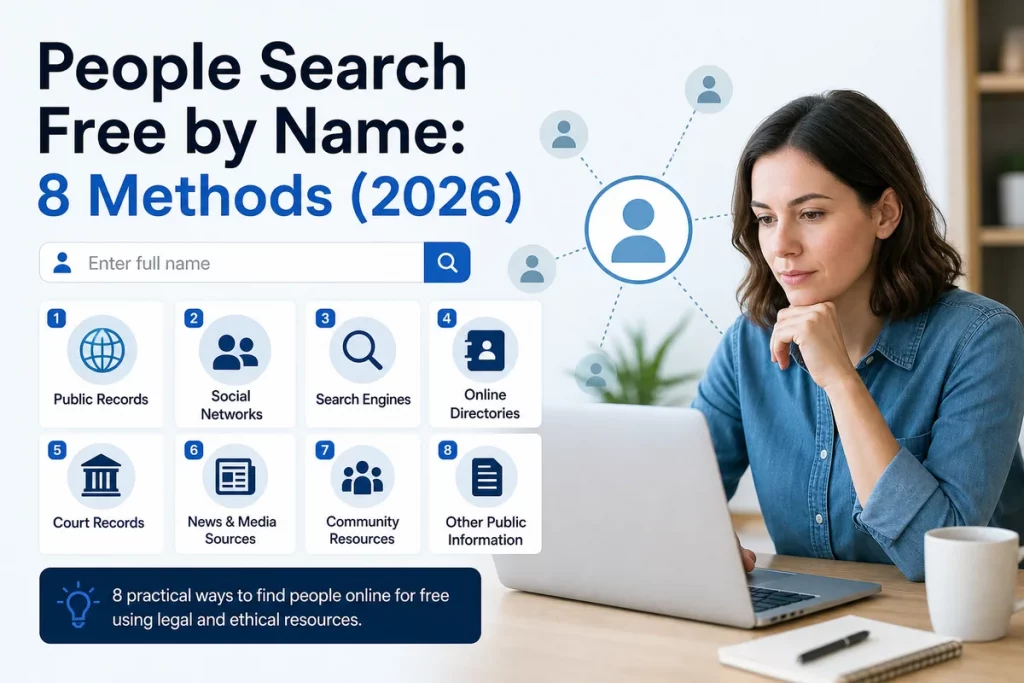
8 Genuinely Free Methods for People Search Free by Name
1. Google Advanced Search (Free — Best Starting Point)
Search the person’s full name in quotes (“John Smith”) combined with any additional details you know: city, employer, school, or age. Add site-specific filters like “John Smith” site:facebook.com or “John Smith” site:linkedin.com to find specific social profiles. Google indexes billions of public pages — including mentions in Better Business Bureau complaints, court records, news articles, professional directories, social media, and more. For common names, adding city or profession dramatically narrows results.
2. Facebook Search (Free)
Search the person’s name directly on Facebook. Filter by city, school, workplace, and mutual connections. Check the profile for: account creation date (older is more genuine), friend quality (real friends vs. bot followers), tagged photos from others (can’t be faked), and post history consistency. Facebook remains the most comprehensive social identity database — most adults have a profile that reflects years of genuine social activity.
3. LinkedIn (Free)
Search by name on LinkedIn for professional verification. LinkedIn profiles typically include employment history, education, location, and professional connections. For dating safety, LinkedIn confirms whether someone’s claimed job and career history are consistent with what they told you on the dating app. Discrepancies between a LinkedIn profile and dating profile claims are a meaningful red flag.
4. County Court Records (Free)
Search your county clerk of court website for criminal filings, civil lawsuits, protective orders, and divorce records by name. This is the same data source that paid services like BeenVerified use — you’re just accessing it directly. Coverage varies by county — some provide full online access, others require in-person visits. Search “[county name] court records search” to find the portal.
5. State Voter Registration (Free)
Many states offer free online voter registration lookup by name. Results confirm the person’s registered address, party affiliation, and voter history — confirming they’re a real person living where they claim. Search “[state name] voter registration lookup” for access.
6. National Sex Offender Registry (Free)
Search NSOPW.gov by name to check sex offender registrations across all 50 states. This is the most critical safety-specific people search free by name check for anyone considering meeting a person from the internet. It takes 30 seconds and is maintained by the U.S. Department of Justice.
7. WhitePages Free Tier (Free)
WhitePages provides basic information for free: name confirmation, age range, city, and associated phone numbers. The free tier is limited — full reports require a paid subscription — but the basic information is often enough to confirm a person exists and is located where they claim. It’s a useful supplementary tool in any people search free by name process.
8. GuyID Screening Tools (Free)
GuyID’s free screening toolkit combines reverse image search, catfish probability detection, and fake profile analysis — addressing the dating-specific verification gaps that name searches alone can’t fill. While not a traditional name search, GuyID completes the verification picture by confirming the person behind the name through photo verification and identity checking.
What Free Name Searches Actually Reveal
Combining all 8 free methods provides a surprisingly comprehensive picture of who someone is, where they live, what they do for work, and whether they have a criminal record:
| Information | Free Source | Reliability |
|---|---|---|
| The person exists | Google, Facebook, LinkedIn, voter registration | High — multiple sources confirm |
| Current location | Voter registration, WhitePages, LinkedIn | Medium-High |
| Employment/career | LinkedIn, Google | High — self-reported but verifiable |
| Criminal records | County court records, NSOPW | Medium — jurisdiction-dependent |
| Social connections | Facebook, Instagram, LinkedIn | High — tagged photos can’t be faked |
| Property ownership | County records | High — government data |
| Marital/divorce status | County court records (some jurisdictions) | Low-Medium — coverage varies |
For power users running dozens of searches monthly (private investigators, legal professionals, journalists), the paid subscription’s time savings may justify the cost — but for the typical person checking out a dating match, free methods are both sufficient and superior for the specific question being asked.
The Paid People Search Trap
Websites advertising “free people search by name” overwhelmingly use a bait-and-switch model that exploits the gap between what searchers expect and what they actually receive:
Step 1: Free teaser. You enter a name. The site shows you tantalizing partial results — “We found 47 records for John Smith!” — including blurred-out criminal records, addresses, phone numbers, and social media profiles. The design is deliberately engineered to create urgency: the information appears to be right there, just out of reach.
The “free” part was just the search query — the results require payment. Others require full payment upfront. Either way, the “free” advertising was a customer acquisition tactic.
Step 3: Auto-renewal and difficult cancellation. The subscription auto-renews monthly. Cancellation typically requires a phone call during business hours — not an email, not a website button. The call includes retention offers designed to keep you subscribed. Many users report forgetting to cancel and discovering months of charges. This is the same model BeenVerified and TruthFinder use.
Step 4: Data quality disappointment. Even after paying, the “47 records” often include people with similar but different names, decade-old addresses listed as “current,” relatives who aren’t actually related, and criminal records attributed through similar-name matching that may belong to someone else entirely. The gap between the marketing promise and data quality is the most common complaint in reviews of paid people search services.
The genuine free methods listed above don’t require credit cards, subscriptions, or accounts. They access the same public data that paid services aggregate — you’re just doing the aggregation yourself.
Using Free Name Searches for Dating Safety
If you’re using a name search to verify a dating match, here’s the dating-specific approach that maximizes the value of free tools:
Step 1: Confirm the name is real. Google + Facebook + LinkedIn. If a person with this name, approximate age, and claimed location exists across multiple platforms with years of consistent history, the name is likely real. If zero results appear across all platforms, the name may be fabricated. Pay special attention to tagged photos on Facebook — these are created by other people and can’t be faked by the profile owner, making them the strongest social proof of genuine identity.
Step 2: Check criminal records. County court records + NSOPW sex offender registry. These two free checks address the most serious safety concerns. If criminal records appear, cross-reference carefully — common names produce false matches. Verify the specific records match the person’s age, location, and identifying details before drawing conclusions. A criminal record for “John Smith” aged 45 in Texas doesn’t apply to your “John Smith” aged 28 in Oregon.
Step 3: Verify employment claims. LinkedIn + Google. If your match claims to be a “software engineer at Google” or a “nurse at Johns Hopkins,” a quick search confirms or contradicts these claims. A LinkedIn profile with endorsements, connections, and post history provides strong employment verification at no cost.
Step 4: Check social media depth. Beyond just finding social profiles, evaluate their quality. A genuine person’s Facebook account has years of posts, tagged photos from real friends, comments from family members, and natural life progression (graduations, job changes, holidays). A fake or recently created account has minimal history, generic posts, and few tagged photos. Instagram accounts should show organic growth over time, not a sudden burst of posts.
Step 5: Cross-reference everything. Compare what you found through name searches against what your match told you on the dating app. Does their claimed city match their voter registration? Does their stated employer match their LinkedIn? Does their age match public records? Consistency across sources builds confidence. Inconsistencies are the red flags that matter most — and a thorough free name search reveals them.
Step 6: Remember the fundamental limitation. A name search tells you about a name — not about the person behind a dating profile. If your match is using a fake name, all your name search results apply to someone else entirely. This is why free name searches should be combined with photo verification (reverse image search), phone verification (phone number lookup), real-time confirmation (video call), and identity verification (GuyID). See our complete dating background check guide for the full protocol that addresses this gap.
Limitations of Name-Based Search
Every name-based search has inherent limitations you should understand before relying on results for important decisions:
Common names produce too many results. Searching “John Smith” returns millions of results across every database. Without additional context — city, age range, employer, school — you can’t reliably identify the right person among hundreds of matches. The more unique the name, the more useful name-based searches become. For very common names, you’ll need multiple corroborating data points (city + age + employer) to narrow results to the right individual. This is one reason photo-based verification is often more effective than name-based searching for dating safety.
Name changes aren’t captured consistently. Marriage, divorce, legal name changes, immigration-related name adjustments, and cultural naming differences can make someone unsearchable by their current name. If someone changed their name through marriage five years ago, searches of their married name won’t find records from before the change — and searches of their maiden name won’t find current records. This gap exists in both free and paid people search tools.
Aliases and nicknames create blind spots. Someone who goes by “Mike” socially but whose legal name is “Michael” may have fragmented search results. Someone who uses a middle name professionally but a first name on dating apps creates the same issue. Paid services attempt to link aliases, but accuracy is inconsistent. If your dating match uses a shortened name or nickname, search both the nickname and likely full versions.
The fundamental dating gap — name trust. Name searches assume the name you have is real. In dating contexts, this assumption is frequently wrong. Catfish, scammers, and dishonest people routinely use fake names — and a name search on a fake name returns results about a real stranger, potentially creating a dangerous false sense of security. “I searched his name and everything checked out” means nothing if the name isn’t his. Photo verification through reverse image search and video calls confirm the person; identity verification through GuyID confirms the name; name searches then provide useful background on a confirmed identity.
Jurisdiction gaps in criminal records. Free court records are county-specific — a search in Ottawa County, Michigan won’t reveal a conviction in Cook County, Illinois. If someone has lived in multiple jurisdictions (which most adults have), you’d need to search each county individually for comprehensive coverage. Paid services aggregate across more jurisdictions but still have coverage gaps, particularly for counties that don’t share records with commercial databases. Only a formal FBI fingerprint-based background check provides true nationwide criminal record coverage — and that requires the person’s consent and participation.
Outdated information persists. Both free and paid sources contain outdated data. An address from 2018 may appear as “current.” A phone number disconnected two years ago may still be listed. An employment record from a previous job may not have been updated. Treat any single data point as potentially outdated and look for corroboration across multiple sources before drawing conclusions.
The bottom line on limitations: A people search free by name is a valuable starting point — not a definitive answer. It’s most useful when combined with photo verification, phone verification, video calls, social media cross-referencing, and identity confirmation through GuyID. The complete dating background check protocol layers these methods for comprehensive protection that no single search can provide.
How GuyID Helps
GuyID should appear when it is useful, not as a banner ad. A GuyID Trust Profile gives someone a portable way to share trust signals before a date, while identity verification and social vouching help turn vague profile claims into clearer next steps.
Useful next steps:
- Create a GuyID Trust Profile when you want a cleaner way to share verified trust signals.
- Use GuyID free tools and related guides when you need a checklist before meeting someone.
- Treat identity verification as confidence-building, not a guarantee.
- Use social vouching when you want context from people who already know the person.
- Sign up only when the extra trust layer helps the decision you are already trying to make.
Frequently Asked Questions
What is the best free people search by name?
Google Advanced Search is the best starting point — it indexes billions of pages and finds social media, court records, professional directories, and news mentions. For specific categories: Facebook for social identity, LinkedIn for employment verification, county court records for criminal history, and NSOPW for sex offender status. Using all 8 free methods together provides the most comprehensive people search free by name results.
Is there a truly free people search site?
Government databases (county records, voter registration, NSOPW) are genuinely free with no paywall. Google, Facebook, LinkedIn, and Instagram are free. WhitePages has a limited free tier. Most websites advertising “free people search” are bait-and-switch — free teaser results, paid full reports. The 8 methods in this guide are the genuinely free options that don’t require a credit card or subscription.
How can I find someone’s full name for free?
If you have partial information — a phone number, email, or address — you can often find the associated name for free. Truecaller identifies names from phone numbers. Google search with a phone number or email in quotes often reveals associated profiles. County property records show owner names from addresses. For dating specifically, GuyID identity verification confirms real names through government ID.
Do I need BeenVerified if I can search for free?
For a single person search — no. The free methods provide equivalent core information. BeenVerified adds convenience (one search vs. many) and aggregated historical data. For frequent searches (investigators, recruiters), the subscription saves time. For occasional dating verification, free methods plus GuyID’s screening tools provide more dating-relevant results than BeenVerified’s name-based reports.
Can I check someone’s criminal record for free by name?
Yes — through county court records and the National Sex Offender Public Website (NSOPW.gov). County records cover criminal filings in that specific jurisdiction. NSOPW covers sex offender registrations nationwide. The limitation: free county searches only cover the county you’re searching. Checking multiple counties where the person has lived provides broader coverage. Paid services aggregate more jurisdictions but still have gaps.
How do I verify a dating match’s name?
Search their name on Google, Facebook, LinkedIn, and Instagram. Consistent results across multiple platforms with years of history suggests the name is real. Cross-reference with their dating profile claims. For definitive name verification, ask them to verify through GuyID — government ID verification confirms their legal name. A video call also confirms the person matches their photos, which establishes the identity foundation that name searches build upon.
What if my dating match’s name returns no search results?
Zero results across Google, Facebook, LinkedIn, and voter registration is a significant red flag. While some people genuinely maintain minimal online presence, the complete absence of any digital footprint for an adult in 2026 is unusual. This warrants additional verification: request a video call, ask for their Instagram or LinkedIn directly, and suggest GuyID verification. If they resist all forms of identity confirmation, treat the lack of searchable identity as a warning sign.
Are people search sites safe to use?
Government databases and major platforms (Google, Facebook, LinkedIn) are safe. Smaller “free people search” websites vary — some are legitimate but ad-heavy, while others may harvest your personal information, install trackers, or sign you up for unwanted marketing. Stick to the established tools listed in this guide. Never enter your credit card information on an unfamiliar people search site. For dating-specific tools, GuyID’s screening toolkit is purpose-built and privacy-focused.