

Vouching vs Background Checks for Dating: Which Catches What (2026)
47% of online daters want background checks required on dating apps (Pew/SSRS). The demand is clear: people want to know who they’re dating before investing emotionally, physically, and financially. But the question most people haven’t considered is whether background checks are actually the right tool — or whether they’re reaching for the most familiar safety concept without evaluating whether it matches the actual threat. Vouching vs background checks isn’t a competition — it’s a comparison that reveals how each tool addresses a fundamentally different dimension of dating safety. Background checks screen the past (criminal records, public filings). Social vouching assesses the present (character as confirmed by people who know you now). Understanding what each catches — and what each misses — explains why the safest dating approach uses both, and why vouching addresses the character gap that background checks structurally cannot.
This guide compares vouching and background checks across every dimension that matters for dating safety: what each confirms, what each misses, cost and accessibility, scam resistance, and the practical recommendation for which to use when.
The Fundamental Difference Between Vouching and Background Checks
The vouching vs background checks comparison starts with what each system is designed to answer.
A background check answers: “What has this person been convicted of, sued for, or publicly recorded doing in the past?”
Social vouching answers: “Do real people who know this person currently trust them enough to publicly say so?”
Background checks look backward through institutional records. Vouching looks at the present through human relationships. Background checks are conducted by a third-party service accessing databases. Vouching is conducted by real humans with direct personal knowledge. Background checks assess legal history. Vouching assesses lived character. Both are valuable. Neither is complete without the other.
The Complete Side-by-Side Comparison
| Dimension | Background Check | Social Vouching (GuyID) |
|---|---|---|
| What it assesses | Criminal history, court records, sex offender registry, public records | Character, trustworthiness, reliability — as confirmed by real people |
| Time dimension | Past (historical records) | Present (current character as assessed by current connections) |
| Who provides the assessment | Database search through a third-party service | Real humans with direct personal knowledge |
| Information required to run | Full legal name + date of birth (+ sometimes SSN) | Nothing — click their Date Mode link to view |
| Cost | $20-$100+ per check | Free for women to check any Trust Profile |
| Catches criminal behavior | ✅ Yes — convicted offenses, registered offenders | ❌ No — not designed for criminal screening |
| Catches non-criminal character issues | ❌ No — lying, manipulation, infidelity aren’t crimes | ✅ Yes — people who know them assess full character |
| Catches fake identities | ⚠️ Partial — a fake name returns no results (informative but ambiguous) | ❌ No — vouching requires known identity (pair with gov ID) |
| Works on unverified matches | ⚠️ Only if you have their real name | ✅ Anyone with a GuyID profile is checkable via link |
| Scalable for every match | ❌ Too expensive and info-intensive for routine use | ✅ Check every match in 10 seconds via link — free |
| Portable across platforms | ❌ Must run separately each time | ✅ Trust Profile works everywhere |
| AI-proof | N/A (screens records, not identities) | ✅ Real humans can’t be AI-generated |
Neither column is entirely green. Each catches what the other misses. The complete picture requires both — plus the identity verification layer (GuyID’s government ID) that catches fake identities before either background checks or vouching even become relevant.

What Background Checks Catch: The Criminal Screening Layer
Background checks are genuinely valuable for one specific purpose: identifying people with documented criminal histories that represent safety risks.
What Background Checks Screen
- Criminal convictions: Felonies, misdemeanors, violent crimes, domestic violence, DUI — documented through court records.
- Sex offender registry: Registered sex offenders across national and state databases — the highest-priority screening for physical safety.
- Court records: Restraining orders, civil judgments, bankruptcy filings — legal proceedings that may indicate behavioral patterns.
- Identity verification (partial): A background check that returns no results for a claimed name can indicate the name is fake — though it could also mean a common name or limited records.
When Background Checks Are Most Valuable
Background checks are most valuable before deepening commitment — particularly before cohabitation, financial entanglement, or introducing someone to children. The cost ($20-$100+) and information requirements (full legal name, DOB) make them impractical for every dating match — but essential for the matches that progress toward commitment. For serious relationship seekers and women prioritizing safety, a background check at the commitment stage is a reasonable investment.
What Background Checks Miss: The Character Blind Spot
The critical limitation of background checks — and the reason the vouching vs background checks comparison matters — is everything they can’t screen.
Non-Criminal Behavior That Harms Dating Partners
- Lying about relationship status: Being married while claiming to be single isn’t a crime. No criminal record is generated. A background check returns clean results for a person actively deceiving their dating partners. Their friends, however, know they’re married — and wouldn’t vouch for their dating profile.
- Emotional manipulation: Love-bombing, gaslighting, narcissistic behavior patterns, and emotional exploitation aren’t criminal offenses. The most psychologically damaging dating behaviors are entirely invisible to background checks. People who’ve known someone for years have observed these patterns — their vouch (or absence of vouch) reflects this knowledge.
- Financial deception: Lying about income, debt, career, or financial stability to attract partners isn’t illegal. Background checks don’t screen financial honesty. Colleagues and close friends, however, know someone’s actual professional and financial reality.
- Pattern infidelity: Serial cheating doesn’t generate criminal records. A background check returns clean results for someone who has betrayed every previous partner. Long-term friends know the pattern — their character assessment includes this information.
- Disrespect and poor treatment: Being rude, dismissive, controlling, or generally disrespectful to romantic partners isn’t criminal. Background checks screen for legal violations, not interpersonal quality. Friends and colleagues observe how someone treats the people in their life.
The common thread: most of the behavior that makes someone a bad dating partner isn’t criminal. Background checks screen the legal floor — the minimum standard of “has this person been convicted of a crime.” They don’t assess the character ceiling — “Is this person honest, kind, reliable, and safe to build a relationship with?” Social vouching assesses both.
The Practical Problem: Information Requirements
Running a background check requires the target’s full legal name and date of birth — information you may not have from a dating app where people use first names only. Asking a match for their full legal name and DOB specifically to run a background check creates an awkward dynamic that most people avoid. Social vouching requires nothing from the match except sharing their Date Mode link — or having it in their dating app bio. The information barrier makes background checks impractical for early-stage screening. Vouching has zero information barrier.
What Social Vouching Catches: The Character Assessment Layer
Social vouching fills every gap that background checks leave open — providing the character reference that no criminal database search can generate.
What Vouching Assesses
- Current character: How people who know the person RIGHT NOW assess their trustworthiness — not what a record from years ago says.
- Honesty and authenticity: Whether the person presents themselves genuinely — as judged by people who know the reality behind the presentation.
- Interpersonal quality: How they treat friends, colleagues, and community members — observable to anyone in their life, invisible to databases.
- Social integration: Whether they have real relationships with real people — the basic social proof that they exist within a community of trust.
- Consistency over time: Whether people who’ve known them for years still trust them — the temporal dimension that criminal records don’t provide (a clean record could reflect genuinely good behavior OR simply never being caught).
Why the Present Matters More Than the Past for Dating
A background check tells you about someone’s documented past. Social vouching tells you about someone’s current character as assessed by current connections. For dating decisions, the present is more relevant: “Is this person trustworthy NOW?” matters more than “Was this person convicted of something THEN?” A person who made mistakes 15 years ago may have genuinely reformed — their current friends’ willingness to vouch reflects that reformation. A person with a clean record who is currently dishonest has no past violations but represents a present risk — their friends’ reluctance to vouch reflects that risk. Vouching captures the present state. Background checks capture the historical record.
What Social Vouching Misses: The Criminal Blind Spot
Transparency requires acknowledging what vouching doesn’t cover — because the vouching vs background checks comparison is about understanding each tool’s scope, not declaring a winner.
What Vouching Can’t Assess
- Criminal history: Vouching doesn’t access criminal databases. A person’s friends may not know about convictions, sealed records, or offenses in other jurisdictions. Criminal screening requires database access that personal knowledge doesn’t provide.
- Sex offender registry: The most safety-critical screening — registered sex offenders — requires database checks. Personal acquaintances may not have this information, particularly for newer connections or people who’ve relocated.
- Hidden behavior: Some people successfully conceal problematic behavior from their entire social circle. If no one in a person’s life knows about their harmful patterns, their vouches won’t reflect it. Vouching assesses character as known to the vouchers — not character in absolute terms.
- Voucher bias: Friends may vouch based on personal loyalty rather than objective assessment. A close friend might vouch for someone whose behavior they’ve rationalized or minimized. Vouching provides subjective human assessment — not objective institutional records.
These limitations don’t diminish vouching’s value — they define its scope. Vouching assesses character as observed by real humans. Background checks screen criminal history from institutional records. Each has blind spots the other covers. The combination is comprehensive. Either alone is incomplete.
Why Neither Alone Is Sufficient — And What Completes the Picture
The vouching vs background checks comparison leads to one conclusion: neither tool alone provides complete dating safety. Here’s why, and what fills the gaps.
Background Checks Alone
Screen criminal past but miss character, honesty, relationship status, emotional patterns, and current trustworthiness. A clean background check tells you “not convicted of a crime” — not “safe to date.” The character gap remains open.
Vouching Alone
Assesses current character but misses criminal history, doesn’t confirm legal identity (a fake identity could theoretically receive vouches from accomplices), and depends on voucher knowledge and honesty. The criminal screening gap and identity gap remain open.
The Complete Stack
The safest dating verification combines three layers — each catching what the others miss:
| Layer | What It Catches | What It Misses | How to Access |
|---|---|---|---|
| Government ID Verification (GuyID) | Fake identities, AI-generated personas, catfish | Character, criminal history | Check Trust Profile — free for women |
| Social Vouching (GuyID) | Character issues, dishonesty, untrustworthiness, poor interpersonal patterns | Criminal records, hidden behavior | Visible on Trust Profile — free for women |
| Background Check (third-party service) | Criminal convictions, sex offender registry, court records | Character, non-criminal behavior | $20-$100+, requires full name + DOB |
Layer 1 (government ID) confirms the person is real. Layer 2 (vouching) confirms the person’s character. Layer 3 (background check) confirms the person’s criminal history. Together: identity confirmed + character assessed + criminal history screened. No gap remains.
The Complete Dating Safety Stack: Practical Recommendations
Here’s when and how to use each tool for maximum protection.
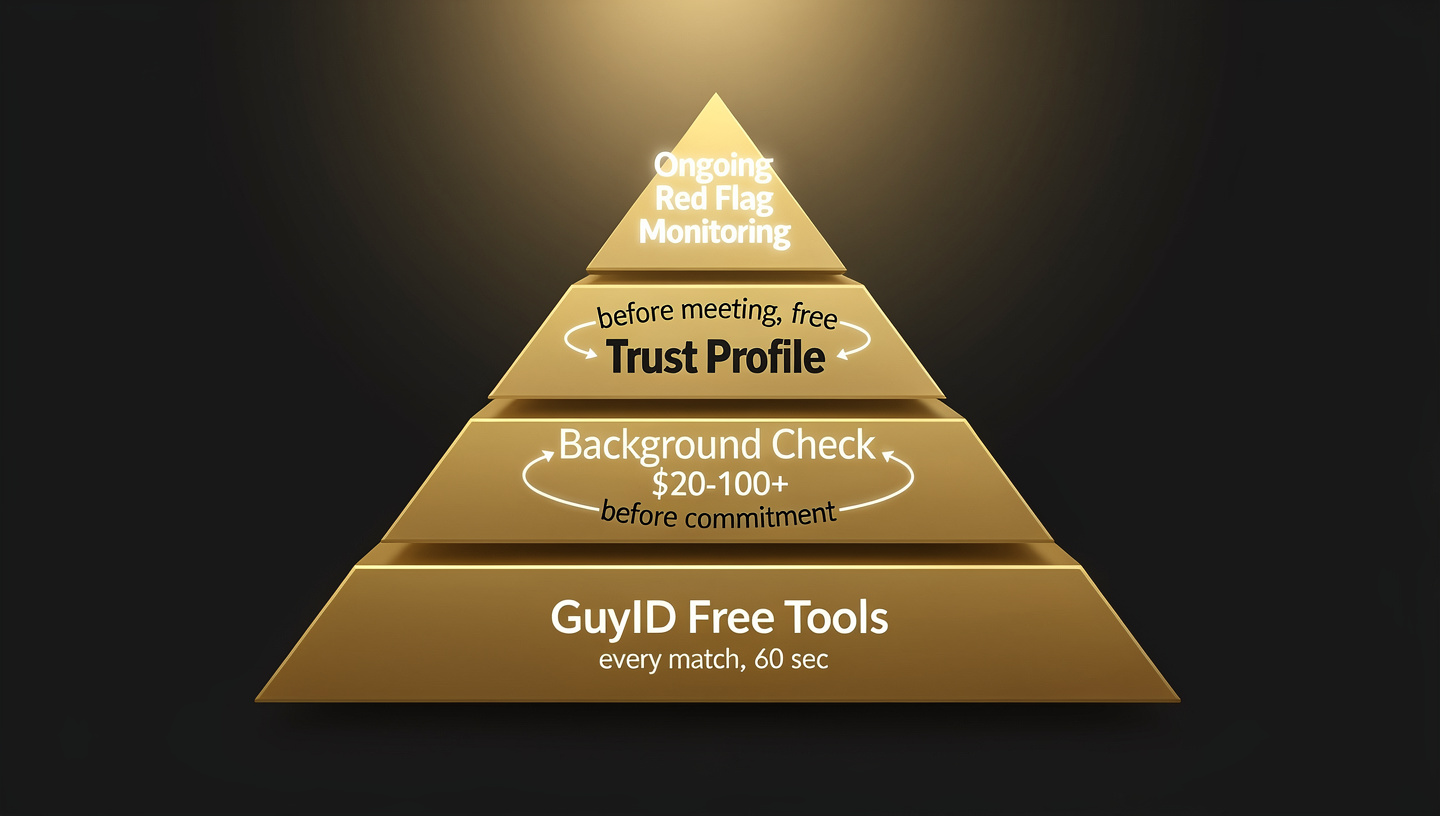
☐ GuyID free safety tools: reverse image search + catfish detector + bio analyzer
☐ Check their GuyID Trust Profile if available (Trust Tier, gov ID, vouches)
Cost: $0 | Time: 60 seconds | Catches: fake profiles, scam patterns, unverified identities
☐ Request their Date Mode link — gov ID verified? Social vouches present? Trust Tier?
☐ Video call with active deepfake testing
☐ Social media cross-reference (LinkedIn, Instagram, Facebook)
Cost: $0 | Time: 2-5 minutes | Catches: unverified identity, absent character references, catfish
☐ Run a background check through a reputable service (requires full name + DOB)
☐ Screen: criminal history, sex offender registry, court records
☐ Cross-reference results with what you know from Trust Profile and personal experience
Cost: $20-$100+ | Time: 1-3 days for results | Catches: criminal history vouching can’t see
☐ Monitor for red flags at every stage
☐ Maintain privacy boundaries proportional to verified trust
☐ Never send money before verified, in-person relationship established
☐ Report any suspicious behavior
Cost: $0 | Time: ongoing awareness | Catches: emerging issues that initial screening missed
Why This Sequence Works
The stack is ordered by practicality: free, fast checks on every match (catching the majority of threats), deeper verification before meeting (confirming identity and character), optional criminal screening before commitment (adding the criminal history layer when stakes are highest), and ongoing awareness throughout (catching what develops over time). GuyID’s Trust Profile — government ID + social vouching + Trust Tiers — covers the first two stages entirely for free. Background checks supplement at the commitment stage for those who want maximum protection.
Summary: Different Tools for Different Threats
Vouching vs background checks isn’t a competition — it’s a complementary pair that covers different dimensions of dating safety. Background checks screen criminal past (legal floor). Social vouching assesses current character (character ceiling). Government ID confirms real identity (foundation). Together: complete coverage that no single method provides.
For practical dating safety: use GuyID’s free tools on every match (60 seconds), check Trust Profiles before meeting (identity + vouches + tier), and consider a background check before deepening commitment ($20-100+, requires name/DOB). The vouching layer is free, instant, scalable to every match, and catches the character dimensions that background checks structurally miss. The background check layer catches the criminal dimensions that vouching structurally misses. Together, they provide the comprehensive safety that 47% of online daters are already demanding.
GuyID provides the character layer for free: social vouching + government ID + Trust Tiers. Supplement with background checks at the commitment stage. Together: the complete dating safety stack. Women check Trust Profiles for free — always.
Frequently Asked Questions: Vouching vs Background Checks
Which is better for dating safety: vouching or background checks?
Do dating apps do background checks?
Can I run a background check on a dating match?
What do background checks miss that vouching catches?
What does vouching miss that background checks catch?
When should I use each tool?
Is social vouching free?

Founder, GuyID · Dating Safety Researcher · 13+ Years in Data Analytics
Ravishankar Jayasankar is the founder of GuyID, a consent-based dating trust verification platform. With 13+ years in data analytics and a deep focus on consumer trust, Ravi built GuyID to close the safety gap in digital dating. His research found that 92% of women report dating safety concerns — validating GuyID’s mission to make online dating safer through proactive, consent-based verification. GuyID offers government ID verification, social vouching, a Trust Tiers system, and 60+ free interactive safety tools.