8 Online Dating Safety Tips That Actually Protect You (2026)
Romance scams cost Americans $1.3 billion in 2025 alone (FTC, 2026), and 57% of women on dating apps say they don’t feel safe (Essence). These aren’t abstract numbers — they represent real people who trusted too quickly and paid the price. These actionable online dating safety tips empower you, whether you want to verify a potential match or prove you are trustworthy and safe.
This guide gives you a concrete plan. You will learn how to verify a person’s identity before you agree to meet, analyze profiles for red flags using simple techniques, protect your personal and financial information, and plan a safe first date from start to finish. Every tip is backed by 2026 data and real-world tools you can use right now.
1. Verify Identity Before Meeting in Person
Confirming a potential date is who they claim to be is the single most effective online dating safety tip you can follow. You must move beyond trusting a profile and use real-world checks to confirm their authenticity. This step directly counters the risks of catfishing and romance scams, which cost victims an average of $2,001–$4,000 per incident (NordProtect, Jan 2026).
This process involves more than a quick glance at their photos. You need a proactive approach to ensure the person matches their digital persona. Many dating apps offer built-in photo verification badges, which are a good start. However, these only confirm you look like your pictures, not that your name or age is real. With 1 in 4 Americans encountering fake profiles or AI bots on dating apps (McAfee, Feb 2026), photo badges alone are no longer sufficient protection.
How to Implement Identity Verification
For a more reliable check, you need to go a step further. Platforms like GuyID offer a structured verification process that combines government-issued ID checks with social vouching from friends. This creates a portable trust profile, allowing you to prove you are safe or to ask a match to do the same — across any dating app.
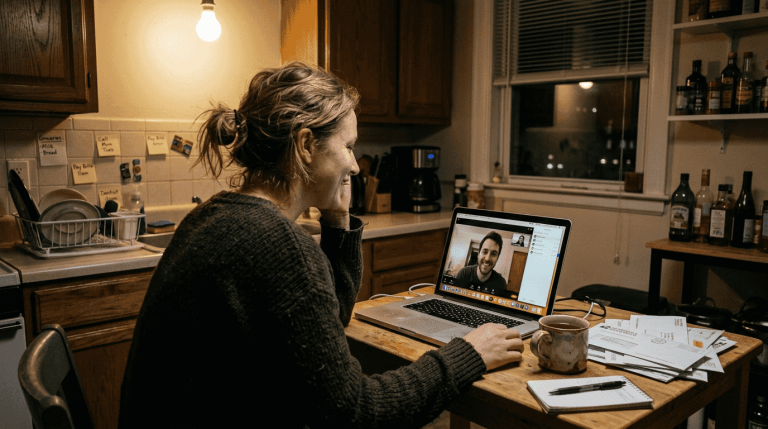
Request a Video Call: This simple, low-effort action confirms the person matches their profile pictures in real-time. If they consistently avoid or make excuses for not video chatting, consider it a major red flag.
Use Reverse Image Search: Take their profile photos and use free tools like the ones available at GuyID’s safety tools. This can reveal if their photos have been stolen from another person’s social media or a stock photography website.
Ask for a Verified Profile Link: Services like GuyID allow you to create a verified “Date Mode” link that consolidates your ID verification and social proof. Asking a match to share theirs is a direct and effective way to confirm their identity.
Cross-Reference Social Media: Check for consistency across platforms like LinkedIn or Instagram. Do the name, photos, and personal details match what they told you? Discrepancies are a warning sign.
2. Conduct Reverse Image Searches on Dating Profile Photos
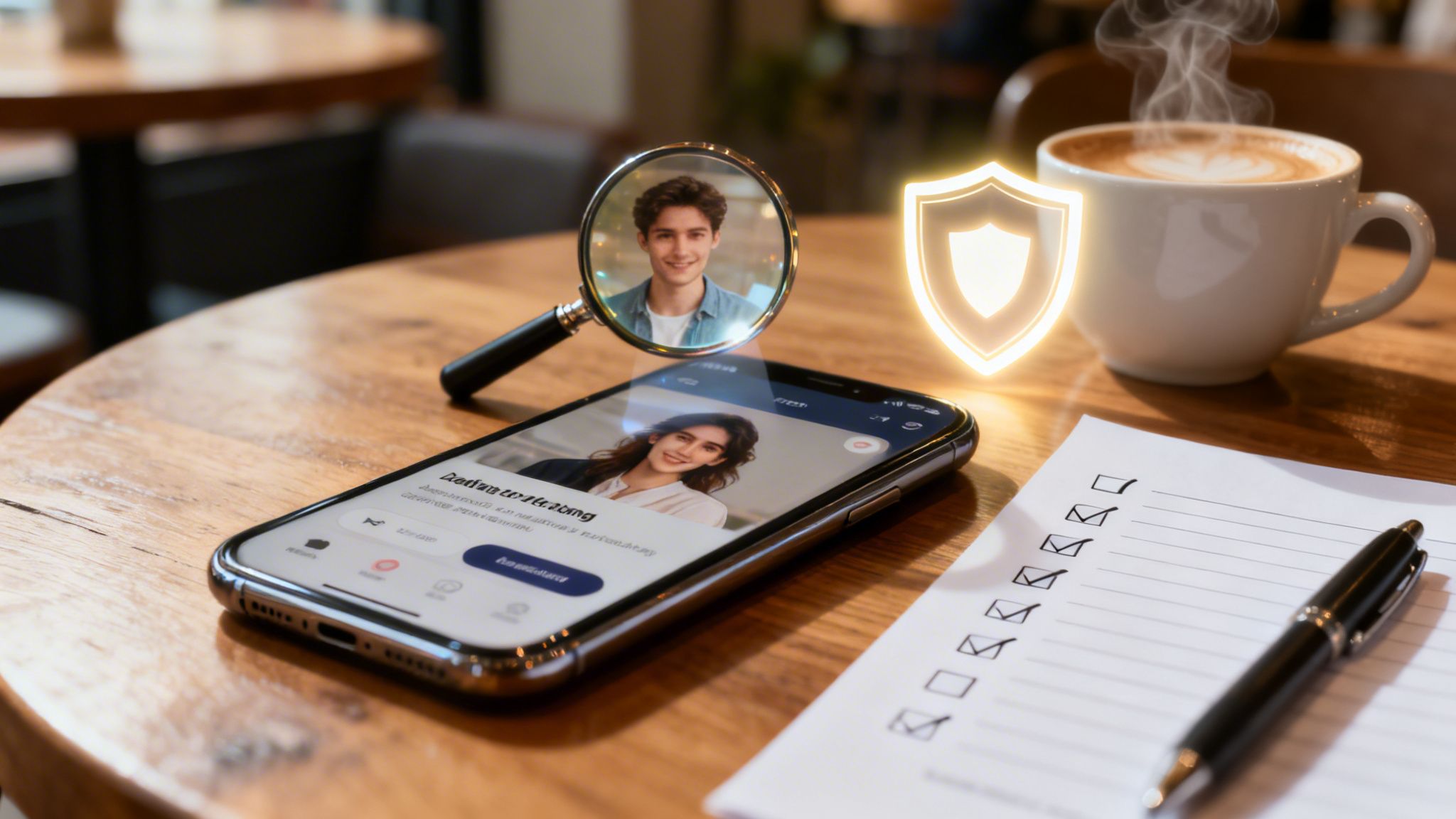
A reverse image search is a powerful, free technique for detecting catfishing and verifying profile authenticity. You can take a photo from a dating profile and search the internet to see where else it appears. This method helps you quickly identify if a match is using stolen, stock, or celebrity images — a growing threat since 35% of Americans have spotted AI-generated photos on dating apps (McAfee, Feb 2026).
This simple check can expose a scammer before you invest any emotional energy or personal information. If their photo shows up on an influencer’s account or a stock photography website, you have found a major red flag. Integrating this step into your screening process is one of the most effective online dating safety tips you can implement — and it takes less than 60 seconds per photo.
How to Implement Reverse Image Search
Executing a reverse image search is straightforward. You can use widely available search engines or specialized tools designed for dating safety. For instance, GuyID offers a free reverse image search tool as part of its safety toolkit, tailored specifically for dating profile verification.
- Search Every Photo: Don’t just check the main profile picture. Scammers often mix real (stolen) photos with more generic ones. Search each one individually for a thorough check.
- Use Multiple Engines: Start with Google Images or a simple right-click “Search Image with Google.” For more comprehensive results, use specialized search engines like TinEye and Yandex.
- Look for Stock Photo Sites: If a picture appears on sites like Getty Images or Shutterstock, it is almost certainly a fake profile. This is a definitive red flag.
- Cross-Reference Social Media: A search might lead you to a real person’s social media account. If the name or location doesn’t match what your date told you, you’ve likely uncovered a catfisher.
3. Use Dedicated Dating Safety Tools and Red Flag Detectors
Specialized dating safety tools identify common warning signs of romance scams and unsafe matches before they escalate. These tools analyze profile information and communication patterns to flag suspicious activity. With 630,000+ cybercriminals operating romance scams globally (SpyCloud, Feb 2026) and losses exceeding $1.3 billion annually (FTC, 2026), using these protective resources is one of the most critical online dating safety tips available.
Red flag detectors examine elements like requests for money, inconsistent stories, and demands for personal information. They provide an objective layer of analysis, helping you spot risks that emotions might otherwise obscure. This proactive step helps you vet matches more effectively before you become emotionally invested.
How to Implement Safety Tools
Integrating these tools into your dating routine provides a structured way to evaluate potential matches. You can use data-driven checkers to assess risk instead of relying solely on intuition. GuyID offers a suite of 60+ free safety tools, including red flag detectors, catfish probability checkers, and romance scam risk calculators — all created specifically to protect online daters.
- Run Profiles Through Red Flag Detectors: Before investing too much time, use a red flag detector to screen a match’s profile and early messages. Look for common scam indicators like love-bombing or an immediate push to move off the dating app.
- Use Catfish Probability Checkers: If a profile seems too good to be true, run the information through a catfish probability checker. These tools help assess the likelihood that a flawless-seeming profile is fake.
- Check for Scam Language: Be alert for common scam scripts, such as sudden emergencies requiring money or claims of working overseas with no access to funds. AI bots can now send 60+ messages in just 12 hours (McAfee Labs, 2026), making scripted outreach harder to detect manually.
- Trust the Results, But Verify: Use the output from these tools as a guide, not a final judgment. If a tool flags a profile as high-risk, use that as a signal to be extra cautious, ask more probing questions, or conduct further verification.
4. Meet in Public Locations and Inform Trusted Friends
Arranging your initial meetings in public and notifying a trusted friend about your plans are foundational online dating safety tips. This strategy significantly reduces your vulnerability to physical risks by ensuring you are never isolated with a new person. Public venues like busy coffee shops or restaurants provide witnesses, security cameras, and clear escape routes.
This practice creates a crucial safety net. Informing a friend of your date’s details means someone is aware of your whereabouts and can check on you. While identity verification through a service like GuyID confirms you are meeting a real, verified person, this step protects you during the in-person interaction itself. Both layers work together for comprehensive protection.
How to Implement Safe Meeting Practices
A successful and safe first date requires some light planning. You need to remain in control of your own safety without creating an awkward atmosphere. Openly communicating that you prioritize safety can also signal to your date that you are a responsible and conscientious person — which is an attractive quality.
Choose a Public, Familiar Venue: Opt for a place you know well, like a popular coffee shop in a busy area. Avoid secluded spots or private residences for early dates.
Share Your Live Location: Use a feature like Google Maps location sharing or Find My on iOS to give a trusted friend real-time access to your whereabouts for the duration of the date.
Arrange Your Own Transportation: Drive yourself or use a ride-sharing service to get to and from the date. This prevents you from being dependent on your date for transportation and gives you full control over when you leave.
Establish a Check-In Time: Agree on a specific time to text or call your friend to confirm you are safe. If you don’t check in, they know to take action immediately.
5. Protect Personal and Financial Information Until You’re Certain
Guarding your sensitive personal and financial information is a non-negotiable rule for online dating. This practice is your primary defense against romance scams and identity theft. The average victim loses between $2,001 and $4,000 (NordProtect, Jan 2026), while FBI field investigations suggest losses of $10,000–$50,000 for the average reported case. Shockingly, fewer than 5% of victims ever report to authorities (FTC), meaning the true financial toll is far higher than official statistics suggest.
The strategy is simple: you must establish clear boundaries and build trust gradually over time. Never share passwords, bank account numbers, or your home address with someone you’ve only met online. Scammers often invent elaborate stories involving medical emergencies or needing money for travel to meet you. These are among the most common tactics reported in dating fraud cases.
How to Protect Your Information
A fundamental part of following online dating safety tips is creating a secure personal environment. You need discipline about what you share and tools that promote trust without compromising your data. Building trust should be mutual, and platforms like GuyID can help by allowing both parties to verify their identity before any sensitive information is exchanged — without sharing actual documents.
- Never Share Financial Details: Refuse all requests for money, gift cards, or cryptocurrency, no matter how convincing the story. Never provide bank account information or credit card numbers. Men are 65% more likely to encounter scam requests weekly than women (McAfee, 2026), and 21% of men report losing money versus 10% of women.
- Keep Personal Identifiers Private: Do not share your Social Security number, driver’s license number, or exact home address until you have established a significant, long-term, in-person relationship.
- Use a Separate Email Address: Create an email address exclusively for your dating profiles. This prevents a potential scammer from accessing your personal or professional life through your primary inbox.
- Reject All Money Requests: If someone asks you for money, it is a definitive red flag. End contact immediately. Scammers excel at emotional manipulation, so your only safe response is to disengage completely and report the profile.
6. Ask for Video Verification Before Committing to Meeting
Requesting a live video call bridges the gap between digital messaging and an in-person meeting. This real-time interaction confirms your match looks like their profile photos and is a genuine person. A live video is significantly harder to fake than static photos and offers a powerful layer of security against the growing threat of AI-generated profile images and deepfakes.
Video dates are a standard part of the online dating process for many safety-conscious daters. It’s a low-pressure way to check for chemistry and communication styles from the comfort of your home. Observing someone’s body language provides valuable insights that text-based chats cannot, acting as an effective filter against catfishing. This is one of the simplest online dating safety tips to implement — and one of the most effective.
How to Implement Video Verification
Integrating a video call into your pre-date routine should feel natural. You should position it as a casual, fun way to connect before arranging a real-life date. Many popular dating apps, including Hinge and Bumble, have built-in video call features to make this step easy and comfortable.
- Suggest It Casually: Frame the request positively. You can try saying, “It’s been great chatting, would you be up for a quick video call sometime this week before we plan something in person?”
- Keep It Short and Sweet: Your first video call doesn’t need to be a full-length date. Aim for 15–30 minutes to confirm they are who they say they are and to gauge initial compatibility.
- Use Familiar Platforms: Stick to widely used services like FaceTime, WhatsApp, Google Meet, or the video feature within the dating app itself. Avoid clicking links to unfamiliar video platforms — these can be phishing attempts.
- Watch for Red Flags: Be wary if they consistently make excuses to avoid a video call. Other warning signs include poor video quality that obscures their face, a refusal to show their face from different angles, or clearly pre-recorded responses.
7. Build and Share a Trust Profile with Social Vouching
Creating a portable trust profile moves beyond one-time checks by building a shareable, credible identity system. This approach combines government ID verification with social vouching from friends and colleagues. Social vouching digitizes the age-old practice of personal references, creating a layer of accountability tied to your real-world reputation — and it’s quickly becoming an essential component of online dating safety.
This system is effective because it is not confined to a single dating app. Trust profiles from platforms like GuyID allow you to build a verifiable identity that you can share via a unique “Date Mode” link — on Tinder, Bumble, Hinge, or any platform. The demand is clear: 80% of Gen Z prefer verified profiles (Bumble survey), and verified users on Hinge report 200%+ more dates (Match Group). Only 48% of US adults feel online dating is somewhat safe (SSRS/Pew) — trust profiles address this gap directly.
How to Implement a Trust Profile with Social Vouching
Building this profile requires proactive steps to gather and present your credentials. Platforms like GuyID offer a structured system where men can build verified profiles ($12.99/month) and women can verify potential matches completely free. The professional equivalent is seen in LinkedIn recommendations, while the sharing economy uses similar models like Uber passenger ratings.
- Verify Your Government ID: This is the foundation of your trust profile. Use a service that checks your government-issued ID through biometric verification to establish a baseline of credibility that goes far beyond a selfie match.
- Request Vouching from Your Network: Ask trusted friends, colleagues, and community members to vouch for your character. A diverse set of vouches from different parts of your life — work, social circles, community — adds significant weight to your profile.
- Share Your “Date Mode” Link: Once your profile is built, services like GuyID provide a unique “Date Mode” link. You can share this link on your dating app profiles or in direct messages to give matches a direct way to see your verified information.
- Check a Match’s Trust Tier: If you are looking for the best online dating safety tips, ask your match for their trust profile link. You can review their verification level, trust tier, and social vouches for free before deciding to meet in person.
8. Research Profiles Thoroughly and Trust Your Instincts
A thorough review of a potential date’s online presence is a critical safety measure that puts you in control. This goes beyond a quick scan of their dating profile. You should cross-reference information across multiple platforms to spot inconsistencies or red flags before you become emotionally invested. With 80 million Americans using dating apps (SSRS, 2026) and 11 million Americans aged 50+ targeted by romance scams (AARP, Feb 2026), vigilance is not paranoia — it’s practical wisdom.
Your intuition is your brain recognizing subtle patterns based on past experiences, often faster than your conscious mind can process them. If a profile or conversation feels “off” for reasons you can’t immediately pinpoint, there’s often a logical basis for that feeling. Combining this gut instinct with practical research is one of the most effective online dating safety tips you can adopt.
How to Research a Potential Match
Your goal is to build a consistent picture of the person you’re talking to. You should watch for inconsistencies in their story, photos, or background details, as these are significant warning signs that warrant closer inspection or disengagement.
- Search Their Name on Google: Enclose their name in quotation marks (e.g., “John Smith”) along with their city to narrow the search. This simple step can reveal professional profiles, public records, or news articles.
- Verify Professional Claims: Look for their LinkedIn profile to confirm their job title, company, and career history. A mismatch between their dating profile and their professional one is a major red flag that suggests deception.
- Cross-Reference Social Media: Find their Instagram or Facebook profiles. Do the photos match their dating app pictures in terms of timeline and appearance? Are their friends and tagged photos consistent with the life they describe? Fake profiles typically have few friends, recent creation dates, and minimal engagement.
- Trust Your Gut: If something feels wrong, it probably is. You should not feel obligated to continue a conversation if you have doubts. Honor that feeling by stepping back. Remember: 55% of romance scam victims never report because they feel embarrassed (AARP, Feb 2026) — trusting your instincts early prevents becoming part of that statistic.
Your Proactive Online Dating Safety Plan
Navigating online dating requires you to have a plan, not just hope. These actionable online dating safety tips are about building a foundation of trust so that genuine relationships can flourish. Your safety is an investment in your well-being, and adopting a proactive strategy is the most effective way to protect that investment.
From verifying identity to scrutinizing profiles for red flags, each step you take is a deliberate move toward a safer experience. You become an empowered dater who controls the terms of your engagement. This shift in mindset is the single most important takeaway from this guide.
From Passive Hope to Active Verification
You should not rely solely on intuition. While your gut feeling is a powerful tool, it becomes far more reliable when you support it with concrete data and conscious verification. Your proactive safety plan should integrate both instinct and intelligence.
- For Men: Your opportunity is to lead with transparency. Instead of waiting to be asked, you can proactively verify your identity. Using a platform like GuyID to assemble your verified credentials and social vouches sends a clear signal: “I am who I say I am, and I respect your safety.” This immediately sets you apart from the 80 million Americans on dating apps (SSRS, 2026). Verified users get more matches — Tinder verified users aged 18–25 see approximately 10% more matches (Tinder), and Hinge verified users report 200%+ more dates.
- For Women: Your power lies in setting a standard of verification. You have the right to ask for proof and to use tools to confirm it. Requesting a video call or a link to a verified profile from a platform like GuyID is not an accusation; it is a sensible precaution. By making verification a non-negotiable part of your process, you filter out those who are not safe or not who they claim to be. Remember: 47% of online daters want companies to require background checks (Pew/SSRS) — you’re not alone in wanting stronger verification.
A Multi-Layered Defense Against Deception
No single tip is a magic bullet. The strength of your safety plan comes from layering multiple online dating safety tips together. Think of it as a security system with several components working in unison.
A reverse image search might catch a recycled photo. A check of social media might reveal inconsistencies. Free safety tools, like those available at guyid.com/tools, can help you spot the language of a romance scammer. And a quick video chat can confirm they match their pictures. Each layer catches what the others might miss.
When you combine these checks, you create a robust defense that is extremely difficult for dishonest individuals to penetrate. You are not being paranoid; you are being smart. The Federal Trade Commission (FTC) reported that consumers lost $1.3 billion to romance scams in 2025 alone — and with fewer than 5% of victims reporting (FTC), the real number is estimated to be 15–20 times higher. Your layered approach is the best defense against becoming a statistic.
Mastering these online dating safety tips transforms your entire experience. It reduces anxiety, builds confidence, and frees you to focus on finding a meaningful connection. Your proactive stance on safety is the first and most critical step toward a more successful dating journey.
GuyID helps you verify the identity and trustworthiness of people you meet online. 60+ free safety tools, government ID verification, and a portable trust score that works across every dating platform.
Frequently Asked Questions About Online Dating Safety Tips
Is it rude to ask someone to verify their identity before a date?
What are the most common online dating safety red flags to watch for?
If someone has a verified badge on a dating app, is that enough to stay safe?
How can men prove they are safe and trustworthy on dating apps?
What should I do if my date makes me feel uncomfortable during our first meeting?
What are the best free tools for following online dating safety tips?

Founder, GuyID · Dating Safety Researcher · 13+ Years in Data Analytics
Ravishankar Jayasankar is the founder of GuyID, a consent-based dating trust verification platform. With 13+ years in data analytics and a deep focus on consumer trust, Ravi built GuyID to close the safety gap in digital dating. His research found that 92% of women report dating safety concerns — validating GuyID’s mission to make online dating safer through proactive, consent-based verification. GuyID offers government ID verification, social vouching, a Trust Tiers system, and 60+ free interactive safety tools used by thousands of safety-conscious daters.