

Reader Briefing
Reader Briefing
Start here if you need a practical read on moving in together: the conversations to have before sharing a home: who should use verification, what signals to check, and what to do before moving from online interest to an in-person plan.
Who this is for
- Readers preparing for a first in-person date.
- Anyone checking identity, profile consistency, and trust signals.
- People trying to avoid romance scams, fake profiles, or pressure tactics.
- Online daters improving conversations, profiles, or match screening.
You’ll learn
- How to evaluate identity signals without treating any single check as certainty.
- Which trust signals matter and how to weigh them together.
- How to spot inconsistencies, pressure, or behavior patterns that deserve caution.
- How to move from online conversation to a safer first meeting.
- Where GuyID tools fit into a quick pre-date screening workflow.
- How to compare options using practical safety and trust criteria.
Bottom line
Verification reduces uncertainty; it does not guarantee future behavior. Use a layered approach: confirm identity signals, compare profile consistency, ask for a short video call, keep early plans public, and slow down when someone pressures you to skip normal safety steps.
Key takeaways
- Identity verification improves confidence, not certainty.
- Patterns matter more than isolated incidents.
- Verify before meeting privately or sharing sensitive details.
- A short video call can reveal many inconsistencies.
- Pressure to skip reasonable safety steps is useful information.
Free Tools
Catfish Probability Detector
Check whether a dating profile has suspicious identity or photo signals.
Dating Bio Red Flag Detector
Review a bio for scam, pressure, or trust-warning language.
Dating Safety Checklist
Use free GuyID tools before moving from chat to a real date.
Next step
Create your GuyID trust profile
Share consent-based trust signals before a date without turning the conversation into an interrogation.
Quick Answer
Move in together when the decision is deliberate, reversible enough to be safe, and supported by clear agreements about money, chores, privacy, guests, conflict, and what the move means. A calendar milestone cannot tell you that you are ready.
Before signing anything, each person should understand the lease or mortgage, total monthly cost, debt and credit implications, ownership of major purchases, household workload, legal status, and exit options. If you cannot discuss a possible breakup without the conversation becoming threatening, you are not ready to make leaving harder.

The most romantic version of moving in together is one in which both people understand the practical commitment.
NavigateTable of Contents31 sections
How to Know Whether You Are Ready
Readiness is not “we spend every night together anyway.” Staying over uses one person’s existing home. Cohabitation creates shared costs, shared labor, fewer automatic breaks, and greater difficulty leaving.
You are more likely to be ready when:
- both people actively want the move rather than merely accepting it;
- the relationship has experienced ordinary stress, disappointment, and repair;
- each person has seen the other’s daily habits;
- money can be discussed with reasonable honesty;
- neither person needs the move to rescue them from an unsafe or unaffordable situation;
- the future meaning of cohabitation is explicit;
- each person can retain private relationships, belongings, time, and access to money;
- an exit would be painful but practically possible.
Delay when:
- one person uses the move to prove commitment;
- rent pressure is the only reason and expectations remain unclear;
- serious conflict is expected to disappear under one roof;
- there is coercion, surveillance, financial control, or fear;
- one person would become homeless immediately after disagreement;
- the lease, ownership, or legal status is hidden from either partner.
Use the committed relationship versus dating guide to clarify whether both people attach the same meaning to this step.
Why Are You Moving In Together?
Ask each person to answer separately:
“Why do I want to live together now, and what do I expect it to change?”
Possible answers include wanting more shared time, reducing travel, building a household, testing compatibility, saving money, preparing for marriage, raising children, or supporting a health need. More than one reason can be true.
A longitudinal cohabitation study found that reasons for moving in were associated with later relationship functioning, while also cautioning that those reasons may reflect relationship quality that already existed. The study, “Thinking About Moving in Together?”, followed adults who moved in with an opposite-sex partner and found different average outcomes associated with spending time together versus testing the relationship. The authors caution against assuming the reason itself caused later outcomes.
The practical lesson is not “never test a relationship.” It is “do not use a shared lease to solve doubts you are unwilling to name.”
Compare answers in three areas:
| Question | Aligned example | Misaligned example |
|---|---|---|
| What does the move mean? | We are building a committed household | One sees commitment; the other sees cheap rent |
| What comes next? | We will review long-term plans in a year | One assumes marriage; the other avoids the topic |
| What changes financially? | We share agreed household costs | One expects access to all accounts |
| What remains separate? | Personal spending and private time | One expects constant availability |
| How could we leave? | Notice, deposit, belongings, backup housing | Leaving is treated as betrayal or impossible |
Misalignment does not always mean break up. It means do not sign until the disagreement is understood.
The Seven Conversations to Have First
1. Housing and legal responsibility
Whose name will be on the lease, title, utilities, insurance, and deposits? What can each person access? Who is legally responsible if the other does not pay?
Read every document. Do not accept “I will handle the paperwork” when the document affects your housing.
2. Full monthly cost
List rent or mortgage, utilities, insurance, internet, parking, transportation, food, household supplies, pets, repairs, furniture, subscriptions, and emergency savings. Use realistic amounts from recent bills where possible.
Decide whether contributions are equal, proportional to income, or divided by category. Fairness is an agreement, not a universal formula.
3. Debt, credit, and financial privacy
Disclose obligations that could affect shared plans: debt payments, unstable income, support obligations, collections, gambling, or a major upcoming expense. You do not need to surrender every password or transaction.
Discuss what information is necessary for informed decisions and what remains private.
4. Chores and invisible work
“We will split chores” is not a plan. List cooking, dishes, cleaning, laundry, shopping, maintenance, scheduling, pet care, hosting, and emotional labor. Assign ownership rather than waiting for one person to ask.
5. Space, guests, and routines
Talk about sleep, noise, work from home, alone time, family visits, overnight guests, keys, smoking, alcohol, pets, and shared versus private belongings.

Shared space works better when privacy, ownership, and household labor are visible rather than assumed.
6. Conflict and repair
Where can someone cool down? How long can a pause last? What topics are never argued about late at night? Who can be contacted for help?
Use the framework in conflict resolution in relationships to agree on a pause-and-return process before the first household conflict.
7. The exit plan
Discuss:
- required notice;
- who can remain in the home;
- deposit and furniture ownership;
- pet arrangements;
- joint account closure;
- digital access and keys;
- a deadline for belongings;
- emergency alternatives if the home becomes unsafe.
An exit plan is not pessimism. It prevents housing and money from becoming tools of coercion.
How to Divide Money Without Losing Independence
Couples should understand how joint borrowing, shared accounts, taxes, and household responsibilities can affect each person’s finances before combining them. The Financial Consumer Agency of Canada’s guide to managing money as a couple outlines different ways couples share expenses and urges people to understand joint borrowing and the legal implications of living together.
Common systems
Equal split
Each person contributes the same amount. This is simple but may create very different strain when incomes differ.
Proportional split
Each contributes a percentage based on income. Define whether the calculation uses gross income, take-home pay, or another measure.
Category ownership
One person pays rent while the other covers food and utilities. This can work, but track actual totals and avoid leaving one person with no documented contribution to a major shared asset.
Shared household account
Both transfer an agreed amount for shared costs while keeping personal accounts. Clarify whether the account can overdraft, who monitors it, and what happens at separation.
Minimum financial safeguards
- Each person can see shared bills and balances.
- Each retains access to some money in their own name.
- Neither signs debt under pressure.
- Large shared purchases have written ownership records.
- Beneficiaries, insurance, and emergency contacts reflect informed choices.
- Password sharing is not required as proof of trust.
- A small emergency reserve is available to each person.
Financial independence does not mean hiding material risks. Transparency does not mean total surveillance.
The article on transactional relationships can help when fairness conversations become constant scoring.
Chores, Invisible Work, and Personal Space
The person who notices every task is doing work before the visible chore begins. Divide:
- noticing;
- planning;
- buying supplies;
- doing;
- checking;
- rescheduling when something fails.
Use a weekly ten-minute household meeting:
- What needs attention this week?
- Who owns each item?
- Is the current split still fair?
- Does either person need a temporary adjustment?
- Is there one unresolved home issue to discuss?
Do not turn the meeting into a performance review. The purpose is coordination.
Personal space also needs definition. A closed door may mean “do not interrupt unless urgent.” Headphones may mean focus time. A shelf, drawer, device, journal, or conversation with a friend can remain private.
Cohabitation does not create unlimited access to a partner’s body, location, phone, messages, or attention.
Legal and Safety Considerations
Cohabitation and marriage do not create identical rights in every location, so couples should check the rules that apply where they live. For example, Citizens Advice explains significant differences for people living together versus married in England and Wales, including housing and property rights. Other jurisdictions define common-law status, property, support, tax, and inheritance differently.
Consider qualified local advice when:
- buying property together;
- one person contributes to a home owned by the other;
- signing or guaranteeing debt;
- blending major assets;
- moving across borders;
- one person’s immigration status depends on the relationship;
- children or significant support obligations are involved;
- creating a cohabitation agreement, will, or power of attorney.
Do not assume “common-law marriage” begins automatically everywhere after a certain period. Do not assume living together creates the same rights as marriage.
Safety
Keep access to identification, medication, transportation, communication, and emergency money. Tell a trusted person about the move. If a partner demands control over these basics, pause the move.
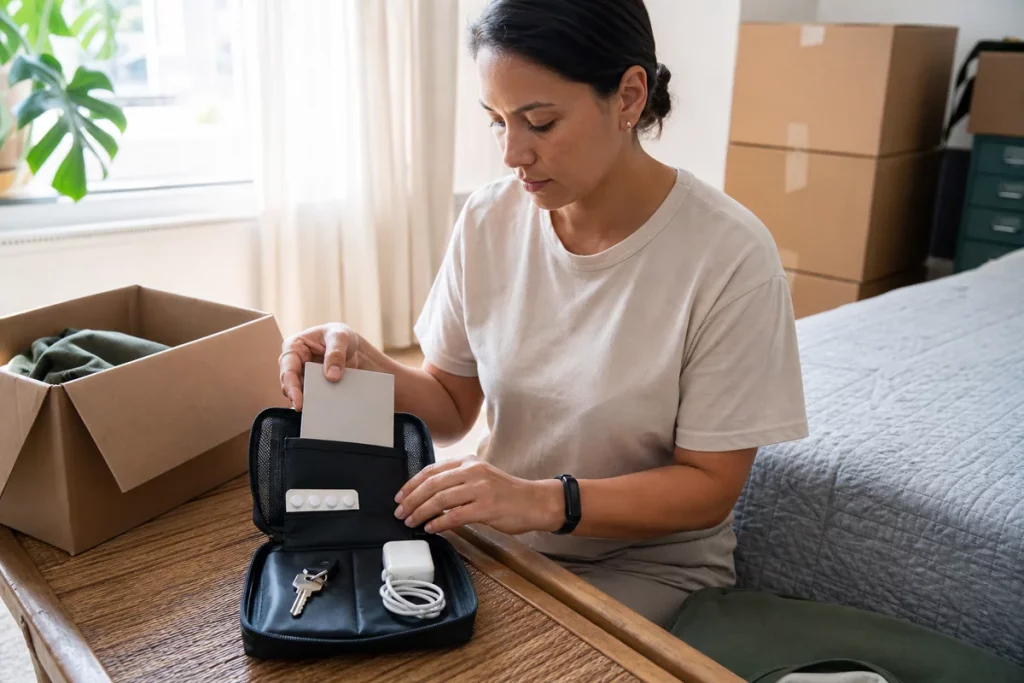
Keeping independent access to essentials is ordinary preparation, not a sign of disloyalty.
If there is abuse or coercive control, a standard breakup conversation may not be safe. Seek confidential, local support and use a device the other person cannot monitor.
A Thirty-Day Trial Plan
A trial cannot reproduce the legal and financial constraints of a real move, but it can expose assumptions.
Week 1: Daily routines
Track sleep, meals, commuting, work calls, downtime, cleaning, and pet care. Notice friction without trying to win.
Week 2: Household labor
Use the proposed chore division in the current spaces. Include noticing and supplies.
Week 3: Money simulation
Each person transfers the planned household contribution into their own savings account. Pay normal expenses and observe whether the budget is sustainable. Do not create joint debt for the experiment.
Week 4: Conflict and review
Discuss the hardest moment. Did both people repair? Did anyone become controlling, disappear, or threaten the relationship? Revise the agreement.
At the end, choose:
- proceed;
- proceed after a specific condition;
- delay and gather information;
- decide not to live together.
“Not yet” is a complete decision.
How GuyID Helps
GuyID should appear when it is useful, not as a banner ad. A GuyID Trust Profile gives someone a portable way to share trust signals before a date, while identity verification and social vouching help turn vague profile claims into clearer next steps.
Useful next steps:
- Create a GuyID Trust Profile when you want a cleaner way to share verified trust signals.
- Use GuyID free tools and related guides when you need a checklist before meeting someone.
- Treat identity verification as confidence-building, not a guarantee.
- Use social vouching when you want context from people who already know the person.
- Sign up only when the extra trust layer helps the decision you are already trying to make.
Frequently Asked Questions
How long should you wait before moving in together?
There is no universally safe number of months. Wait long enough to observe daily habits, conflict, repair, financial behavior, and each person’s ability to maintain boundaries, then make the legal and financial decision with complete information.
Is moving in together before marriage a good idea?
It can be a good choice when both people want it and understand what it means. Research cannot turn cohabitation into a universal cause of relationship success or failure; motives, prior relationship quality, resources, and legal context all matter.
Should we split rent equally?
Equal splitting is one option, but proportional or category-based systems may fit better when incomes differ. Agree on the method, calculate the real total cost, and preserve independent access to money.
Do we need a cohabitation agreement?
The answer depends on your jurisdiction, assets, children, debts, and housing arrangement. If property, substantial contributions, inheritance, or unequal ownership is involved, seek qualified local legal advice before relying on an informal promise.
What if one partner owns the home?
Discuss contributions, repairs, equity expectations, notice, privacy, and what happens at separation. Payment toward household costs does not automatically create the same ownership rights everywhere, so document the arrangement with local advice.
Is it a red flag to discuss a breakup before moving in?
No. A calm exit discussion shows that neither person intends to use housing as leverage. Threats, punishment, or refusal to let the other person retain options are the concerning signs.
Conclusion
Moving in together should make a shared life more visible, not make either person less free.
Choose the move because its meaning is understood, not because a lease can settle relationship uncertainty. Put the money, labor, privacy, legal responsibilities, and exit plan into words. The strongest household agreement is not the one that assumes love will prevent every problem; it is the one that gives both people enough clarity and security to solve ordinary problems without losing themselves.