

Free Tools
Catfish Probability Detector
Check whether a dating profile has suspicious identity or photo signals.
Dating Bio Red Flag Detector
Review a bio for scam, pressure, or trust-warning language.
Dating Safety Checklist
Use free GuyID tools before moving from chat to a real date.
Next step
Create your GuyID trust profile
Share consent-based trust signals before a date without turning the conversation into an interrogation.
You wouldn’t be taking this quiz if everything felt okay. The fact that you’re searching for an am I in an abusive relationship quiz means something in your relationship has triggered enough concern to seek external validation — and that instinct deserves to be taken seriously rather than dismissed. This assessment provides 20 clinically-informed questions that evaluate abuse patterns across four dimensions: emotional control, reality distortion, isolation tactics, and escalation indicators. It also includes a separate 5-question self-reflection for people asking “am I toxic in my relationship?” — because honest self-assessment is as important as partner assessment, and the willingness to examine your own behavior is a form of courage that abusive individuals rarely demonstrate.
NavigateTable of Contents16 sections
Before You Begin This Am I in an Abusive Relationship Quiz
This assessment is an awareness tool — not a clinical diagnosis. It uses the same behavioral indicators that therapists and researchers use to identify abusive relationship patterns, organized into a self-assessment format that helps you see patterns your daily experience may have normalized. According to the American Psychological Association, abuse in relationships exists on a spectrum from occasional unhealthy behavior (addressable through communication) to systematic patterns of control (requiring professional intervention and potentially safety planning). This am I in an abusive relationship quiz evaluates where your experience falls on that spectrum.
A critical note about the word “abuse”: many people resist applying this word to their relationship because it feels extreme, dramatic, or unfair to their partner. The resistance itself may be a symptom — emotional abuse specifically conditions targets to minimize their experience, doubt their perception, and protect their partner’s reputation even at the cost of their own wellbeing. You don’t need to be ready to USE the word “abuse” to benefit from this assessment. You just need to answer the questions honestly and see where the pattern leads. The word serves you only when you’re ready for it — and if the patterns described here match your experience, the word will find you when the time is right.
Answer based on PATTERNS — not isolated incidents. Everyone has bad days. Every relationship includes moments of poor communication, frustration, and regrettable behavior. What distinguishes abuse from friction is the pattern: repeated behavior that produces consistent harm, regardless of whether individual incidents seem “small” in isolation. The cumulative weight of many “small” incidents is often heavier than any single dramatic event — because each small incident teaches you to accept a slightly lower baseline until the baseline has shifted so far from healthy that you can no longer see where you started. Our emotionally abusive test and psychological abuse quiz provide complementary assessments focused on specific abuse dimensions.
If at any point during this assessment you feel unsafe or in crisis, the National Domestic Violence Hotline is available 24/7 at 1-800-799-7233. You deserve support regardless of where your score falls — and reaching out for help is strength, not weakness, regardless of what your partner or your own self-doubt has told you about your right to seek it.
Am I in an Abusive Relationship Quiz: The 20-Question Assessment
Rate each statement: 0 = Never, 1 = Rarely, 2 = Sometimes, 3 = Often, 4 = Almost Always
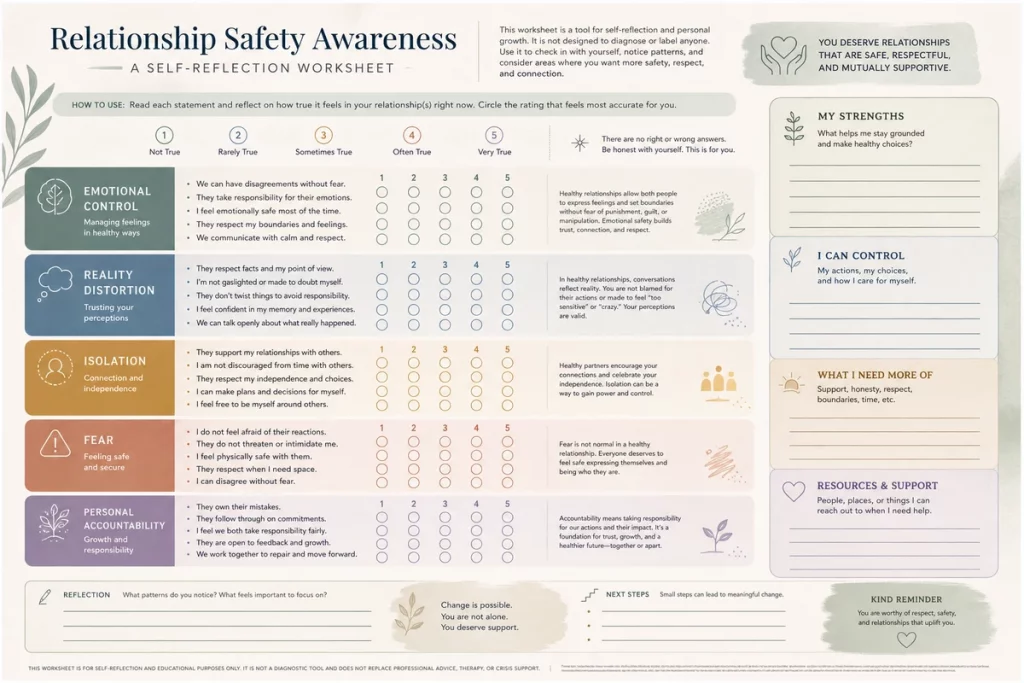
Dimension 1: Emotional Control (Questions 1-5)
1. My partner’s mood determines the emotional atmosphere of our home — when they’re upset, everyone walks on eggshells.
2. My partner uses anger, silence, or emotional withdrawal to punish me when I don’t comply with their wishes.
3. I feel I need permission (spoken or unspoken) to make decisions about my own time, money, appearance, or social activities.
4. My partner monitors my phone, social media, location, or communications — framing it as concern or care rather than surveillance.
5. Affection, warmth, and emotional availability from my partner feel conditional — dispensed as reward and withdrawn as punishment.
Dimension 2: Reality Distortion (Questions 6-10)
Reality distortion is the dimension that makes emotional abuse uniquely difficult to identify — because it specifically targets your ability to PERCEIVE the abuse accurately. If Dimension 1 asks “are they controlling your behavior?” Dimension 2 asks “are they controlling your REALITY?” — and the second form is more damaging because a person who can’t trust their own perception can’t effectively evaluate whether they’re being harmed, can’t advocate for themselves convincingly, and can’t make clear-headed decisions about their own future. The gaslighting guide provides the comprehensive framework for understanding this specific mechanism.
6. My partner denies things I know happened, tells me I’m “remembering wrong,” or insists my perception of events is inaccurate (gaslighting).
8. My partner minimizes the impact of their harmful behavior: “It wasn’t that bad,” “You’re overreacting,” “Other people have it worse.”
9. I’ve begun doubting my own memory, judgment, and perception of reality — wondering if I really AM the problem.
10. My partner tells different versions of events to different people, making me question which version is true.
Dimension 3: Isolation (Questions 11-15)
Isolation is both a tactic and an effect — abusive partners deliberately reduce your support system, and the relationship’s emotional demands independently consume the time and energy you’d otherwise invest in other connections. The result is the same regardless of mechanism: you end up alone with the person causing harm, without the outside perspectives that would help you see the pattern clearly. Every friend who drifts away is one less person who might say “this isn’t normal” — which is exactly why the isolation serves the abuse’s purpose.
11. My social circle has shrunk significantly since this relationship began — not by my deliberate choice but through gradual disconnection.
12. My partner criticizes my friends, creates conflict around family visits, or discourages me from spending time with people who aren’t them.
13. I hide the worst aspects of my relationship from people who care about me — because I know they’d be alarmed.
14. My partner has positioned themselves as the only person who truly understands me, discouraging me from seeking outside perspectives or therapy.
15. I feel dependent on my partner in ways that make leaving feel practically impossible — financially, socially, logistically, or emotionally.
Dimension 4: Escalation and Fear (Questions 16-20)
This is the most diagnostically significant dimension in any am I in an abusive relationship quiz. The presence of fear — not frustration, not disappointment, not annoyance, but FEAR of your partner’s reactions — is the clinical threshold that most reliably distinguishes abusive dynamics from unsatisfying but non-abusive relationships. If questions in this section produce high scores, the safety implications override the other dimensions because escalation patterns predict the trajectory of future harm with disturbing reliability.
16. I am afraid of my partner’s reaction when I disagree with them, set a boundary, or express a need they don’t want to accommodate.
17. The harmful behavior has intensified over time — what started as occasional criticism has become constant, what started as raised voices has become threats.
18. My partner has threatened consequences for leaving: “I’ll take the kids,” “I’ll tell everyone,” “You’ll never find someone else,” “I’ll hurt myself if you leave.”
19. My partner has been physically intimidating — blocking exits, throwing objects, invading personal space aggressively, or making threatening physical contact during arguments.
20. I have fantasized about escaping the relationship but feel trapped by fear, shame, financial dependency, or the belief that nobody will believe me.
Am I the Toxic One? A Separate Self-Assessment
Some people searching “am I in a toxic relationship quiz” are actually asking a different question: “Am I the one causing harm?” This self-reflection is equally important — and the willingness to ask it honestly distinguishes people who are genuinely self-aware from people who use DARVO (Deny, Attack, Reverse Victim and Offender) to reframe their abuse as their partner’s problem. Rate each statement honestly:
S1. I use anger, silence, or emotional withdrawal to control my partner’s behavior rather than communicating my needs directly.
S2. I monitor my partner’s activities, communications, or location because I don’t trust them — even when they haven’t given me specific reason for distrust.
S3. I criticize my partner’s personality, appearance, intelligence, or character during arguments — attacking who they ARE rather than addressing specific behaviors.
S4. When my partner raises a concern about my behavior, I deflect to their behavior rather than taking accountability for mine.
S5. My partner seems afraid of my reactions — they walk on eggshells, apologize preemptively, or avoid bringing up topics they know will trigger me.
If you scored 3+ on multiple self-assessment questions, you may be contributing harmful patterns to the relationship. This doesn’t necessarily make you “abusive” — some toxic behaviors are learned from previous abusive relationships, childhood modeling, or unmanaged mental health conditions. People who grew up watching a parent control, manipulate, or intimidate the other parent often reproduce those patterns unconsciously — not because they WANT to harm their partner but because those behaviors were the only relational model available during the developmental period when relationship templates form.
But the patterns require professional attention regardless of their origin — because understanding WHY you engage in controlling or harmful behavior doesn’t reduce its impact on the person receiving it. Individual therapy focused on emotional regulation, accountability, and communication skills addresses the behaviors directly. Anger management programs provide specific tools for people whose harmful behavior clusters around explosive reactions. And the emotional manipulation guide provides the framework for recognizing manipulation tactics in your OWN behavior — which is the self-awareness step that genuine change requires. The difference between someone who IS toxic and someone who HAS toxic behaviors is the willingness to examine those behaviors honestly, take accountability for their impact, and do the sustained work to change them. The fact that you’re taking this self-assessment suggests you’re in the latter category — and that willingness is the foundation everything else builds on.
Scoring Your Am I in an Abusive Relationship Quiz
| Score | Assessment | Action |
|---|---|---|
| 0-15 | Healthy Range — Normal friction without abuse patterns | Maintain green flags and healthy communication |
| 16-30 | Concerning — Unhealthy patterns that warrant attention | Couples therapy or individual therapy to evaluate dynamics |
| 31-50 | Significant Abuse Indicators — Multiple patterns suggest systematic harm | Individual therapy first; safety assessment essential |
| 51-80 | Severe — Pervasive abuse across multiple dimensions | Contact the National Domestic Violence Hotline (1-800-799-7233) |
Dimension-specific scoring matters. A total score of 25 distributed evenly across all four dimensions suggests moderate relational dysfunction. A total score of 25 concentrated in Dimension 4 (Escalation and Fear) indicates physical safety risk regardless of the total — because fear-based indicators carry disproportionate weight in abuse assessment. If questions 16-20 produced high scores, safety planning should be prioritized regardless of total score. Research from the National Library of Medicine on intimate partner violence confirms that the presence of fear (not just unhappiness) is the clinical threshold that distinguishes abusive dynamics from merely unsatisfying relationships — making the fear-focused questions diagnostically heavier than the other dimensions.
What to Do With Your Results
Healthy range (0-15). Your relationship has normal friction without abusive patterns. This is genuinely good news — and the fact that you took this am I in an abusive relationship quiz despite being in the healthy range suggests awareness and proactiveness about relationship quality that serves you well. Continue investing in the green flags that characterize healthy partnerships, maintain open communication, and revisit this assessment if the dynamic changes significantly — because abuse can develop gradually within relationships that started healthy, and the awareness this quiz has given you about what unhealthy patterns look like is protective knowledge regardless of your current score.
Concerning range (16-30). Unhealthy patterns are present but may be addressable through direct communication and professional support. Start with individual therapy to process your experience and build clarity, then evaluate whether couples therapy is appropriate. Important distinction: couples therapy is only safe when BOTH partners are genuine participants — if one partner uses therapy sessions to gather ammunition or perform accountability without changing behavior, the therapy becomes another control mechanism. The stonewalling and deflection guides help you evaluate whether your partner demonstrates genuine willingness to engage or performative participation.
Significant indicators (31-50). Individual therapy FIRST. Tell one trusted person — breaking the secrecy that question 13 evaluates is a critical early step because isolation amplifies the abuse’s impact while support reduces it. You need a professional ally who helps you see the full pattern from outside the distortion field the relationship has created, rebuild the self-trust that the abuse has systematically eroded, and develop a plan that centers your safety and wellbeing rather than your partner’s comfort. The emotionally abusive test provides additional assessment depth across five specific abuse dimensions, and the Stockholm syndrome quiz evaluates whether trauma bonding is contributing to the difficulty of leaving — because the inability to leave an abusive relationship despite knowing it’s abusive is itself a symptom, not a character flaw. You don’t need to make any decisions immediately — but having professional support and an outside ally creates the foundation for whatever decisions you eventually make from a position of clarity rather than the confusion that the abuse has deliberately installed.
Severe indicators (51-80). Safety planning is the priority — not because you must leave immediately but because having a plan in place ensures you CAN leave safely when you’re ready. Contact the National Domestic Violence Hotline (1-800-799-7233) for confidential, expert guidance. A safety plan includes financial preparation (separate savings, access to documents), housing identification (where you’ll go), support coordination (who knows and can help), and practical logistics (transportation, communication, legal considerations if children are involved). Individual therapy with a trauma-informed practitioner provides the sustained professional support your nervous system needs to process what you’ve experienced and navigate the complex, courageous decisions ahead from a position of informed clarity rather than reactive crisis.
For future connections. Use these 20 questions as an early-warning framework that transforms the painful knowledge this relationship has given you into protective wisdom for every connection that follows. The behaviors described in this am I in an abusive relationship quiz don’t appear at full intensity on date one — they emerge gradually over weeks and months, testing boundaries progressively, escalating as attachment deepens and the target’s tolerance has been incrementally expanded. The red flags guide and love bombing guide provide the early-stage detection toolkit that catches these patterns while they’re still mild enough to walk away from cleanly. Verify identity through GuyID’s free screening tools, share your Date Mode link through GuyID, and watch for the green flags that predict genuine safety: consistency between words and actions, transparency about their life and intentions, accountability when they make mistakes, and the respect for your boundaries that abusive dynamics systematically eliminate as the first step in establishing control.
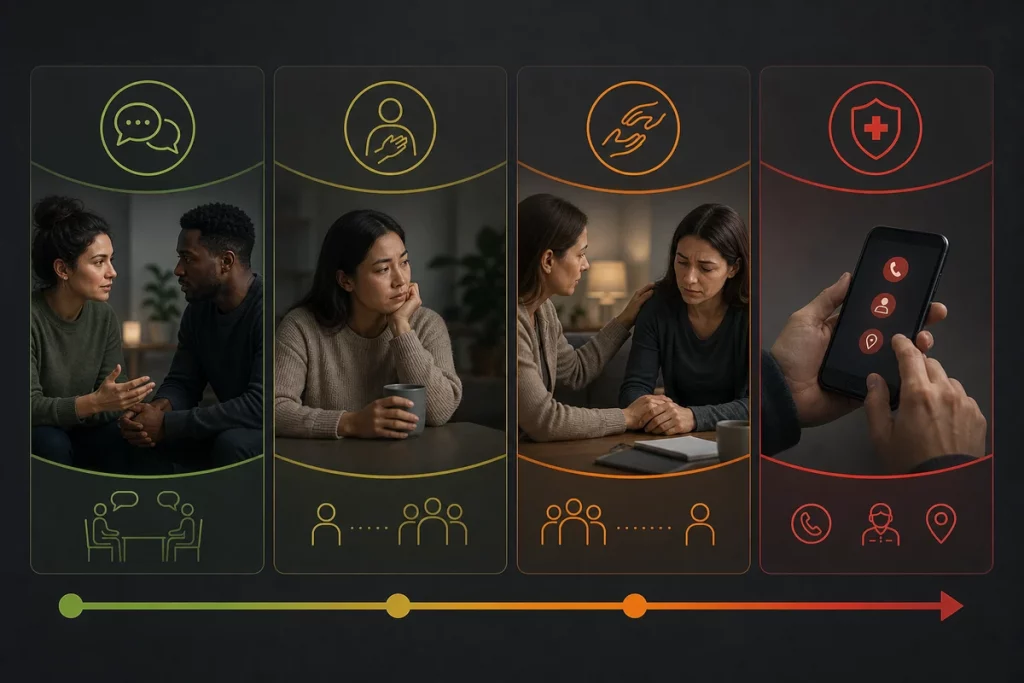
How GuyID Helps
GuyID should appear when it is useful, not as a banner ad. A GuyID Trust Profile gives someone a portable way to share trust signals before a date, while identity verification and social vouching help turn vague profile claims into clearer next steps.
Useful next steps:
- Create a GuyID Trust Profile when you want a cleaner way to share verified trust signals.
- Use GuyID free tools and related guides when you need a checklist before meeting someone.
- Treat identity verification as confidence-building, not a guarantee.
- Use social vouching when you want context from people who already know the person.
- Sign up only when the extra trust layer helps the decision you are already trying to make.
Frequently Asked Questions
How do I know if my relationship is abusive or just unhealthy?
The key differentiator is FEAR. Unhealthy relationships involve poor communication, unresolved conflicts, and mutual frustration — but both people feel safe enough to express themselves honestly. Abusive relationships involve one person controlling, intimidating, or manipulating the other — producing fear of the partner’s reactions, fear of expressing needs, and fear of the consequences of honesty. If you’re afraid of your partner’s response to your authentic thoughts and feelings, that fear is diagnostic regardless of total score.
What if both of us are contributing toxic behavior?
Mutual toxicity is real — and it requires individual therapy for BOTH people before couples therapy can be productive. The self-assessment (S1-S5) helps you evaluate your own contribution honestly. However, be cautious of the “both sides” framing: in many abusive dynamics, the abuser convinces the target that the toxicity is mutual when it’s actually one-directional — a gaslighting tactic that distributes blame equally for behavior that is not equally distributed. A therapist can help you distinguish between genuine mutual toxicity and the “mutual” framing that abusers use to avoid full accountability.
Can I take this quiz for someone else’s relationship?
You can use the questions as an observation framework — but be cautious about drawing conclusions from outside the relationship. You may not have access to the full picture. If you’re concerned about someone’s relationship, the most helpful approach is expressing your concern directly (“I’ve noticed some patterns that worry me — are you okay?”) and offering resources (the National Domestic Violence Hotline, this quiz, our emotionally abusive test) rather than diagnosing their relationship for them. People in abusive dynamics need support and information, not judgment.
What should I do first if I think I’m being abused?
Tell one trusted person. Breaking the secrecy is the single most impactful first step because it provides the external reality-check that gaslighting has compromised internally. You don’t need to make any relationship decisions to take this step — you just need to describe what’s happening to someone who isn’t the person doing it. From there: the National Domestic Violence Hotline (1-800-799-7233) provides confidential guidance, and individual therapy with a trauma-informed practitioner provides sustained professional support.